You are typing a text. You want to say “yes” in a casual way. Then you stop. Is it yeah or yea?
You are not alone. Many people pause at this word. Both spellings look right. Both show up online. So which one is correct?
People search for “yeah or yea” for simple reasons. They want to write an email, a post, or an essay. They do not want to look careless. Some also see “yea” in news about votes and wonder if it means the same thing.
The answer is short. One spelling is the normal choice for casual speech. The other has a different job.
This guide clears up the confusion. You get a quick answer first. Then you learn where each word comes from and how people use them. You will also see real examples, common mistakes, and a handy table.
By the end, you will know exactly which one to type. Let’s start.
Yeah or Yea Quick Answer
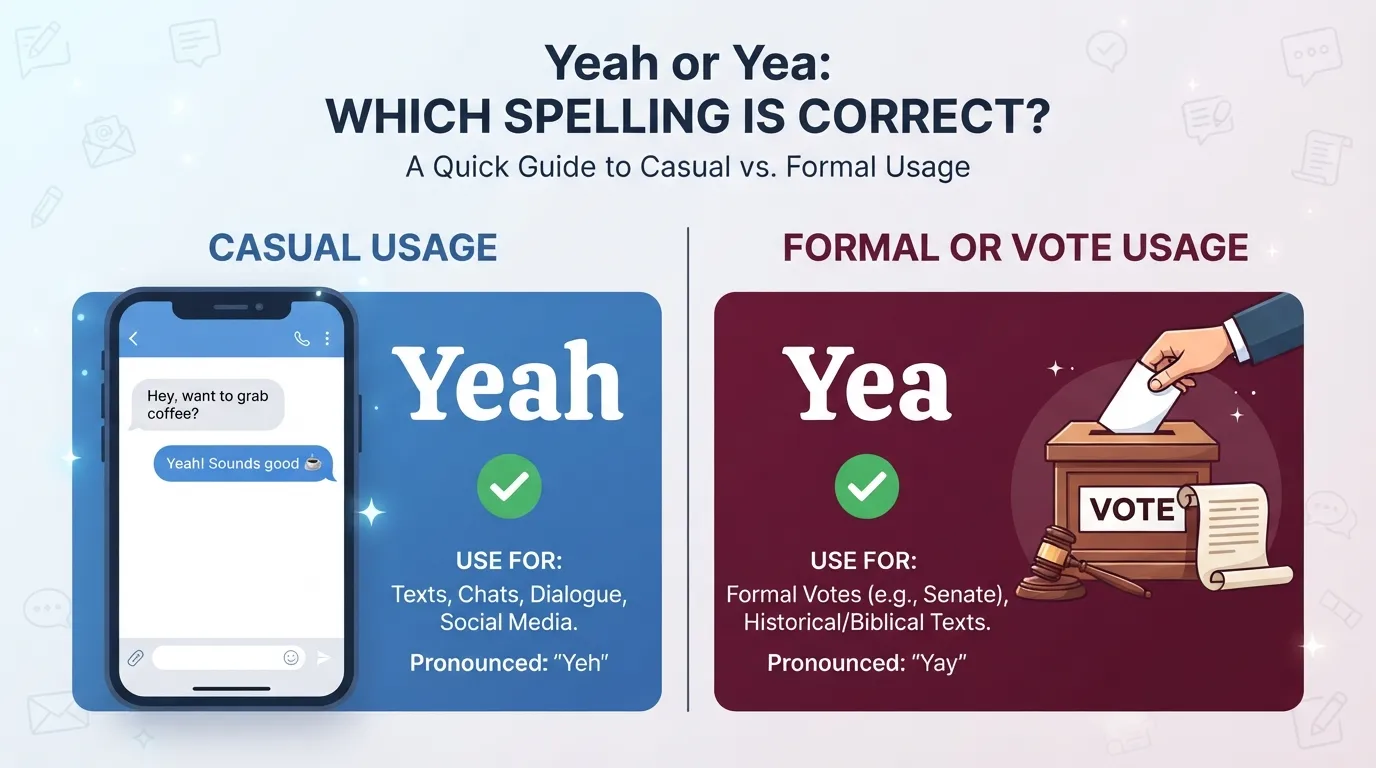
Use “yeah” for casual “yes.” It is the standard spelling for informal speech and writing.
Use “yea” for formal votes or old-style writing. It means “yes” or “indeed.”
Examples:
- “Yeah, I can come tonight.” ✅
- “Yeah, that sounds great!” ✅
- “The yeas have it.” ✅ (a vote)
- “Yea, though I walk through the valley…” ✅ (old, formal style)
- “Yea, I’ll be there at five.” ⚠️ (common in texts, but less standard)
Many people type “yea” as a shortcut for “yeah.” You will see it in texts and posts. But “yeah” is the safer choice.
The Origin of Yeah or Yea
“Yea” is the older word. It comes from Old English gēa, which meant “yes.” It is a cousin of the German word ja. For hundreds of years, people used “yea” to agree or to stress a point. You still see it in old texts and in the Bible.
“Yeah” is newer. It is a casual form of “yes.” This began to appear in print in the early 1900s. It copies the way people really talk. When people say “yes” fast, it often sounds like “yeah.”
So why two spellings? Because they are two different words that grew apart.
- “Yea” kept its old, formal feel.
- “Yeah” took over everyday speech.
Over time, texting made things messy. People shortened “yeah” to “yea” to type faster. Now the two blur together online.
British English vs American English Spelling
Here is a surprise. This is not a real British vs American split. Both countries use “yeah” for casual speech. Both use “yea” for votes and old-style writing.
| Feature | American English | British English |
| Casual “yes” | yeah | yeah |
| Formal vote | yea | aye (in Parliament) |
| Old-style “indeed” | yea | yea |
| Texting shortcut | yea (common) | yeah (common) |
The big difference is in voting. In the US Congress, members say “yea” or “nay.” In the UK Parliament, members say “aye” or “no.”
Do not worry about spelling rules by country here. The real rule is about tone, not location.
Which Spelling Should You Use?
If your readers are in the US: Write “yeah” in casual text. Use “yea” only for votes.
If your readers are in the UK or the Commonwealth: Write “yeah” for casual speech. Use “aye” for votes in a UK setting.
If your readers are global: Choose “yeah.” It is clear everywhere.
Quick tips:
- Writing a blog or email? Use “yeah.”
- Writing dialogue in a story? Use “yeah.”
- Writing about a vote? Use “yea.”
- Writing a school essay? Avoid both. Use “yes.”
Common Mistakes with Yeah or Yea
1: Using “yea” for “yeah” in formal work.
❌ “Yea, we agree with the plan.”
✅ “Yes, we agree with the plan.”
2: Using “yeah” in a vote.
❌ “All in favor say yeah.”
✅ “All in favor say yea.”
3: Mixing up “yea” and “yay.”
“Yay” shows joy. “Yea” means yes.
❌ “Yea! We won!”
✅ “Yay! We won!”
Mistake 4: Mixing up “yea” and “yeah” in the same text.
Pick one and stick with it.
Mistake 5: Using “yeah” in serious writing.
It is too casual for reports and legal papers. Use “yes.”
Yeah or Yea in Everyday Examples
Email (casual, to a friend):
“Yeah, Friday works for me. See you then!”
Email (work):
“Yes, Friday works for me. Thank you.”
News:
“The Senate vote ended with 52 yeas and 48 nays.”
Social media:
“Yeah, this is the best pizza in town 🍕”
“yea i’m coming” (casual, no caps)
Formal or old-style writing:
“Yea, the king has spoken.”
Notice the pattern. Casual spaces use “yeah.” Votes and old-style writing use “yea.”
Yeah or Yea Google Trends & Usage Data
I cannot pull live Google Trends numbers here, so I will not make any up. Here is what is generally true, and how you can check it yourself.
What you will likely see:
- “Yeah” is the far more common word in everyday writing and speech.
- “Yea” gets searches that jump around votes, elections, and news about government.
- Many searches for “yeah or yea” come from people checking spelling before they write.
- English-speaking countries such as the US, UK, Canada, Australia, and India search for these words.
How to check it:
- Go to Google Trends.
- Type “yeah” and “yea” side by side.
- Pick a country and a time range.
- Look at the “Related queries” box.
Search spikes for “yea” often match big vote days. That fits the meaning of the word.
Keyword variations side by side:
| Word | Meaning | Tone | Best use |
| yeah | yes | casual | texts, chats, dialogue |
| yea | yes / indeed | formal or old | votes, old-style writing |
| yep | yes | casual, short | quick replies |
| yeh | yes | very casual | slang, texting |
| ya | you / yes | slang | informal texts |
| yay | joy | excited | cheering |
Frequently Asked Questions
1. Is it “yeah” or “yea”?
Use “yeah” for casual “yes.” Use “yea” for votes and old-style writing.
2. Is “yea” a real word?
Yes. It is an old word that means “yes” or “indeed.” It is still used in voting.
3. Is “yeah” correct in formal writing?
No. It is too casual. Use “yes” in reports, essays, and business letters.
4. How do you pronounce “yea”?
In a vote, it sounds like “yay.” In some old texts, it may sound like “yeh.”
5. Is there a difference between American and British spelling?
Not really. Both use “yeah” in casual speech. The difference is in voting: “yea” in the US, “aye” in the UK.
6. Can I write “yea” in a text message?
Yes. Many people do. But “yeah” is more standard.
7. What is the opposite of “yea”?
The opposite is “nay.” You hear it in votes: “yeas and nays.”
8. Is “yea” the same as “yay”?
No. “Yay” shows joy. “Yea” means yes.
Conclusion
So, yeah or yea? The answer is simple.
Use “yeah” when you want to say a casual “yes.” It fits texts, chats, emails to friends, and story dialogue. It works in every English-speaking country.
Use “yea” when you write about a vote or want an old-style feel. You will see it in news about the government and in old books.
Do not mix them up with “yay.” That word is for cheering.
For formal writing, skip both. Write “yes.” It is always safe.
Remember one more thing. This is not a British vs American problem. It is a tone problem. Ask yourself: is this casual or formal? Then pick your word.
Here is your cheat sheet:
- Casual chat → yeah
- Vote → yea
- Formal paper → yes
- Cheering → yay
Keep it simple, and your writing will stay clear and sharp.

Sikandar Hayat is the author and creator of Journalneste.com, a website dedicated to heartfelt wishes, messages, greetings, and inspiring words for every special moment. With a passion for meaningful writing, Sikandar creates warm and thoughtful content that helps readers express their feelings with ease. His goal is to provide beautiful, shareable words for birthdays, celebrations, relationships, and memorable occasions.