You are not alone. Many people pause at this word. It looks simple, but the apostrophe causes trouble. Some writers skip it to save time. Others add it in the wrong place. Phones and keyboards do not always help.
People search for this keyword because they want a fast, safe answer. They also want to know if the rule changes between American and British English. This article clears up that confusion.
Here is the short version. One spelling is correct. The other is a common mistake. Below, you will learn which is which and why. You will see how the word started and where writers go wrong. You will also find real examples you can copy.
By the end, you will never second-guess this word again.
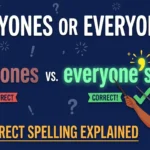
Everyones or Everyone’s Quick Answer
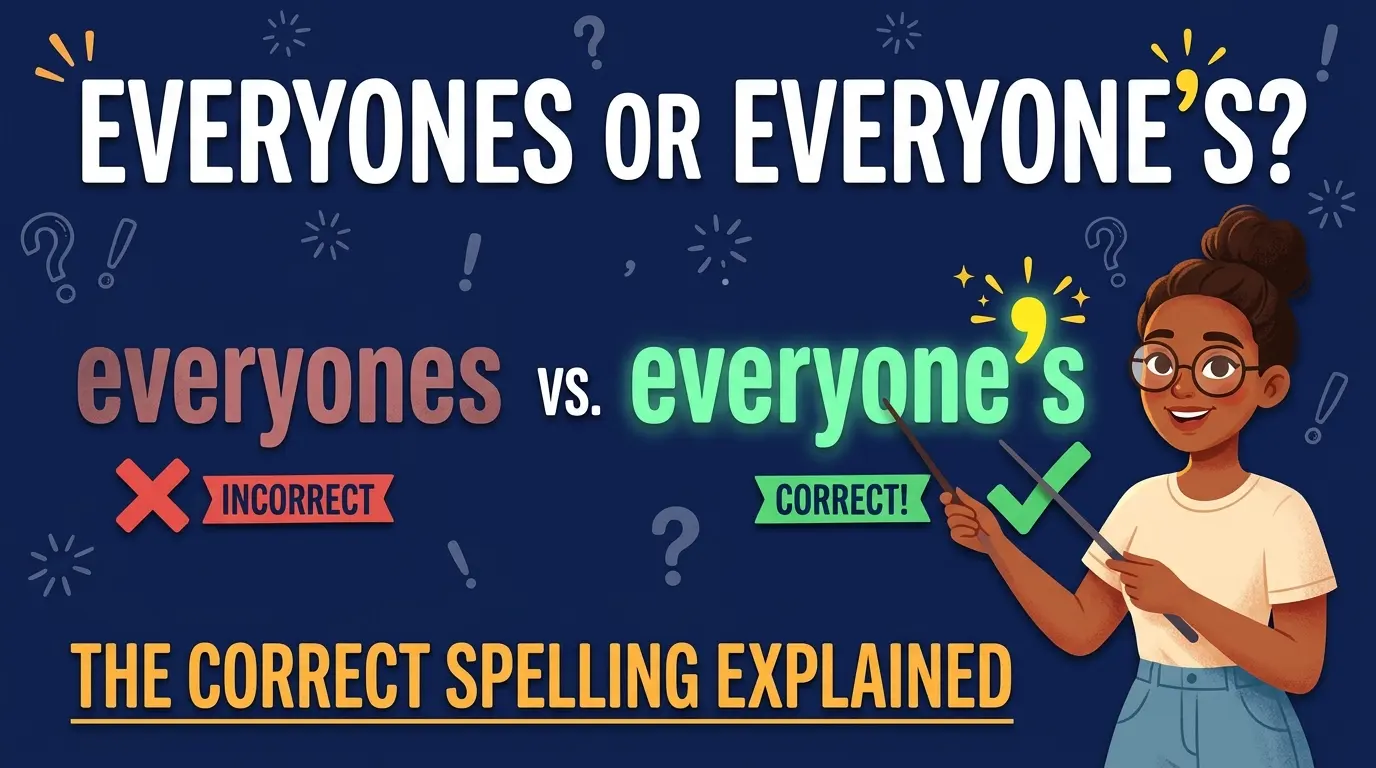
Everyone is correct. Everyones is wrong.
“Everyone” is a singular word. It means each person in a group. It does not take an “s” to become plural. So “everyones” is not a real word.
The apostrophe + s does one of two jobs:
- It shows ownership. Everyone’s opinion matters. (The opinion belongs to everyone.)
- It is a short form of “is” or “has.” Everyone’s here. (Everyone is here.) Everyone’s gone home. (Everyone has gone home.)
More examples:
- Everyone’s coat is by the door.
- Is everyone’s work done?
- Everyone’s invited to the party.
The Origin of Everyone’s
“Everyone” is two small words joined together: every and one. “Every” comes from Old English ǣfre ǣlc, which meant “ever each.” Over time, people merged the words into “everyone.”
The “‘s” has its own story. In Old English, many nouns showed ownership by adding -es. Later, writers dropped the “e” in speech and spelling. In the 1500s and 1600s, printers began using an apostrophe to show the missing letter. Slowly, the apostrophe + s became the standard sign of ownership.
Why do spelling mistakes happen? Because “s” at the end of a word usually means plural. Writers see “everyone” and think it needs an “s” to cover many people. But “everyone” already means many people. It is singular in grammar and plural in meaning. That mix is what confuses us.
British English vs American English Spelling
Here is the good news: there is no difference. Both American and British English use everyone’s. Neither accepts everyones.
People often expect a split because many words differ across the two (color/colour, center/centre). But this word is not one of them.
Where British and American writing do differ is nearby:
| Feature | American English | British English |
| Possessive of “everyone” | everyone’s | everyone’s |
| Spelling without apostrophe | everyones (wrong) | everyones (wrong) |
| Closely related word | everybody’s | everybody’s |
| Two-word form (“every one”) | every one (each single item) | every one (each single item) |
| Quotation marks around the word | Double quotes: “everyone’s” | Single quotes: ‘everyone’s’ |
| Possessive after a name ending in s | James’s or James’ | James’s or James’ |
The rule for “everyone’s” is the same on both sides of the Atlantic. Only the quotation style changes.
Which Spelling Should You Use?
Use everyone’s every time. Here is how that works for each audience.
- US readers: Use everyone’s. Style guides like AP and Chicago both agree.
- UK and Commonwealth readers: Use everyone’s. This includes Australia, Canada, India, Pakistan, and South Africa.
- Global readers: Use everyone’s. International English follows the same rule.
You do not need to pick a side. This is one of the easy ones.
Tip: If you are unsure, say the sentence with “everyone is” or “everyone has.” If it still makes sense, use the apostrophe. If you mean ownership, use the apostrophe too. In both cases, the answer is everyone’s.
Common Mistakes with Everyone’s
1: Leaving out the apostrophe
- Wrong: Everyone’s opinion counts.
- Right: Everyone’s opinion counts.
2: Putting the apostrophe after the s
- Wrong: Everyones’ time is valuable.
- Right: Everyone’s time is valuable.
3: Treating “everyone” as plural
- Wrong: Everyone are ready.
- Right: Everyone is ready.
4: Mixing up “everyone’s” and “everyone”
- Wrong: Everyone idea is welcome.
- Right: Everyone’s idea is welcome.
5: Mixing up “everyone” and “every one”
- Everyone means all people: Everyone came.
- Every one means each single item: Every one of the cakes was gone.
Everyone’s in Everyday Examples
In an email:
- “Thanks for your help. Everyone’s feedback has been useful.”
- “Please check that everyone’s name is on the list.”
In the news:
- “The new law affects everyone’s taxes.”
- “Safety is everyone’s job, officials said.”
On social media:
- “Monday is nobody’s favorite, but it’s everyone’s problem.”
- “Happy Friday! Hope everyone’s weekend is great.”
In formal writing:
- “It is everyone’s responsibility to follow the policy.”
- “We value everyone’s contribution to this project.”
Everyone’s Google Trends & Usage Data
I can’t pull live Google Trends numbers, so I won’t invent figures. Here is what is generally true about how people search for this word, and how you can check it yourself.
What usually drives searches:
- Writers, students, and office workers want to check grammar before sending something.
- Searches tend to rise during school terms and busy work seasons.
- Mobile users may search more, since autocorrect often drops apostrophes.
By region: Interest tends to come from English-speaking countries, such as the US, UK, Canada, Australia, India, Pakistan, and Nigeria. People in places where English is a second language often search for grammar checks too.
How to check real data: Open Google Trends. Enter “everyones” and “everyone’s” side by side. Pick a country and a time range. You can then see which form people search for most, and where.
Usage comparison:
| Variation | Correct? | Meaning | Example |
| everyone’s | Yes | Belongs to everyone, or “everyone is/has” | Everyone’s here. |
| everyones | No | Not a real word | |
| everyones’ | No | Not a real word | |
| everybody’s | Yes | Same meaning, more casual | Everybody’s invited. |
| every one’s | Rare | Each single person’s (very rare) | Everyone’s turn is next. |
| everyone | Yes | All people (no ownership) | Everyone came. |
FAQs
1. Is it everyones or everyone’s?
It is everyone’s. “Everyones” is a spelling mistake.
2. Is “everyones” ever correct?
No. Not in American English, British English, or any other standard form.
3. Does the apostrophe show ownership or “is”?
It can show either. Everyone’s book shows ownership. Everyone’s happiness means “everyone is happy.”
4. Is “everyone” singular or plural?
It is singular in grammar. Say everyone is, not everyone is.
5. Is “everyone’s” the same as “everybody’s”?
Yes. They mean the same thing. “Everybody’s” sounds a bit more casual.
6. What is the difference between “everyone” and “every one”?
“Everyone” means all people. “Every one” means each single thing in a group, and it is usually followed by “of.”
7. Should I write “everyones'”?
No. That form is wrong. The apostrophe goes before the “s”: everyone’s.
Conclusion
The answer is simple. Everyone is correct. Everyones is not a word.
Let’s recap the main points:
- “Everyone” is singular, so it never needs a plural “s.”
- Use the apostrophe + s to show ownership (everyone’s idea).
- Use it as a short form for “is” or “has” (everyone’s here).
- American and British English follow the same rule for this word.
- The common mistakes are skipping the apostrophe, moving it after the “s,” and treating “everyone” as plural.
When in doubt, try a quick test. Swap in “everyone is,” “everyone has,” or “belonging to everyone.” If one fits, write everyone’s.
If you write for the US, the UK, or a global audience, you can use this spelling with confidence. Your emails, posts, and reports will look clean and professional.
Small details build trust. A correct apostrophe tells your reader that you care about your work. Now you know the rule, and you can use it every time.

Sikandar Hayat is the author and creator of Journalneste.com, a website dedicated to heartfelt wishes, messages, greetings, and inspiring words for every special moment. With a passion for meaningful writing, Sikandar creates warm and thoughtful content that helps readers express their feelings with ease. His goal is to provide beautiful, shareable words for birthdays, celebrations, relationships, and memorable occasions.