You are writing an email. You stop. Is it “I want to complain” or “I want to complaint”? Many people freeze at this moment. You are not alone.
People search “complain or complaint” for one reason. The two words look almost the same. They sound close too. But they do different jobs. One is an action. The other is a thing. Mix them up, and your sentence sounds wrong.
Some people also wonder if one word is British and the other is American. That is a common guess. It is not true. Both words are spelled the same in every English-speaking country.
This guide clears up the confusion fast. You will get a quick answer first. Then you will learn where the words come from, how to use them, and which mistakes to avoid. You will see real examples from emails, news, and social media. You will also find a handy table and answers to common questions.
By the end, you will know exactly which word to pick. Every time.
Complain or Complaint Quick Answer
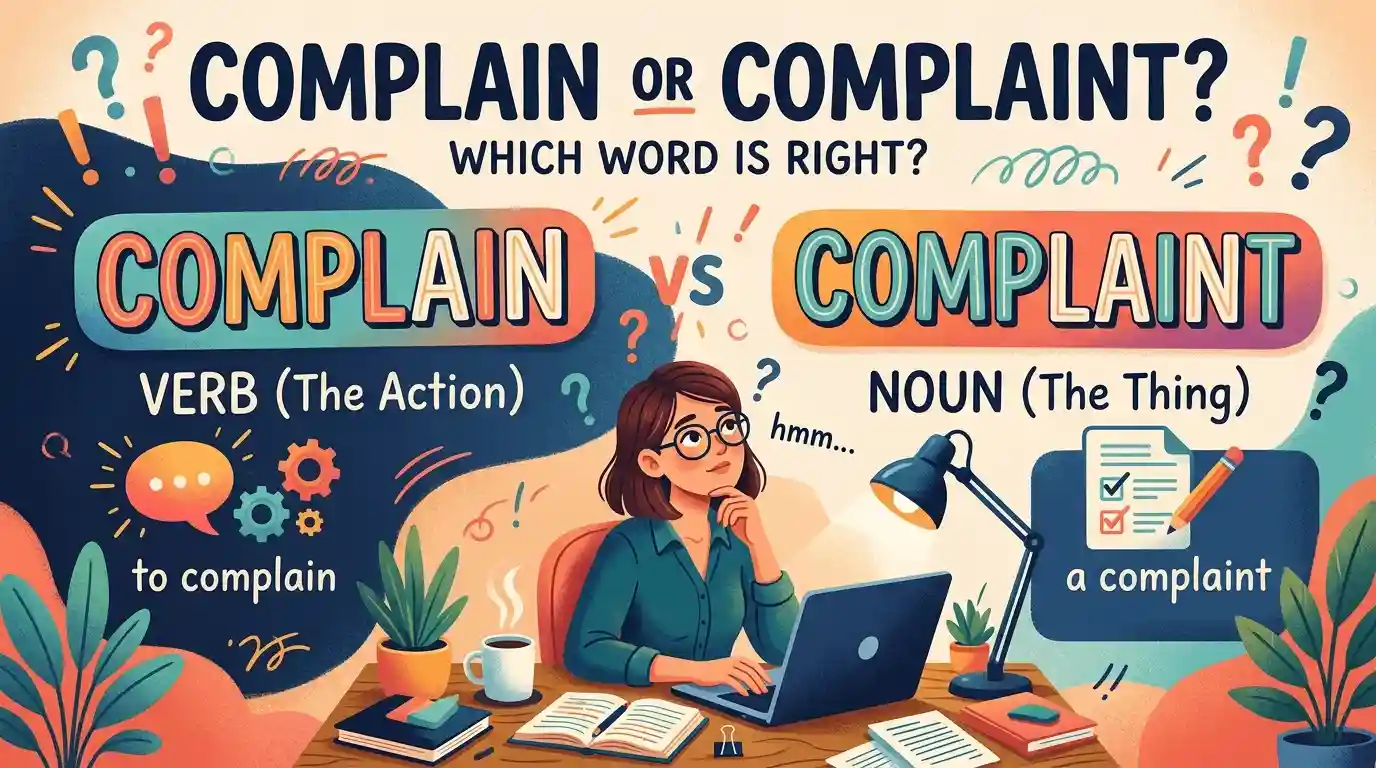
Complain is a verb. It is an action. Complaint is a noun. It is a thing.
- Use complain when someone does the action.
- Use complaints when you name the thing.
Here are simple examples:
- I want to complain about the noise. (action)
- I want to make a complaint about the noise. (thing)
- She complains every morning. (action)
- He filed a complaint with the bank. (thing)
- They complained to the manager. (action, past)
- The manager read the complaints. (things, more than one)
Memory trick: Complain rhymes with explanation. Both are verbs. You explain a problem. You complain about a problem. When you need a word after “a”, “the”, “my”, or “your”, pick a complaint.
The Origin of Complain and Complaint
Both words come from the same family. They share one root.
The story starts in Latin. The Latin word plangere meant “to strike” or “to beat.” People used it for beating the chest in grief. Add the Latin prefix com-, and you get a strong word for loud sorrow.
That word moved into Old French as complaindre. It meant “to lament” or “to bewail.” English borrowed it in the Middle Ages. Early English spellings varied a lot, such as compleynen. Over time, the spelling settled into complain.
The noun came from French too. Old French had complainte, a noun for the act of lamenting. English took it in as a complaint. It dropped the final “e” and kept the “t”.
So the pair works like many English word pairs:
- complain is the action word
- complaint is the name for what you say or write
Why do spelling differences exist in English? Before printed books and dictionaries, people spelled words how they sounded. Spelling later became fixed. In the early 1800s, Noah Webster pushed some American changes, such as color instead of colour. He did not change these two words. That is why complaint and complaint look the same in the US, the UK, and everywhere else.
British English vs American English Spelling
Here is the good news. There is no British or American spelling of these words. US and UK writers spell them the same way. The same is true in Canada, Australia, India, and Pakistan.
The real difference is grammar, not spelling. One word is a verb. One is a noun.
| Word | American English | British English | Part of speech |
| complain | complain | complain | verb |
| complains | complains | complains | verb |
| complained | complained | complained | verb |
| complaining | complaining | complaining | verb |
| complaint | complaint | complaint | noun |
| complaints | complaints | complaints | noun |
| complainant | complainant | complainant | noun (a person who files a complaint) |
So why do people expect a difference? Many English words do change between the US and the UK. Look at these:
| Pattern | American English | British English |
| -or / -our | color | colour |
| -ize / -ise | organize | organise |
| -er / -re | center | centre |
| -se / -ce | defense | defence |
| single / double l | traveled | travelled |
None of these rules touch complaints or complaints. These words have no “-our”, “-ize”, or “-re” ending. So they stay the same.
Which Spelling Should You Use?
The spelling is the same for every reader. Your choice is about the job the word does in your sentence.
US readers. Use complaints for the action. Use complaints for the thing. Americans also say “file a complaint” and “lodge a complaint.”
UK and Commonwealth readers. The rules are the same. Britons often say “make a complaint” or “raise a complaint.” You may also hear “I’d like to complain.” It is a polite, common phrase in shops and restaurants.
Global readers. If your audience speaks English as a second language, keep it plain. Short phrases work best:
- “I want to complain.”
- “I have a complaint.”
- “Please send your complaint to this email.”
One rule for all. If you can put “a” or “the” before the word, use complaint. If you can put “to” before it, as in “to complain,” use complain.
Common Mistakes with Complain or Complaint
Most errors come from mixing the verb and the noun. A few come from small word slips.
| Mistake | Fix | Why |
| I want to make a complaint. | I want to make a complaint. | “A” needs a noun. |
| I complained about the food. | I complain about the food. | “I” needs a verb. |
| She has a lot of complaints. | She has a lot of complaints. | Plural noun. |
| He complains every day. | He complains every day. | Verb with -s. |
| They complain about the service. | They complain about the service. | Use “about,” not “on.” |
| I did a complaint. | I filed a complaint. | Say “make,” “file,” or “lodge.” |
| Complaing, compalin, complaen | Complain | Spelling slips. |
| The complainant signed. | The complainant signed. | The person is a complainant. |
Two more tips
- Say “complain about” a problem. Say “complain to” a person.
- Use “complain of” for pain or illness. For example, “He complained of a headache.” Doctors use this form a lot.
Complain or Complaint in Everyday Examples
These sample lines show how the words work in real life. They are made-up examples in common styles.
In emails
- “Dear Sir or Madam, I am writing to complain about a late delivery.”
- “I would like to make a complaint about order #4821.”
- “Thank you for your complaint. We will reply in two days.”
In news writing
- “Residents complained about the noise from the new road.”
- “The city received more than 200 complaints last week.”
- “Police said no formal complaint had been filed.”
On social media
- “Why does everyone complain about Mondays?”
- “My complaint is simple: fix the app.”
- “Not trying to complain, but the Wi-Fi is down again.”
In formal and legal writing
- “The plaintiff filed a complaint in district court.”
- “The complainant has the right to a written reply.”
- “Employees may complain to HR without fear of punishment.”
Notice the pattern. Action words follow “to” or a person (“they complained“). Thin words follow “a,” “the,” or “formal.”
Complain or Complaint Google Trends & Usage Data
Note: These are general patterns, not exact numbers. I could not pull live Google Trends figures for this draft. Check Google Trends before you publish and add the current charts.
Which word do people search more for? In general, complaints are searched far more than complaints. People use it in practical searches. Think of “file a complaint,” “complaint letter,” and “complaint form.” These come from real problems with banks, phones, airlines, and landlords.
By country and context
- United States. Searches focus on consumer and legal topics, such as filing a complaint with a company or an agency.
- United Kingdom. Searches often use “how to complain” and “complaints procedure.” The verb shows up more here, often next to service and public bodies.
- India, Pakistan, and other South Asian countries. Searches lean toward online complaint portals, consumer rights, and government services.
- Nigeria, Kenya, South Africa, and the Philippines. Searches mix customer service, telecom, and workplace topics.
Why does the grammar search exist? The phrase “complain or complain” is a learner’s question. It spikes with students, job seekers, and people writing formal letters.
Keyword variations side by side
| Form | Type | Common use | Example |
| complain | verb | Speak about a problem | I will complain to the manager. |
| complains | verb | He, she, it | She complains about the heat. |
| complained | verb | Past action | We complained last week. |
| complaining | verb | Ongoing action | Stop complaining. |
| complaint | noun | One problem raised | I have a complaint. |
| complaints | noun | Many problems raised | The shop gets many complaints. |
| complainant | noun | Person who files it | The complainant signed the form. |
| complaint form | noun phrase | Official paperwork | Fill out the complaint form. |
FAQs
1. Is it “complain” or “complaint”? Both are correct. Complaint is a verb. Complaint is a noun. Pick the one that fits your sentence.
2. Is “complain” British and “complaint” American? No. Both words are spelled the same in British and American English.
3. Can I say “make a complaint”? No. Say “make a complaint.” You can also say “file a complaint” or “lodge a complaint.”
4. What is the past tense of complaining? The past tense is complained. For example: “She complained to the waiter.”
5. Do I complain about “about” or “on” something? Use about for the problem. Use to for the person. Example: “I complained to the manager about the delay.”
6. What is the plural of complaint? The plural is complaints. Example: “The office received five complaints.”
7. What is a complainant? A complainant is the person who makes a formal complaint. You see this word in legal and official writing.
8. What is a polite way to complain? Stay calm and be specific. Try: “I would like to raise a complaint about…” or “I am sorry to complain, but…”
Conclusion
Complaint or complaint? Now you know the answer.
Complaint is a verb. It is the action. Complaint is a noun. It is the thing. That is the whole rule.
Here are the key points to keep:
- Use “complain after “to,” “will,” “can,” or a person: “I will complain.”
- Use complaint after “a,” “the,” “my,” or “your”: “I have a complaint.”
- The spelling is the same in the US, the UK, and the rest of the world. There is no British or American version.
- Say “make,” “file,” or “lodge” a complaint. Never “make a complaint.”
- Use “complain about” a problem and “complain to” a person.
- Use complainant for the person who files a formal complaint.
When you write for work, keep it short and calm. Name the problem. Say what you want. Then say thank you.
If you are ever unsure, test your sentence. Can you put “a” in front of the word? Then choose a complaint. Can you put “to” in front of it? Then choose to complain.
Use that quick test, and you will not make this mistake again.

Sikandar Hayat is the author and creator of Journalneste.com, a website dedicated to heartfelt wishes, messages, greetings, and inspiring words for every special moment. With a passion for meaningful writing, Sikandar creates warm and thoughtful content that helps readers express their feelings with ease. His goal is to provide beautiful, shareable words for birthdays, celebrations, relationships, and memorable occasions.