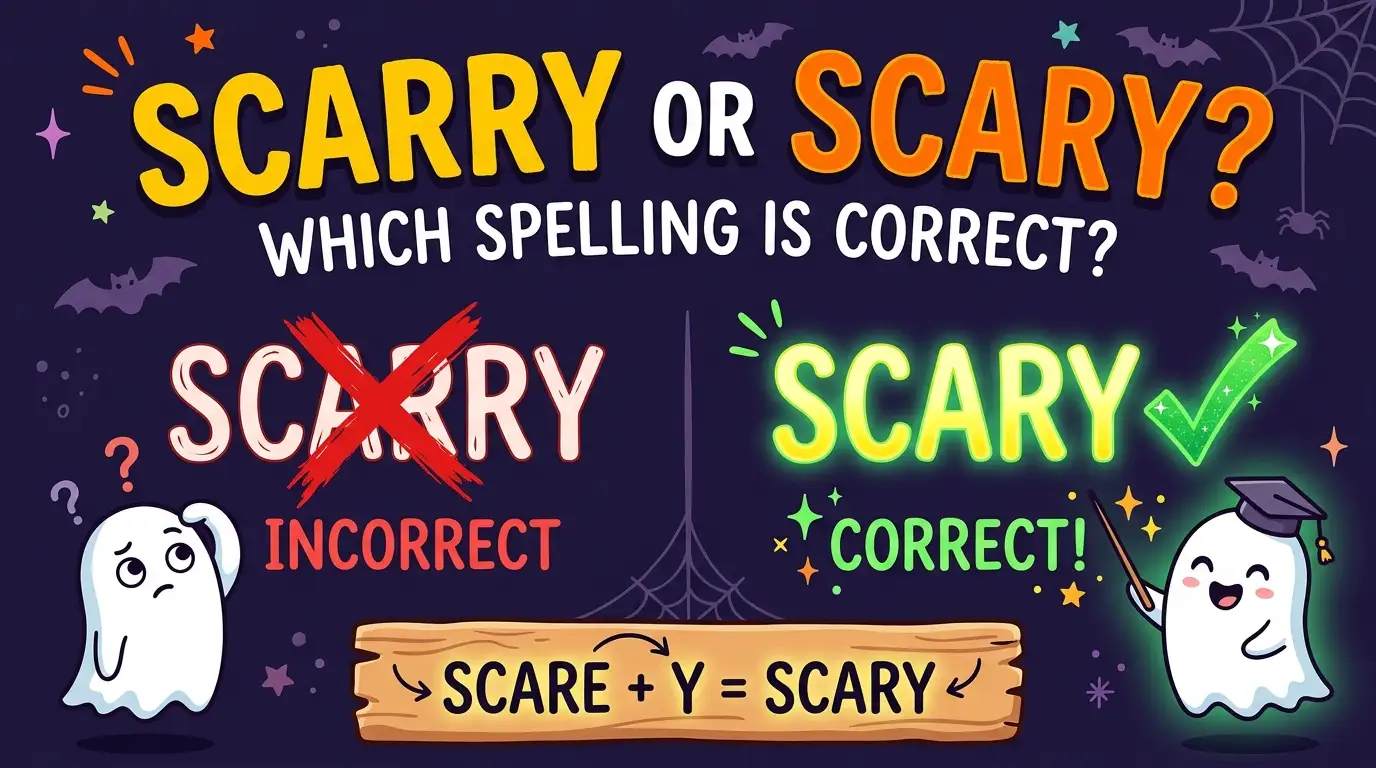
You are not alone. Thousands of people search this question every month. The doubt is easy to understand. Many English words double a letter. Think of “carry,” “marry,” and “worry.” So “scarry” looks right to the eye. But it is not.
People search “scarry or scary” for one simple reason. They want a fast, safe answer before they hit send. Some also wonder if one spelling is British and the other is American. Here is the good news. There is no split. Only one spelling is correct, and it works everywhere in the English-speaking world.
This article clears up the confusion. You will get the quick answer first. Then you will learn where the word comes from, why people mix it up, and how to avoid the mistake. You will also see real examples, usage patterns, and a short FAQ. Read on, and you will never doubt this word again.
Scarry or Scary Quick Answer
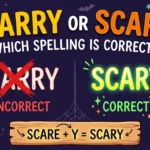
“Scary” is the correct spelling. “Scarry” is a misspelling. It is wrong in American English, British English, and every other kind of English.
“Scary” is an adjective. It describes something that makes you feel afraid.
- The movie was scary.
- That dark road looks scary.
- My dog is not scary. He is just loud.
- This is the scariest ride in the park.
There is one small catch. “Scarry” with two r’s does exist, but only as a name. Richard Scarry was a famous children’s author. His family name has two r’s. If you are not writing that name, use “scary.”
Easy memory trick: “Scary” comes from “scare.” Drop the “e,” add “y.” That is all. Scare + y = scary.
The Origin of Scary
The word “scary” grows out of the verb “scare.” Most dictionaries trace “scare” back to the Middle Ages. It came into English from an Old Norse word meaning to frighten or to shy away. Over time, English speakers shaped it into the word we use today.
The “-y” ending turns a word into an adjective. We do this all the time. Shake becomes shaky. Ice becomes icy. Bone becomes bony. Scare becomes scary. In each case, the silent “e” falls away before the “y.” Records show “scary” has been in use for several hundred years. At first it often meant “easily frightened.” Today it mostly means “causing fear.”
Why do people write “scarry”?
There are two main reasons.
- Look-alike words. Words like “carry,” “hurry,” “worry,” and “sorry” all have a double r. The eye expects the same pattern.
- Sound. In much of North America, “Mary,” “merry,” and “marry” sound the same. So the “ar” sound in “scary” can feel like it needs a double r to match “carry.”
But spelling follows the word’s roots, not its sound. Because “scary” comes from “scare,” it keeps a single r.
British English vs American English Spelling
Here is a surprise. British and American English spell “scary” the same way. There is no “scarry” in the UK and “scary” in the US. Both use “scary.”
People often expect a split because many words do differ. British English likes “-our” and “-re.” American English likes “-or” and “-er.” But “scary” has none of those parts. It is just a plain word with a single r.
The same goes for its family: scare, scared, scarier, and scariest. All are spelled the same in both versions.
| Word | American English | British English | Same or Different? |
| Frightening (adjective) | scary | scary | Same |
| More frightening | scarier | scarier | Same |
| Most frightening | scariest | scariest | Same |
| To frighten (verb) | scare | scare | Same |
| Frightened | scared | scared | Same |
| Incorrect form | scarry | scarry | Wrong in both |
| Color | color | colour | Different |
| Center | center | centre | Different |
| Realize | realize | realise | Different |
The last three rows show real US and UK differences. They are here to show that “scary” is not one of them.
Which Spelling Should You Use?
Use “scary.” The answer does not change with your reader.
- US readers: Use “scary.” Teachers, editors, and style guides all expect it.
- UK, Canada, Australia, and other Commonwealth readers: Use “scary.” Same rule, same spelling.
- Global readers: Use “scary.” It is the only form that dictionaries list.
There is only one time to write “scarry.” That is when you write the name of a person or brand that uses it, such as the author Richard Scarry. Capitalize it, since it is a name.
Pro tip: If you write for a global site, you do not need a regional setting for this word. Pick “scary” and move on. Save your spell-check energy for words like “colour” and “color,” where your audience really does matter.
Common Mistakes with Scarry or Scary
Most errors come from the same few habits. Here they are, with the fix.
| Mistake | Correct | Why it happens |
| scarry | scary | Double r copied from “carry” and “hurry” |
| scarey | scary | The silent “e” from “scare” was kept |
| scarrier | scarier | The double r was kept before “-er” |
| scarriest | scariest | The double r was kept before “-est” |
| scaryer | scarier | The “y” must change to “i” before “-er” |
| I am scary of spiders. | I am scared of spiders. | “Scary” and “scared” get mixed up |
The big one: scary vs. scared
These two words mean different things.
- Scary describes the thing that causes fear. The clown is scary.
- Scared describes the person who feels fear. I am scared of the clown.
If you say “I am scary,” you mean you frighten other people. That is not what most people want to say.
Quick check
- Does the word describe the cause of fear? Use scary.
- Does it describe the feeling inside someone? Use scared.
- Does it have two r’s? Fix it, unless it is a name.
Scarry or Scary in Everyday Examples
Seeing the word in real settings helps it stick. These examples are written for illustration.
In an email
Hi Sam, the new safety video is a bit scary, but it is clear. Can we add a short intro first?
In a news headline
Storm Brings Scary Moments to Coastal Town as Winds Hit 90 mph
On social media
I just watched the new horror film alone at night. Way too scary. 😱 #Halloween
In formal writing
Participants rated the haunted house as the scariest exhibit in the survey.
In a children’s setting
The dark forest was scary, but the little fox was brave.
In every case, the word has one r. Only a proper name, like the author Richard Scarry, keeps the double r.
Scarry or Scary Google Trends & Usage Data
A note first: these are general patterns, not exact figures. I did not pull live Google Trends numbers for this draft. For exact data, open Google Trends and compare “scary” with “scarry” for your country and dates.
Here is what the pattern usually looks like for this kind of spelling question.
- “Scary” is far more common than “scarry.” Most people type the right spelling. The misspelling is a small share of searches.
- Searches rise before Halloween. Words about fear tend to peak in October. That is when more people write about horror, costumes, and haunted places.
- The doubt shows up in English-speaking countries and where English is a second language. That includes the US, UK, Canada, Australia, India, Pakistan, the Philippines, and Nigeria. Learners often double the “r” because of words like “carry.”
- The “scarry” searches are often questions. People type “scarry or scary” to check, not to use the wrong word.
Keyword variations side by side
| Variation | Correct? | Where you may see it | Verdict |
| scary | Yes | Everywhere in English | Use this |
| scarry | No | Typos, search queries, the name Scarry | Avoid, unless it is a name |
| scarey | No | Typos, mostly from the word “scare” | Avoid |
| scarie | No | Typos, text messages | Avoid |
| scarier | Yes | Comparisons (“more scary”) | Use this |
| scariest | Yes | Superlatives (“most scary”) | Use this |
| scarrier | No | Typos | Avoid |
Frequently Asked Questions
Is it “scarry” or “scary”?
It is “scary.” “Scarry” is a misspelling, unless it is part of a name like Richard Scarry.
Is “scarry” a word in British English?
No. British English uses “scary,” just like American English.
Why does “scary” have only one r?
It comes from “scare.” You drop the silent “e” and add “y.” Nothing in that process adds a second r.
What is the comparative form of “scary”?
It is “scarier,” and the superlative is “scariest.” The “y” turns into “i” before “-er” and “-est.”
What is the difference between “scary” and “scared”?
“Scary” describes what causes fear. “Scared” describes the person who feels fear. A movie is scary. You are scared.
Is “scarey” ever correct?
No. Dictionaries do not list it. Always write “scary.”
Can I use “scarry” as a name?
Yes. Scarry is a real family name. Capitalize it and spell it as the person or brand does.
How can I remember the right spelling?
Think “scare plus y.” Drop the “e,” add “y,” and you get “scary.”
Conclusion
So, which is it: “scarry” or “scary”? The answer is simple. It is “scary.” One r. No exceptions, unless you are writing a name like Richard Scarry.
Here are the key points to take away.
- “Scary” comes from “scare.” Drop the silent “e” and add “y.”
- People write “scarry” because of look-alike words like “carry” and “hurry.” Sound plays a part too.
- American and British English spell the word the same way. You do not need to pick a side.
- Use “scarier” and “scariest” for comparisons. Change the “y” to “i.”
- Use “scary” for the thing that frightens. Use “scared” for the person who feels afraid.
When in doubt, say the word “scare” in your head. Then add “y.” That small trick will keep your writing clean in emails, posts, reports, and stories.
Spelling doubts are normal. Even skilled writers pause on common words. The good news is that this one has a clear answer. Now you have it. Write with confidence, hit send, and let the only scary thing be your horror movie.

Sikandar Hayat is the author and creator of Journalneste.com, a website dedicated to heartfelt wishes, messages, greetings, and inspiring words for every special moment. With a passion for meaningful writing, Sikandar creates warm and thoughtful content that helps readers express their feelings with ease. His goal is to provide beautiful, shareable words for birthdays, celebrations, relationships, and memorable occasions.