You type fast. Your finger hovers. Did you just join a clique, or did you click a link? One wrong letter changes the whole meaning.
Many people search “click or clique” every year. The two words sound alike and look alike, but they are not the same word. One is about a tiny sound and a button. The other is about a group of friends who keep others out.
Some people think this is a spelling fight, like color and colour. It is not. These are two different words with two different jobs. Spell checkers often miss the mix-up because both are real words, which makes it easy to slip.
This guide clears it up. You get a quick answer first. Then you will see where each word comes from, how to say them, and the mistakes people make most. You will also find real examples, comparison tables, and an FAQ. By the end, you will not mix them up again.
Click or Clique Quick Answer
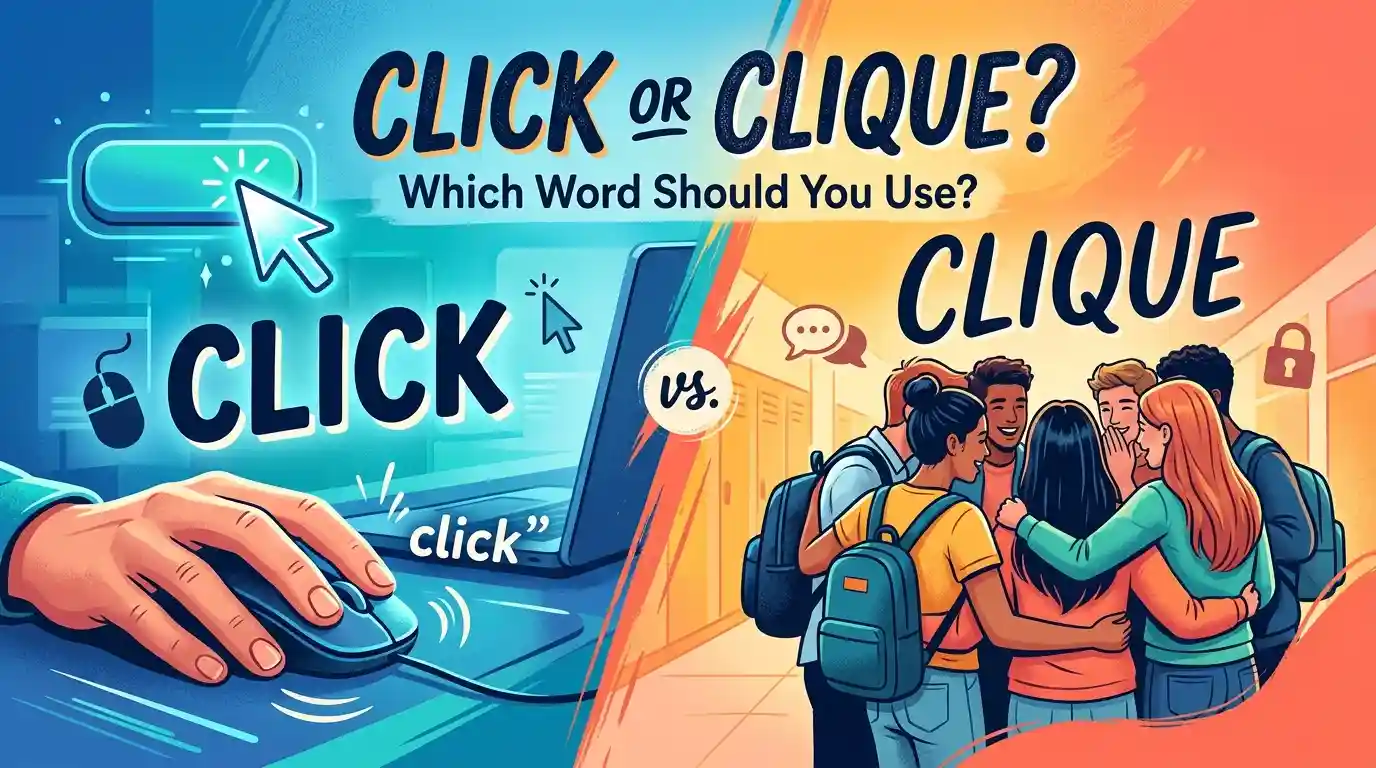
Click means to press a button. It also means a short, sharp sound.
Clique means a small group of people who stay close and keep others out.
Examples:
- Please click the blue button.
- I heard the lock click.
- She sat with her clique at lunch.
- It is hard to break into a tight clique.
Easy trick: Clique has a “que” at the end, like uniqueness and technique. Think of a group that feels unique and hard to join. If your sentence is about people, use clique. If it is about a button, a mouse, or a sound, use click.
The Origin of Click and Clique
Click is an imitative word. People made it to copy the sound it describes, like buzz or pop. It has been in English for hundreds of years. It first meant a light, sharp noise. Later it grew to mean pressing a button or mouse. The online sense of “click a link” is recent and very common now.
Clique came from France. It is linked to an old French verb meaning “to click” or “to clack.” English borrowed it in the 1700s. At first it described a small group working together, often in a sneaky way. Over time it came to mean any tight social circle.
Why the spelling differs: English keeps French spellings when it borrows words. That is why clique ends in “-ique,” like unique and antique. The two words have similar roots in sound, but they grew up in different places and now mean different things.
British English vs American English Spelling
Here is the key point: click and clique are not British and American versions of one word. Both countries spell both words the same way. You will not find “clique” in the UK and “click” in the US.
What can differ is how people say clique. Most speakers say it like “kleek” (rhymes with seek). A few say it like “klick.” Both are heard, but “kleek” is the common one.
Real spelling differences look like this:
| Word type | American | British |
| Real spelling pair | color | colour |
| Real spelling pair | center | centre |
| Real spelling pair | organize | organise |
| Click | click | click |
| Clique | clique | clique |
So if you are choosing between US and UK spelling, you can relax. For these two words, the spelling rules are the same everywhere. What matters is the meaning you want.
Which Spelling Should You Use?
Choose by meaning, not by country.
- US readers: Use click for buttons and sounds. Use clique for tight groups.
- UK and Commonwealth readers: The rule is the same. Nothing changes.
- Global readers: Same rule again. If your reader may be learning English, keep sentences short and clear.
A quick test: Replace the word with “group of friends.” If the sentence still makes sense, use clique. If it sounds silly, use click.
“Please group of friends the link” makes no sense, so you need to click. “She joined a group of friends at school” works, so you need clique.
Common Mistakes with Click or Clique
| Wrong | Right | Why |
| Please clique here to sign up. | Please click here to sign up. | A button needs click. |
| She is part of a popular click. | She is part of a popular clique. | A group of people needs clique. |
| Don’t join their click. | Don’t join their clique. | Same reason. |
| The cliquey sound of the pen. | The clicking sound of the pen. | Sound uses click. |
| Clickbait clique | Clickbait | Clickbait is a link trick. It is spelled with a click. |
More tips:
- Do not trust spell check alone. Both words are real, so it may not warn you.
- Cliquey and cliquish describe people who stay in tight groups. They come from clique.
- Clicker, clicked, and clicking all come from click.
Click or Clique in Everyday Examples
Email:
- “Please click the link below to reset your password.”
- “Our team is a family, not a clique.”
News:
- “Readers click on headlines that feel urgent.”
- “Critics say a small clique of advisers runs the office.”
Social media:
- “That video got a million clicks!”
- “High school can feel like one big clique.”
Formal writing:
- “The study counted how often users click each menu item.”
- “Researchers studied how a clique forms among teenagers.”
Notice the pattern. When the sentence is about a screen, a button, or a sound, it uses click. When it is about people and belonging, it uses clique.
Click or Clique Google Trends & Usage Data
I can’t pull live Google Trends numbers here, so I won’t make any up. Here is what usage generally looks like, and how you can check it yourself.
- Click is far more common. People use it every day online, in tech, in marketing, and in daily talk.
- Clique is rarer. It shows up more in talk about school, friendships, TV shows, and workplace culture.
- “Click or clique” as a search is a spelling-help question. English-speaking countries, such as the US, UK, Canada, Australia, India, and Pakistan, are the likely places for it.
- Searches for clique often rise when a popular show or song uses the word, or when back-to-school season starts.
| Term | Likely popularity | Common context |
| click | Very high | Websites, apps, mouse, ads |
| clicks | Very high | Marketing, traffic, social media |
| clique | Low to medium | Schools, friend groups, media |
| cliquey / cliquish | Low | Describing groups |
| click or clique | Low, steady | Spelling and grammar help |
To check it yourself: Open Google Trends. Type “click” and “clique” as two terms, then compare by country and time. Use a recent date range.
Click vs Clique: Side-by-Side Comparison
| Feature | Click | Clique |
| Part of speech | Verb and noun | Noun |
| Meaning | Press a button; a sharp sound | A small, tight group of people |
| Sounds like | “klick” (rhymes with quick) | “kleek” (rhymes with seek) |
| Origin | Imitates a sound | Borrowed from French |
| Example | Click the link. | Her clique ignored me. |
| Related words | clicking, clicked, clicker | cliquey, cliquish |
| US and UK spelling | Same | Same |
FAQs
1. Is it “click” or “clique”?
Both are correct, but they mean different things. Use click for buttons and sounds. Use clique for tight groups of people.
2. How do you say “clique”?
Most people say “kleek,” like seek. Some say “klick.” Either is understood, but “kleek” is more common.
3. Is “clique” a British spelling of “click”?
No. They are two separate words. They are not spelling variants like color and colour.
4. Can “click” ever mean a group of people?
Not in standard English. A group needs cliques. Using click for a group is a common mistake.
5. What does “clickbait” mean, and why is it not “cliquebait”?
Clickbait is content built to make you click a link. It is about a button, so it uses click.
6. What are the adjective forms?
Cliquey and cliquish come from clique. Both describe people who keep outsiders out.
7. What is a simple way to remember the difference?
Clique ends in “que,” like unique. A clique feels unique and hard to join. Click is short and sharp, like the sound it names.
Conclusion
The two words are easy to mix up, but the fix is simple. Click is for buttons, mice, and sharp sounds. Clique is for small groups of people who stay close and keep others out.
This is not a US versus UK spelling issue. Both countries use the same spelling for both words. Your choice depends on meaning alone.
Here is the short list to remember:
- Press, tap, or sound? Use click.
- Group of friends or insiders? Use clique.
- Think of unique techniques to remember the “que” ending.
- Do not rely on spell check. Both words are real, so it may miss the error.
- Read your sentence aloud. If it is about people, check that you wrote clique.
Mixing these words up can make your writing look careless, especially in emails, ads, and school work. A quick check takes seconds and keeps your message clear. Keep this guide handy, and you will choose the right word every time.

Sikandar Hayat is the author and creator of Journalneste.com, a website dedicated to heartfelt wishes, messages, greetings, and inspiring words for every special moment. With a passion for meaningful writing, Sikandar creates warm and thoughtful content that helps readers express their feelings with ease. His goal is to provide beautiful, shareable words for birthdays, celebrations, relationships, and memorable occasions.