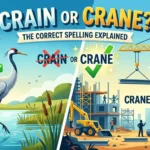
You are typing a sentence. You need the name of a tall bird, or a big machine at a building site. Then you stop. Is it crain or crane?
You are not alone. Many people check this spelling. The two words look alike and sound the same. Spell check does not always catch the error, because “Crain” is a real last name.
People search “crain or crane” for one reason. They want a fast, safe answer. They do not want to look careless in an email, a school paper, or a post.
Here is the good news. The answer is simple. Crane is the word. Crain is not a normal English word. It is mostly a surname.
This article clears up the mix-up. You will get a quick answer first. Then you will learn where the word came from, why the confusion happens, and which mistakes to avoid. You will see real examples, tables, and a list of common questions. By the end, you will never doubt this spelling again.
Crain or Crane Quick Answer
Use “crane.”
It is correct in American English. This is correct in British English. It is correct everywhere English is used.
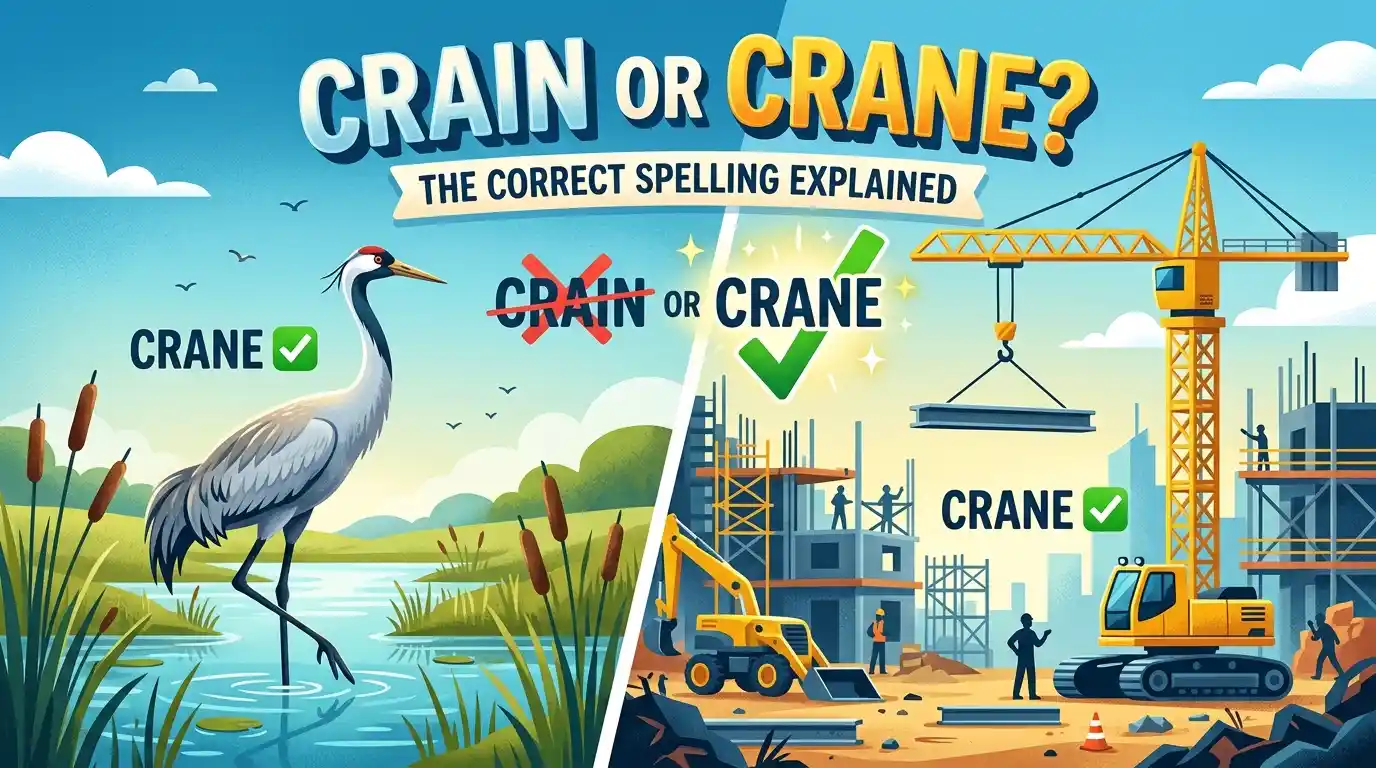
“Crane” has three main meanings:
- A bird. A crane is a tall bird with long legs and a long neck.
The crane stood in the shallow water. - A machine. A crane lifts heavy things.
A crane lifted the steel beam. - A verb. To crane is to stretch your neck to see better.
She craned her neck to see the stage.
“Crain” is not in standard dictionaries as a common word. You will see it as a family name, a company name, or a place name. Unless you mean a person or brand called Crain, write “crane.”
The Origin of Crane
The word “crane” is very old. It comes from Old English, where the bird was called cran. Similar words exist in other Germanic languages. Many other European languages have close cousins too, such as Latin grus and Greek geranos. All of them likely trace back to an ancient word that imitated the bird’s loud call.
The machine got its name later. In the Middle Ages, builders made lifting devices with a long arm. The arm looked like the neck of the bird. So people called the device a “crane.” The same idea appears in other languages.
The verb came from the same picture. When you stretch your neck, you look like a crane bird.
So why do people write “crain”? Mostly because of sound and pattern. English has many words where the “ai” spelling makes the long “ay” sound: rain, train, brain, chain, grain. The word “crane” sounds like it belongs in that group. But it uses a different pattern: a-e, as in plane, lane, cane, and crane.
“Crain” also exists as a surname, so people see it in print. That makes the wrong spelling look more real than it is.
British English vs American English Spelling
Many English spelling differences exist between the US and the UK. Think of color and colour, or center and centre. People often guess that “crain or crane” is one of those pairs.
It is not. There is no British or American version of this word. Both countries spell it the same way.
| Word | American English | British English |
| The bird | crane | crane |
| The machine | crane | crane |
| To stretch the neck | crane | crane |
| Color | color | colour |
| Center | center | centre |
| Gray | gray | grey |
| “Crain” | not a common word | not a common word |
The lesson is simple. A spelling difference between UK and US English follows set rules, such as -or / -our or -er / -re. “Crane” does not follow any of them. It has one correct spelling.
Which Spelling Should You Use?
The answer does not change with your audience.
- US readers: Use “crane.”
- UK and Commonwealth readers (including Australia, Canada, India, and Pakistan): Use “crane.”
- Global readers: Use “crane.”
The only time to use “Crain” is when it is a name. For example, a person called Crain, or a business with Crain in its name. In that case, copy the name exactly as the person or company writes it.
A simple rule: if it is a bird, a machine, or a stretch of the neck, it is “crane.”
Common Mistakes with Crain or Crane
Here are the errors people make most often.
| Wrong | Right | Why |
| The crain lifted the load. | The crane lifted the load. | “Crain” is not the machine. |
| A white crain flew over the lake. | A white crane flew over the lake. | The bird is a crane. |
| He crained his neck. | He craned his neck. | The verb is “crane.” |
| The construction crain was huge. | The construction crane was huge. | Same word, same fix. |
| Crains are tall birds. | Cranes are tall birds. | Add “s” to the right word. |
Tips to remember:
- Think of “plane.” Crane and plane both use the a-e pattern.
- Think of the final “e.” The “e” makes the “a” say its name. That is why it sounds like “ay.”
- Rhyme it. Crane rhymes with plane, lane, and mane. None of those use “ai” in the middle.
- Check capitals. If “Crain” has a capital letter and names a person, it may be correct. If it is a common noun, it is not.
Crane in Everyday Examples
Here is how “crane” looks in real writing.
In an email:
Hi Sam, the crane will arrive at 9 a.m. Please clear the driveway before then.
In a news headline:
Crane Lifts New Bridge Section Into Place
On social media:
I saw a beautiful crane at the lake this morning. 🦢 #birdwatching
Spent an hour craning my neck to see the fireworks.
In formal writing:
The contractor will hire a tower crane for the build. The crane must pass a safety check before use.
In school or science writing:
The sandhill crane is a large bird. It migrates long distances each year.
Notice that the spelling never changes. Only the meaning does.
Crain or Crane Google Trends & Usage Data
I cannot pull live Google Trends numbers here, so I will not invent any. You can check them yourself at trends.google.com. Here is what you can expect to see, based on how people use the words.
“Crane” is a far more common search term than “crain.” It covers the bird, the machine, and many names and brands. Interest tends to be steady all year, with small bumps in spring and fall when birds migrate.
“Crain” shows up in smaller numbers. Many of those searches are for a surname, a company, or a place, not for a spelling fix.
“Crain or crane” is a spelling-check search. People tend to type it when they are writing something and want a quick answer. Interest is spread across English-speaking countries. That fits the facts, because there is no UK versus US difference.
| Search term | Usual meaning | Common context |
| crane | bird, machine, verb | Construction, nature, news |
| crain | surname, brand, place | People and business searches |
| crain or crane | spelling check | Writing and editing |
| crane vs crain | spelling check | Students, writers, editors |
Tip: In Google Trends, compare “crane” and “crain” side by side. Then change the country filter to see how each term varies by region.
Crain vs Crane: Side-by-Side Comparison
| Feature | Crane | Crain |
| Standard English word? | Yes | No |
| Does it mean a bird? | Yes | No |
| Means a lifting machine? | Yes | No |
| Can it be a verb? | Yes (craned, craning) | No |
| Used as a surname? | Yes, sometimes | Yes |
| Same in the US and UK? | Yes | Yes |
| Safe for general writing? | Yes | Only for names |
Frequently Asked Questions
1. Is it crain or crane?
It is “crane.” “Crain” is not a normal English word.
2. Is “crain” ever correct?
Yes, but only as a name. It can be a surname, a company, or a place. Never use it for the bird or the machine.
3. Is there a British spelling of crane?
No. British and American English both spell it “crane.”
4. What does “crane” mean?
It can mean a tall wading bird, a machine that lifts heavy loads, or the act of stretching your neck to see.
5. How do I spell the past tense?
Write “craned.” For example: He craned his neck to see. The “ing” form is “craning.”
6. Why does “crane” not use “ai” like “train”?
English has more than one way to spell the long “ay” sound. “Crane” uses the a-e pattern, like plane and lane. Spelling follows history, not just sound.
7. Where does the word crane come from?
It comes from Old English cran, the name of the bird. The lifting machine was named after the bird because its long arm looks like the bird’s neck.
8. Will spell check catch “crain”?
Not always. Some tools accept “Crain” because it is a known surname. Always read your text again.
Conclusion
Here is what to remember. The correct spelling is crane. It works in American English, British English, and every other English-speaking place. There is no regional twist.
“Crane” has three jobs. It is a bird. This is a machine that lifts heavy things. It is also a verb that means to stretch your neck. That is why you may see it in nature writing, building news, and everyday speech.
“Crain” is not a common word. It is mostly a surname or a brand. Use it only when you are writing a person’s or a company’s name.
People mix up the two because of sound. Words like rain and train use “ai.” But “crane” follows the a-e pattern, like plane and lane. If you can remember that, you will not slip.
So next time you wonder, “crain or crane?”, stop and think of the bird. Think of the long neck. Then write crane. You will be right every time, If you write an email, a post, or a formal report.

Sikandar Hayat is the author and creator of Journalneste.com, a website dedicated to heartfelt wishes, messages, greetings, and inspiring words for every special moment. With a passion for meaningful writing, Sikandar creates warm and thoughtful content that helps readers express their feelings with ease. His goal is to provide beautiful, shareable words for birthdays, celebrations, relationships, and memorable occasions.