Have you ever stopped in the middle of a sentence and stared at one word? Is it bussing or busing? You are not alone. Many people search this question, and the answer can feel confusing. Both spellings look right. Both show up in books, news, and school notices. So which one is correct?
People search for this keyword for simple reasons. A student wants to pass a test. A writer wants a clean copy. A parent reads about school busing and wonders about the spelling. A restaurant worker sees “bussing tables” on a sign and doubts it. Each person wants one clear answer, fast.
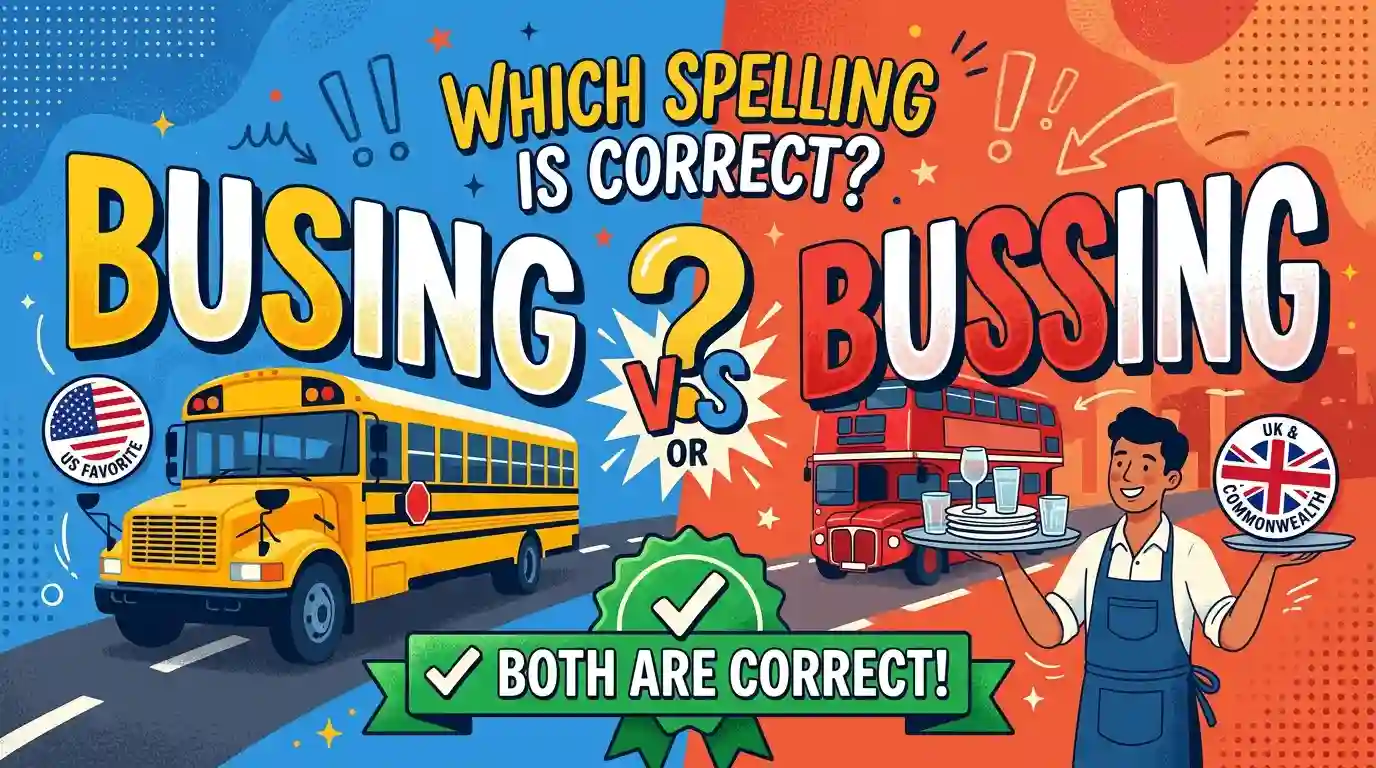
Here is the good news. Both spellings are real. The difference comes from spelling rules, not from meaning. In the United States, busing is the usual choice. The UK, bussing is common. In a few cases, the spelling even hints at a different meaning.
This guide ends the confusion. You get a quick answer first. Then you learn where the word came from, how the two spellings differ, and which one fits your reader. You also get common mistakes, real examples, comparison tables, and answers to common questions.
Bussing or Busing Quick Answer
Both are correct. Busing is the main American spelling. Bussing is a common variant, often seen in British English. Major dictionaries list both.
Both words come from the verb to bus. It means to move people by bus, or to clear dishes from tables.
Examples:
- The city is busing students to the new school. (US)
- The council is bussing pupils to the sports day. (UK)
- She earns extra money bussing tables on weekends.
Quick rule: writing for Americans? Use busing. Writing for a British or Commonwealth reader? Bussing is safe. Pick one and use it every time in the same piece.
The Origin of Bussing and Busing
The word bus is short for omnibus. Omnibus is a Latin word. It means “for all.” In the 1820s, horse-drawn coaches in France carried anyone who paid a fare. People called them omnibuses. Soon, the short form bus took over.
Later, people turned the noun into a verb. To bus meant to carry people by bus. In the United States, it also took on a second job. In restaurants, a “busboy” cleared tables. So to bus tables became a common phrase.
Why two spellings? English has a rule for short words. When a word ends in one vowel and one consonant, you often double the last letter before -ing. Think of run → running and stop → stopping. By that rule, the bus becomes bussing.
But buses are a bit different. It was once a clipped form of a longer word. Writers did not always follow the doubling rule. So busing grew up beside bussing. Both forms were used for many years. Neither one is a mistake.
There is one more fun fact. In older English, bus also meant a kiss. That is a different word with a different history. Today it sounds old or playful, and it can cause a double take. Context usually makes the meaning clear.
British English vs American English Spelling
American English likes short, simple spellings. It often drops extra letters. So busing feels natural to many US writers and editors. Major US style guides and dictionaries list it first.
British English follows the doubling rule more often. So bussing looks normal to many readers in the UK, Australia, and other Commonwealth countries. Even so, dictionaries there accept both forms.
The same pattern shows up in other words:
| Base word | Doubled form | Single form | Notes |
| bus | bussing, bussed | busing, bused | Both accepted; US prefers single |
| focus | focussing, focussed | focusing, focused | Single form is standard in both; doubled is a rare variant |
| bias | biassing, biassed | biasing, biased | Single form is standard today |
| travel | travelling, travelled | traveling, traveled | UK doubles; US does not |
| cancel | cancelling, cancelled | canceling, canceled | UK doubles; US does not |
The table shows the real picture. The UK doubles letters more often. The US often keeps one. But the line is not perfect, and the bus sits in a gray zone where both spellings live side by side.
Past tense follows the same split: bused (US) and bussed (UK). Pick the pair that matches your choice.
Which Spelling Should You Use?
The best spelling is the one your reader expects. Use this simple guide:
- US audience: use busing and bused. Most American readers see these as normal.
- UK, Australia, India, and other Commonwealth readers: use bussing and bussed. They match local habits.
- Global audience: pick one and stay with it. Either is acceptable. Many global brands follow US style because of its reach.
- Restaurant or hospitality writing: bussing tables is common in everyday use. Busing tables is also correct.
- School or civil rights writing (US): busing is the usual form, as in “school busing.”
Professional tip: check the style guide of your school, employer, or publisher. If there is none, set your spell checker to the right region. Then be consistent. Mixing both forms in one piece looks careless, even though each one is fine alone.
Common Mistakes with Bussing or Busing
Most errors are small. But they are easy to fix.
- Calling one spelling wrong. Both are correct. Do not “fix” a colleague’s bussing to busing as if it were a typo. Treat it as a style choice.
- Mixing both in one piece. Writing “busing” in paragraph one and “bussing” in paragraph four looks sloppy. Choose one.
- Mismatching the tense. Do not write busily. Pair bused with busing, and bussed with bussing.
- Using “buses” and “buses” incorrectly. The plural noun is buses in most modern writing. Busses is an older variant and is now rare. Do not confuse the noun plural with the verb.
- Confusing it with “buss.” Buss means a kiss. It is not a typo for the bus. “The coach was bussing the children” and “The coach was bussing the children’s cheeks” mean very different things.
- Forgetting the audience. A US school district notice that says “bussing” may look odd to some readers. A UK council notice that says “busing” may look odd, too.
Fix: pick the form for your audience, set your spell checker to match, and read the piece once for consistency.
Bussing or Busing in Everyday Examples
See how each spelling works in real situations.
Email (US):
Hi team, the district is busing students to the field trip on Friday. Please send permission slips by Wednesday.
Email (UK):
Dear parents, the school will be bussing pupils to the swimming gala on Thursday. Please return the form by Monday.
News headline style:
- City council votes on school busing plan
- Councils review bussing costs for rural pupils
- Voters weigh busing changes in new school year
Social media:
I just finished my first week bussing tables. My feet hurt, but the tips are great! #restaurantlife
Formal writing:
The study examines the long-term effects of busing on school integration in American cities.
Notice the pattern. News and formal writing in the US lean toward busing. Casual restaurant talk and UK writing often show bussing. All of these are fine.
Bussing or Busing Google Trends & Usage Data
Search interest in this keyword comes in waves. It rises when school busing is in the news, when a school year starts, and when students study spelling rules. Interest in bussing tables tends to follow job-hunting seasons.
How usage splits by region (general pattern):
- United States: busing leads in news, law, and education writing. Bussing shows up often in restaurant talk.
- United Kingdom and Commonwealth: bussing is common, though busing also appears, especially in text influenced by US media.
- Global web content: both forms appear, and many sites follow US style.
Note on the data: this article does not quote exact search numbers. They change over time. To see current figures, open Google Trends and compare “bussing” and “busing” by country and time range. Add “bussing tables” and “school busing” to see context.
Bussing vs Busing: Variations Side by Side
| Form | Spelling style | Common in | Typical use |
| busing | Single s | US | School busing, news, formal writing |
| bussing | Double s | UK, Commonwealth, also US | Moving pupils, restaurant work |
| bused | Single s, past tense | US | “Students were bused to school” |
| bussed | Double s, past tense | UK, also US | “Pupils were bussed to the match” |
| buses | Noun plural | Everywhere | “Three buses arrived” |
| busses | Older noun plural | Rare | Seen in older texts |
| buss | Different word | Old or poetic English | A kiss |
FAQs
1. Is it bussing or busing? Both are correct. Busing is the main US spelling. Bussing is common in the UK and also accepted in the US.
2. Which spelling do dictionaries prefer? Major dictionaries list both. Many American dictionaries put busing first. Check your own dictionary or style guide for its preference.
3. What is the past tense? It is bused or bussed. Match it to your choice: busing with bused, and bussing with bussed.
4. Is “bussing tables” correct? Yes. So is “busing tables.” Both mean clearing dishes in a restaurant.
5. Is the plural of bus “buses” or “busses”? Buses is the standard plural today. Busses is an older form and is rare.
6. What does “buss” mean? It is an old word for a kiss. It is a different word from bus, so do not mix them up.
7. Can I use both spellings in one article? Avoid it. Each is correct, but mixing them looks inconsistent. Pick one and stay with it.
8. Which spelling is better for SEO? Use the spelling your readers search for. For a US audience, that is usually busing. For a UK audience, it is often bussing. You can mention both once, as this article does.
Conclusion
So, bussing or busing? Both are correct. That is the short answer, and it is also the full truth. The two spellings come from the same verb, to bus, which comes from the Latin word omnibus. The difference is a matter of habit, not meaning.
Here are the key takeaways. Busing is the most common choice in American English, and many US dictionaries list it first. Bussing is common in British English. It is also widely accepted in the US, especially for restaurant work. The past tense follows the same split: bused and bussed. Do not confuse bussing with buss, which means a kiss.
Here is the advice to follow. Know your reader. Writing for Americans? Choose busing. Writing for British or Commonwealth readers? Choose bussing. Writing for the whole world? Pick either one, and stick with it. Consistency matters more than the choice.
Next time your spell checker flags the word, relax. You are not making a mistake. You are making a style choice. Now you know the reasons behind both spellings, and you can explain them with confidence.

Sikandar Hayat is the author and creator of Journalneste.com, a website dedicated to heartfelt wishes, messages, greetings, and inspiring words for every special moment. With a passion for meaningful writing, Sikandar creates warm and thoughtful content that helps readers express their feelings with ease. His goal is to provide beautiful, shareable words for birthdays, celebrations, relationships, and memorable occasions.