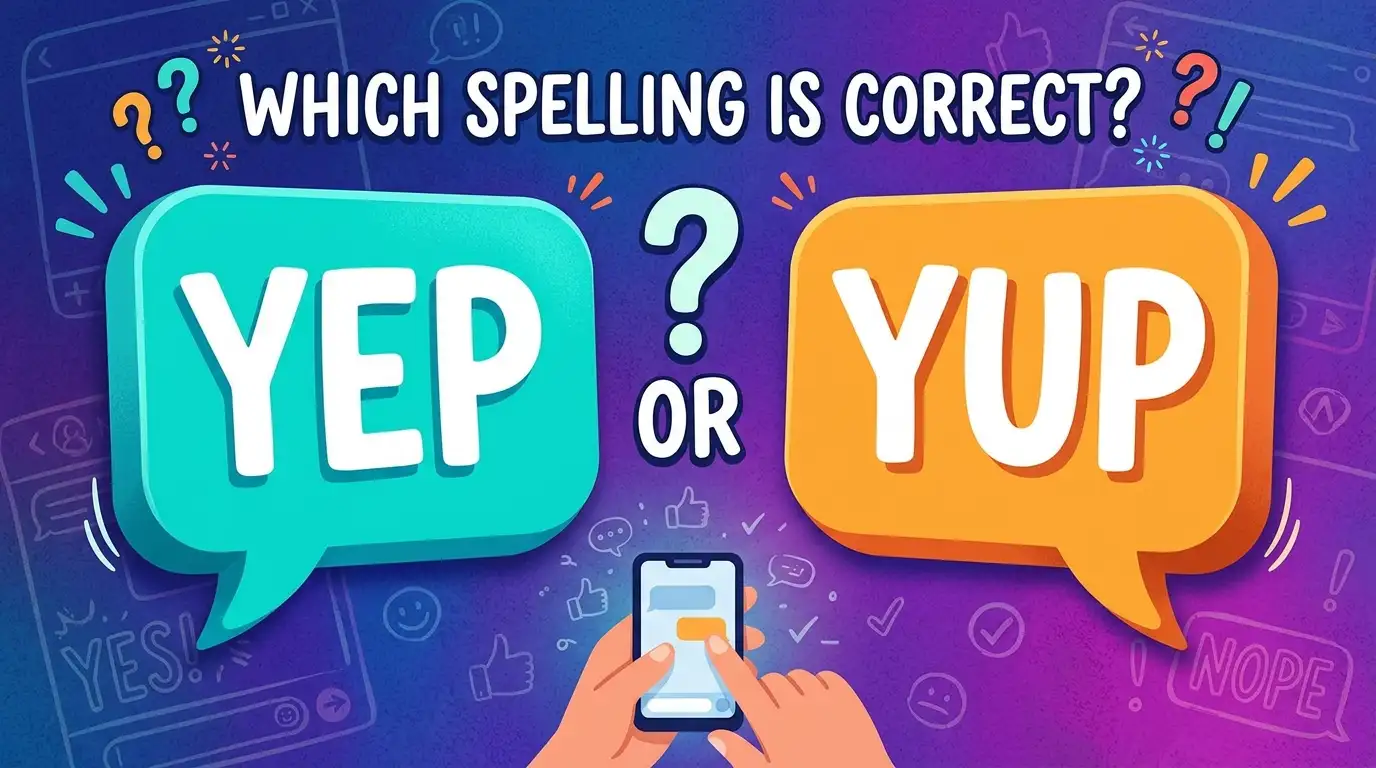
You are typing a quick reply. Someone asks a question. You want to say yes, but in a casual way. Then you stop. Is it yep or yup?
You are not alone. Many people search for this every month. The two words look alike. They sound alike. They mean the same thing. So why are there two spellings?
People search for “yep or yup” because they fear looking wrong. Maybe you are writing to your boss. And maybe you are posting online. Maybe you are a student, a writer, or still learning English. You want a clear answer.
Here it is: both are fine. Yep and yup are casual ways to say “yes.” Neither one is a mistake.
This guide clears up the confusion. You will learn where each word came from. And you will see how they fit in US and UK English. You will get simple tips on which one to pick. You will also see real examples, common mistakes, and answers to common questions.
Let’s settle it.
Yep or Yup Quick Answer
Both are correct. Yep and yup are informal words for “yes.” They are not different words. They are two spellings of one casual sound.
- “Did you finish the report?” “Yep.”
- “Are you coming tonight?” “Yup!”
- “Is this seat taken?” “Nope, all yours.” (The opposite of yep is nope. The opposite of yup is nup, which is rare.)
Use yep or yup in: texts, chats, casual emails, and speech.
Skip them in: essays, reports, legal papers, and formal letters. Write “yes” there.
The Origin of Yep or Yup
Both words are slang forms of “yes.” They come from American English. Most dictionaries trace them to the late 1800s and early 1900s.
How did “yes” turn into “yep”? Speakers often end the word with a quick closing of the lips. That makes a soft “p” sound. Writers then spelled the sound the way they heard it. Some wrote yep. Others wrote yup.
That is why two spellings exist. English has no rule for slang. People simply wrote what they heard. The vowel sound in casual speech is short and a bit vague. So both “e” and “u” felt natural.
Language experts also note that “yeah” and “yep” grew from the same habit of shortening and softening “yes.” Slang words like this often start in speech. They reach print later.
British English vs American English Spelling
Here is a surprise. There is no true British vs American spelling rule for yep and yup. Unlike color and colour, this pair does not split along country lines. Both spellings are used in both places.
The differences are about habit and tone, not rules.
| Feature | American English | British English |
| Is “yep” accepted? | Yes, informal | Yes, informal |
| Is “yup” accepted? | Yes, informal | Yes, informal |
| Most common casual “yes” | yeah, yep | yeah, yep |
| Feels more natural | Both feel natural | “Yeah” is often used more; “yup” can sound slightly American |
| Formal writing | Use “yes” | Use “yes” |
| Spelling rule? | None | None |
So do not worry about which country you are in. Your tone and audience matter more than your passport.
Which Spelling Should You Use?
Pick based on who will read your words.
If your readers are in the US: Use either one. Yep is a safe, friendly choice. Yup sounds a little more playful.
If your readers are in the UK or Commonwealth countries: Use either one. Both are understood. Many people there say “yeah” more often. Yep may fit a bit more smoothly than yup.
If your readers are global: Choose yep. It is simple and widely understood. Or just write “yes.” Plain “yes” is the easiest word for learners of English.
For any formal setting: Always write “yes.” No exceptions.
One easy rule: Pick one spelling and stick with it in the same piece of writing. Do not mix yep and yup in one chat or one article.
Common Mistakes with Yep or Yup
Mistake 1: Thinking one is wrong.
Both are correct slang. Don’t “fix” someone else’s yup into yep.
Mistake 2: Using them in formal writing.
- Wrong: “Yep, we accept the contract terms.”
- Right: “Yes, we accept the contract terms.”
Mistake 3: Writing “yepp” or “yupp.”
Extra letters are playful, but they are not standard. Keep it short in clear writing.
Mistake 4: Mixing up yup and yep with “yap” or “yip.”
A yap is a sharp bark or chatter. A yip is a short cry. They are different words.
Mistake 5: Forgetting punctuation.
Add a comma when the word starts a sentence: “Yep, I’ll be there.” A period works when it stands alone: “Yep.”
Mistake 6: Overusing them.
Too much slang can sound careless at work. Save it for friendly talk.
Yep or Yup in Everyday Examples
Text message
- “Dinner at 7?” “Yep, see you there!”
Casual email to a coworker
- “Hi Sam, did you get the file?” “Yup, got it. Thanks!”
Social media
- “Yes, I really did watch the whole series in one night. Yup.”
News headline or quote (reporting speech)
- Asked if he would run again, the mayor said, “Yep.”
Writers often keep slang inside quotes. That shows how people really talk.
Formal writing (what to do instead)
- Casual: “Yep, the budget is approved.”
- Formal: “Yes, the budget has been approved.”
Spoken conversation
- “Ready to go?” “Yup, let’s move.”
Yep or Yup Google Trends & Usage Data
Google Trends shows how often people search for a term. It does not give exact counts. It shows interest on a scale from 0 to 100.
Here is what usage patterns usually show:
- Casual spelling is common in both forms. Search interest for “yep” and “yup” is steady across the year. It does not depend much on the season.
- Search interest tends to be strongest in English-speaking countries. The US, UK, Canada, Australia, and India often lead.
- Many searches are about the choice. People type “yep or yup” or “yup or yep” to check the spelling. Students and writers drive a lot of this.
- Context matters. Most use is in chat, social media, and casual speech. Very little use appears in formal documents.
These are general patterns. Trends change over time. For the latest numbers, check Google Trends yourself. Compare “yep” and “yup” side by side, and filter by country and date.
Side-by-Side Comparison of Variations
| Variation | Meaning | Formality | Common use | Verdict |
| yes | Agreement | Neutral/formal | Everywhere | Always safe |
| yep | Casual yes | Informal | Texts, chats, speech | Correct |
| yup | Casual yes | Informal | Texts, chats, speech | Correct |
| yeah | Casual yes | Informal | Speech, chats | Correct |
| yepp / yupp | Playful yes | Very informal | Social media | Not standard |
| yap | Chatter or bark | Informal | Different word | Not a “yes” |
FAQs
1. Is it yep or yup?
Both are correct. They are two spellings of the same casual word for “yes.”
2. Which one is more common?
Both are widely used. Many writers see yep slightly more in print, but this can change by region and context. Check Google Trends for current data.
3. Is yup or yep American slang?
Both began in American English. Today, people use them in the UK and other English-speaking places too.
4. Can I use yep or yup in a professional email?
Only in a friendly, casual email. In formal emails, write “yes.”
5. Is there a difference in meaning?
No. Yep and yup mean the same thing. The tone can feel a little different. Yup may sound a bit more playful.
6. What is the opposite of yep and yup?
The usual opposite is nope. It is also informal.
7. Do I need a comma after yep or yup?
Yes, when it starts a longer sentence. Write “Yep, I know.” If it stands alone, use a period: “Yep.”
8. Are yep and yup in the dictionary?
Yes. Major dictionaries list both as informal forms of “yes.”
Conclusion
So, yep or yup? The answer is simple. Both are right.
Yep and yup are casual ways to say “yes.” They began as spoken slang in American English. People wrote the sound as they heard it. That is why two spellings exist.
There is no strict British or American rule here. Both spellings work in both places. What matters is your audience and your tone.
Use yep or yup with friends, in texts, and in relaxed emails. Pick one and stay consistent. If your readers are global, yep is a safe pick. In formal writing, such as reports, essays, and legal documents, always use “yes.”
Avoid common slip-ups. Don’t call either spelling wrong. And don’t add extra letters in clear writing. Don’t confuse them with “yap” or “yip.” And don’t overuse slang at work.
Now you can answer without a second thought. Type your reply and hit send. Yep. Yup. Either way, you got it right.

Sikandar Hayat is the author and creator of Journalneste.com, a website dedicated to heartfelt wishes, messages, greetings, and inspiring words for every special moment. With a passion for meaningful writing, Sikandar creates warm and thoughtful content that helps readers express their feelings with ease. His goal is to provide beautiful, shareable words for birthdays, celebrations, relationships, and memorable occasions.