Have you ever typed “neighbor” and watched your spell checker flag it? Or typed “neighbour” and seen a red line? You are not alone. Millions of people search for “neighbor or neighbour” every year. They want to know one thing: which one is right?
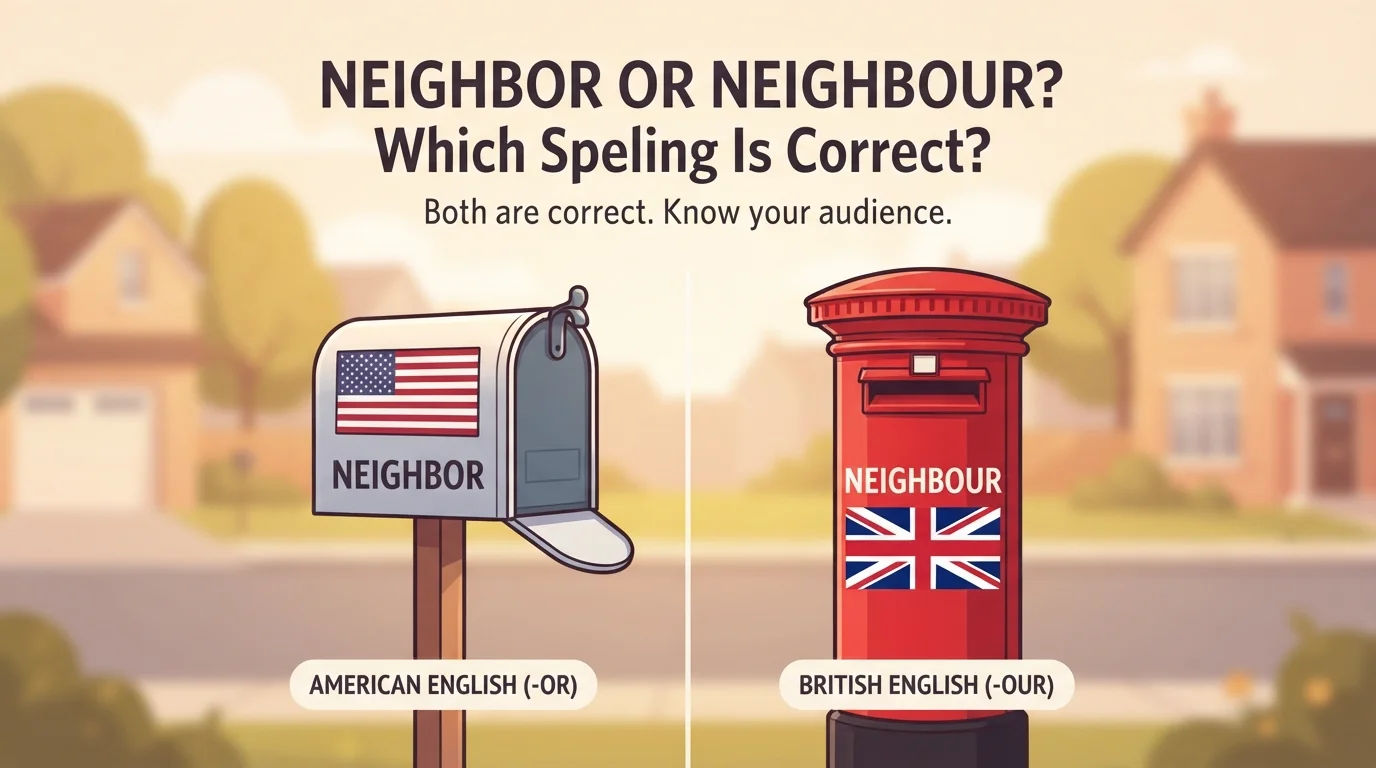
Here is the good news. Both are right. They are the same word. The only difference is where you live and who reads your writing.
People search for this keyword for many reasons. Students want to pass a test. Writers want clean work. Business owners want to look professional. Travelers and new immigrants see two spellings and feel lost. Some people just got a strange note from a teacher or an editor.
This confusion comes from history. English grew in different places. Each place made its own spelling rules over time. The result is two spellings for the same friendly word.
In this guide, you will get a quick answer first. Then you will learn where the word came from, how the two spellings differ, and which one to pick. You will also see common mistakes, real examples, usage data, and answers to common questions. By the end, you will never doubt this spelling again.
Neighbor or Neighbour Quick Answer
Neighbor is the American English spelling. Neighbour is the British English spelling. Both mean the same thing: a person who lives near you.
- Use neighbors in the United States and the Philippines.
- Use neighbors in the UK, Canada, Australia, New Zealand, India, Pakistan, and South Africa.
Examples:
- American: “My neighbor waved at me this morning.”
- British: “My neighbour waved at me this morning.”
The meaning does not change. Only the spelling does. Pick one and stay with it.
The Origin of Neighbor or Neighbour
The word is very old. It comes from Old English. The old form was nēahgebūr. It had two parts:
- nēah means “near.”
- gebūr means “dweller” or “farmer.”
So a neighbor was simply a “near dweller.” Over time, the word changed. In Middle English, it looked like a neighbor. People wrote it in many ways because spelling was not fixed yet.
Then printing spread across England. Printers began to settle on one form. Many words ended in -our, such as colour and honour. The British former neighbour kept this ending.
Across the ocean, a man named Noah Webster wanted simpler spelling. In his American dictionary of 1828, he dropped the “u” in many words. Colour became color. My neighbor became my neighbor. His books were popular, and the American spelling stuck.
That is why we have two spellings today. Neither one is a mistake. They are two paths from the same old word.
British English vs American English Spelling
The “u” difference shows up in many common words. If you learn the rule once, you can use it everywhere.
The rule: British English often ends these words in -our. American English uses -or.
| American English | British English |
| neighbor | neighbour |
| neighbors | neighbours |
| neighborhood | neighbourhood |
| neighborly | neighbourly |
| color | colour |
| favorite | favourite |
| honor | honour |
| humor | humour |
| labor | labour |
| behavior | behaviour |
| flavor | flavour |
| harbor | harbour |
Watch for these tricky parts:
- The “u” comes back in some forms, but not all. Humorous has no “u” in both styles. Honourable keeps it in British English.
- Some words end in -our everywhere. Examples are hour, hour, four, and tour. They are not part of this rule.
- Canada is a mix. Canadians write neighbour and colour, but they often follow US spelling for words like tire or program.
A fun memory trick: the middle of the word has the letters e and i. Many learners spell it wrong here. Remember the old rhyme: “I before E, except after C, or when sounding like A, as in neighbor and weigh.”
Which Spelling Should You Use?
The best spelling is the one your reader expects. Here is a simple guide.
Writing for a US audience? Use neighbors. This includes American blogs, schools, business sites, and news.
Writing for a UK or Commonwealth audience? Use neighbors. This includes the UK, Canada, Australia, New Zealand, India, Pakistan, South Africa, and Ireland.
Writing for a global audience? Pick one and be consistent. Many global brands choose American spelling because most software and web tools default to it. Others choose British spelling to match their home country. Both choices are fine.
Not sure? Check your style guide. If you have none, look at your readers. Where do most of them live? Use that spelling.
One more tip: Set your spell checker to the right language. Choose “English (US)” or “English (UK).” This stops you from mixing spellings in the same document.
Common Mistakes with Neighbor or Neighbour
Here are the errors people make most often.
- Mixing both spellings in one text. Wrong: “My neighbour lives in a nice neighborhood.” Right: “My neighbor lives in a nice neighborhood.” (or both with “u”)
- Swapping the “e” and “i.” Wrong: nieghbor, neighbor Right: neighbor, neighbour
- Forgetting the silent “gh.” Wrong: neibor, nabor Right: neighbor
- Using the wrong spelling for your audience. A US company writing “neighbour” may look odd to US readers. A UK company writing “neighbor” may look odd to UK readers.
- Mixing up plural and possessive. Wrong: “The neighbor’s dog barked.” Right: “The neighbor’s dog barked.” (one neighbor) Right: “The neighbors’ dog barked.” (many neighbors)
- Dropping the “u” in only some words. Wrong: “The neighbour showed great humor and honour.” Right: “The neighbour showed great humour and honour.”
Neighbor or Neighbour in Everyday Examples
See how the word works in real life. Each example shows both spellings.
In an email
- US: “Hi Sam, our neighbor offered to water the plants while we travel.”
- UK: “Hi Sam, our neighbour offered to water the plants while we travel.”
In a news headline
- US: “Neighbors Come Together to Clean Up Local Park”
- UK: “Neighbours Come Together to Clean Up Local Park”
On social media
- US: “Best neighbor ever! Thanks for the cookies! #goodneighbor”
- UK: “Best neighbour ever! Thanks for the biscuits! #goodneighbour”
In formal writing
- US: “The tenant must not disturb any neighboring property.”
- UK: “The tenant must not disturb any neighbouring property.”
In a classic phrase
- US: “Love your neighbor as yourself.”
- UK: “Love your neighbour as yourself.”
Notice something? The sentence works well in both. Readers will understand you either way. Just stay consistent.
Neighbor or Neighbour Google Trends & Usage Data
Google Trends shows how popular a search is over time. It uses a score from 0 to 100, not an exact count. A higher score means more interest.
Here is the general pattern you can expect to see. Check Google Trends yourself for the latest numbers, since they change.
- United States: People mostly type “neighbor.” The US has the largest English-speaking web audience, so this spelling leads in total volume.
- United Kingdom: People mostly type “neighbour.”
- Canada, Australia, New Zealand: “Neighbour” is the usual spelling. You may still see “neighbor” in some places, because of US media and software.
- India, Pakistan, and South Africa: British spelling is taught in schools, so “neighbour” is common. Many people also use “neighbor” because of US websites and apps.
People often search the phrase “neighbor or neighbour” when they are unsure. Interest tends to rise when students are writing and when companies are launching content for new countries.
What this means for you: Search data tells you what readers type. It does not tell you what is correct. Both spellings are correct. Use the data to know your audience, then choose.
Keyword Variations Side by Side
| Word form | American | British | Meaning |
| Single person | neighbor | neighbour | one person living nearby |
| More than one | neighbors | neighbours | many people living nearby |
| Possessive | neighbor’s | neighbour’s | belonging to a neighbor |
| Area | neighborhood | neighbourhood | the local area |
| Describing | neighboring | neighbouring | next to or close by |
| Friendly | neighborly | neighbourly | kind, like a good neighbor |
Frequently Asked Questions
1. Is it neighbor or neighbour? Both are correct. Use “neighbor” in American English. Use “neighbour” in British English and most Commonwealth countries.
2. Which spelling is more common? “Neighbor” is used more often worldwide because of the large US audience. But “neighbour” is the standard in the UK and many other countries.
3. Is “neighbour” wrong in the United States? It is not wrong. But US readers expect “neighbor.” Most American schools, editors, and style guides prefer it.
4. Is “neighbor” wrong in the UK? It is not wrong in meaning. But UK readers expect “neighbour.” Most British publishers will change it.
5. Which spelling does Canada use? Canada uses “neighbour.” Canadian English follows British rules for words with “-our” but often follows American rules in other places.
6. Can I use both spellings in one article? No. Pick one and stay with it. Mixing spellings looks careless.
7. Why does the word have “gh” in it? The “gh” comes from Old English. It once made a sound that has since faded. Now it is silent. That is why the word sounds like “NAY-bur.”
8. What about “neighborhood” and “neighbourhood”? The same rule applies. Use “neighborhood” in the US. Use “neighbourhood” in the UK and Commonwealth.
Conclusion
So, is it neighbor or neighbour? The answer is simple. Both are correct. They mean the same thing. They only differ by one letter.
Remember these key points:
- Neighbor is American English.
- Neighbour is British English, and it is used in Canada, Australia, India, Pakistan, and more.
- The word comes from Old English nēahgebūr, which means “near dweller.”
- The “u” difference also appears in words like colour, favourite, and honour.
- Mixing spellings in one text is the biggest mistake to avoid.
- Always spell “neighbor” with “ei,” not “ie.”
Here is the best advice. Know your reader.For a US audience, use “neighbor.” For readers in the UK or another Commonwealth country, use “neighbour.” When writing for a global audience, pick one spelling and use it consistently throughout.Set your spell checker to match.
Spelling is a small thing, but it shows care. Now you can write this word with full confidence. Share this guide with a friend who is also unsure. They may thank you. Maybe they will even bake you cookies, like a good neighbor.

Sikandar Hayat is the author and creator of Journalneste.com, a website dedicated to heartfelt wishes, messages, greetings, and inspiring words for every special moment. With a passion for meaningful writing, Sikandar creates warm and thoughtful content that helps readers express their feelings with ease. His goal is to provide beautiful, shareable words for birthdays, celebrations, relationships, and memorable occasions.