You are not alone. Thousands of people search “focussing or focusing” every month. The word looks simple, but its spelling is not. Two versions exist. Both appear in books, news, and school papers. Spell checkers disagree. Teachers disagree. Even friends disagree.
People search for this keyword for clear reasons. Readers want to know which spelling is correct. They also want to find out if one is a mistake. Finally, they need to know which one fits their reader.A student in London, a writer in New York, and a manager in Lahore may all ask the same thing.
This article clears up the confusion. You get a quick answer first. Then you see where the word comes from, how British and American English differ, and which spelling to pick. You also get common mistakes, real examples, usage data, and FAQs. By the end, you will know exactly what to type, and why.
Focussing or Focusing Quick Answer
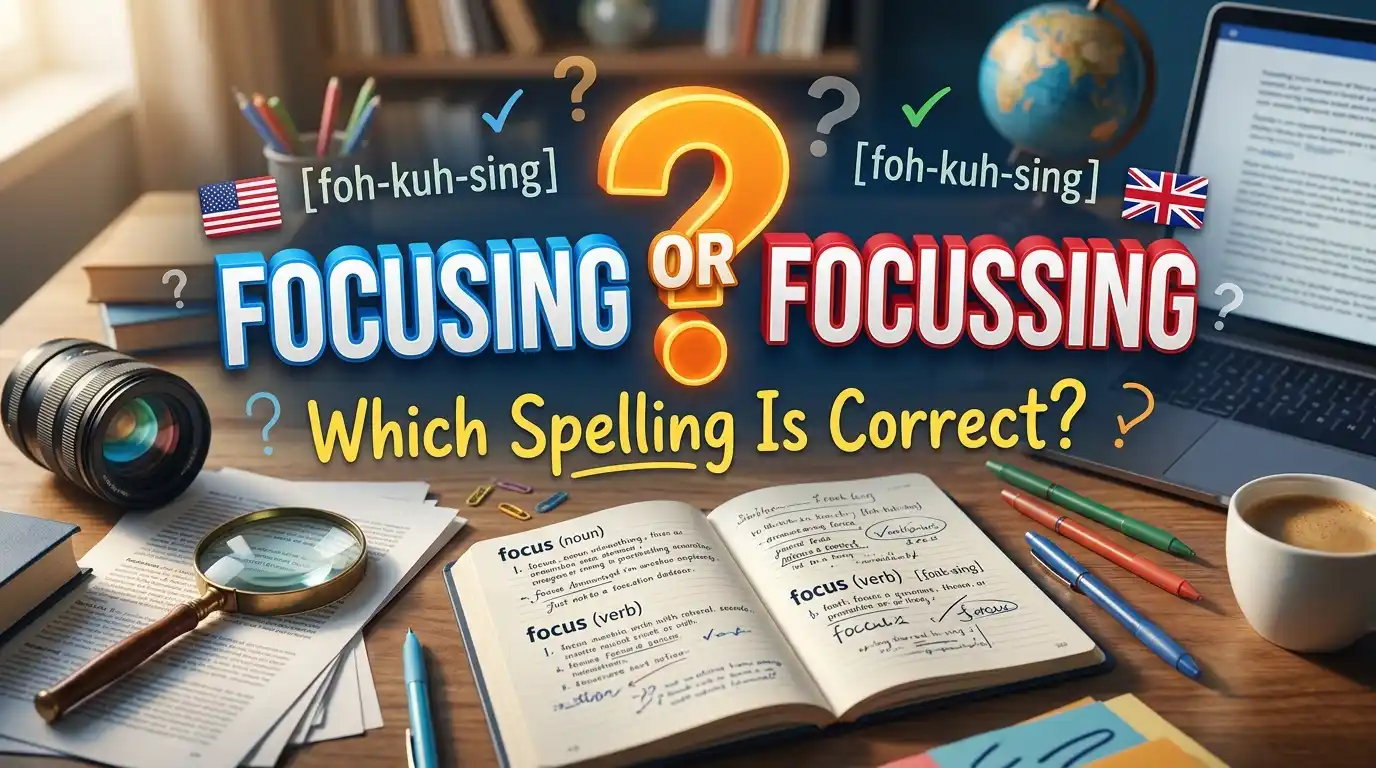
Both spellings are correct. “Focusing” is the standard spelling in American English, and it is the most common spelling worldwide. “Focussing” is an accepted variant in British English, but it is less common.
If you are unsure, use focusing. Major dictionaries accept it everywhere.
Here are simple examples:
- American English: She is focusing on her exams.
- British English: He is focusing on the match. (He is focussing on the match also works.)
- Past tense: focused (everywhere) or focussed (British variant).
- Noun: focus (the same in all countries).
The Origin of Focussing or Focusing
The word “focus” comes from Latin. In Latin, focus meant hearth, or fireplace. The hearth was the center of the home. It was where people gathered for warmth.
In the early 1600s, the scientist Johannes Kepler used the word for the point where light rays meet. English writers took it up soon after. Later, the word grew beyond science. It came to mean the center of attention.
The verb forms came later. People started to say “focus on the task,” and then they needed “focusing” and “focused.”
Why do two spellings exist?
The answer is a spelling rule. English often doubles a last letter before -ing or -ed. Think of run and running. But the rule has limits. When the stress is on the first syllable, we usually do not double the letter. The word “focus” is stressed on the first syllable (FO-cus). So the single S follows the rule: focusing.
So why does focussing exist? Some British writers doubled the S anyway. They did it to keep the S sound clear, much like bus and bussing. The habit stuck in British writing. American dictionaries stayed with the simple form. Over time, both spellings became part of the language.
British English vs American English Spelling
American English keeps things simple. It uses one S in every form: focus, focused, focusing.
British English is more relaxed. It accepts the single S, and it also allows the double S: focussed, focussing. Today, most British publishers and news sites use the single S too. The double S now looks a little old-fashioned to many readers.
The pattern is common in English. Look at other words ending in S:
- bias gives biased (US) and biased (UK variant).
- bus gives bused (US) and bussed (UK variant).
- benefit gives benefited (US) and benefitted (UK variant).
| Word form | American English | British English | Safe choice |
| Verb (base) | focus | focus | focus |
| Present participle | focusing | focusing or focussing | focusing |
| Past tense | focused | focused or focussed | focused |
| Third person | focuses | focuses or focusses | focuses |
| Noun (plural) | focuses or foci | focuses or foci | focuses |
The base word “focus” is the same everywhere. Only the endings change.
Which Spelling Should You Use?
Use focusing in almost every case. It is the safest pick. Here is the advice by audience:
- United States and Canada: Use focusing and focused. Style guides in these countries expect the single S.
- United Kingdom, Australia, New Zealand, India, Pakistan: Both forms are fine. Most editors prefer focusing. If your school, company, or publisher uses the double S, follow their style.
- Global audience: Use focusing. Readers everywhere know it, and no one will call it wrong.
- Exams and school papers: Follow your teacher’s guide. If there is none, use focusing.
- SEO and web writing: Use focusing. More people search and read it. If you want to catch both searches, use the other spelling once in a natural way.
The golden rule is to pick one spelling and stay with it. Do not switch between focusing and focussing in the same document.
Common Mistakes with Focussing or Focusing
| Mistake | Why it is wrong | Fix |
| Thinking “focussing” is always a typo | It is a real British variant | Use it only if your style guide allows it |
| Thinking “focusing” is only American | It is used worldwide | Use it freely in the UK too |
| Mixing both spellings in one text | It looks careless | Pick one and keep it |
| Writing “focuss” or “focusss” | Extra letters, no such word | Write “focus” |
| Writing “focusing” | Double C is wrong | One C: fo-cus-ing |
| Writing “focusing” for the plural noun | The plural is “focuses” or “foci” | Use “focuses” |
| Trusting spell check blindly | Tools follow one region | Set the right language, such as US or UK |
A quick check before you publish
- Choose US or UK style.
- Search your text for “focus.”
- Make every match the same.
- Run a spell check set to the right language.
Focussing or Focusing in Everyday Examples
See how the word works in real life. The examples below use the safe spelling, focusing.
- “I am focusing on the budget this week. I will reply by Friday.”
- “Thanks for your note. We are focusing on the launch plan first.”
News
- “The mayor is focusing on road repairs this year.”
- “The team is focusing on defense after last week’s loss.”
Social media
- “Phone off. Coffee on. Focusing on my goals today.”
- “Focusing on small wins. They add up.”
Formal writing
- “This report is focusing on three key risks.” (A shorter form is stronger: “This report focuses on three key risks.”)
- “The study is focusing on children aged six to ten.”
British style (double S is allowed)
- “She is focussing on her A-level revision.”
- “We have focussed our efforts on customer service.”
Both British sentences would also be correct with a single S.
Focussing or Focusing Google Trends and Usage Data
The exact numbers change over time, so this section gives the general pattern. These points are approximate and come from general knowledge of dictionaries and corpora, not a fresh Google Trends pull. To see live numbers, open Google Trends and compare the two terms by country and date range.
- Overall: “focusing” is far more common than “focussing” in books, news, and web pages.
- United States: “focussing” is rare. Most writers and editors treat it as a typo.
- United Kingdom and Ireland: “focussing” appears more often than in the US, but “focusing” still leads in modern publishing.
- Australia, New Zealand, South Africa: Both appear. Single S is the main choice in news and business.
- India and Pakistan: Both appear, and writers often follow British habits. Single S is common in business, tech, and web content.
- Over time: The double S was more common in older British books. Single S has grown in recent decades, helped by the web, spell checkers, and global publishing.
- Search behavior: People often search “focussing or focusing” when they are unsure. That doubt is strongest among British English users and students writing for international readers.
Side-by-side comparison of the variations
| Variation | Region where used | Standing today | Example |
| focusing | US, UK, worldwide | Standard and most common | She is focusing on work. |
| focussing | UK and Commonwealth | Accepted variant, less common | He is focussing on work. |
| focused | US, UK, worldwide | Standard and most common | They focused on sales. |
| focussed | UK and Commonwealth | Accepted variant, less common | They focussed on sales. |
| focuses | US, UK, worldwide | Standard | It focuses on quality. |
| focusses | UK and Commonwealth | Rare variant | It focusses on quality. |
| focusing | None | Misspelling | Avoid |
FAQs
1. Is it focussing or focusing?
Both are correct. “Focusing” is the standard and most common spelling. “Focussing” is a British variant.
2. Is “focussing” a spelling mistake?
Not in British English. Dictionaries list it as an accepted variant. In American English, most editors will mark it as an error.
3. Which spelling is better for school or exams?
Use “focusing” unless your teacher or exam board says otherwise. It is accepted in every country.
4. Is “focused” or “focussed” correct?
Both are correct. “Focused” is the standard form. “Focussed” is the British variant.
5. Why does the word have two spellings?
English often doubles a last consonant before -ing or -ed. The word “focus” is stressed on its first syllable, so the rule says no doubling. Some British writers doubled the S anyway, and the habit stayed.
6. What is the plural of “focus”?
The plural is “focuses” or “foci.” In everyday writing, “focuses” is easier and more common.
7. Should I use “focusing” on my website for SEO?
Yes, in most cases. It matches more searches and more readers. Keep one spelling across the whole site.
8. Does spell check mark “focussing” wrong?
It depends on the language setting. US English settings often flag it. UK, Australian, and Indian English settings usually accept it.
Conclusion
So, is it focussing or focusing? Both are correct, but one is the smarter pick. “Focusing” is the standard spelling in the United States, and it is the most common choice around the world. “Focussing” is an accepted British variant. You will meet it in older books and in some UK, Commonwealth, and South Asian writing.
Here are the key points to remember:
- Both spellings are real words. Neither is a typo in British English.
- “Focusing” and “focused” are safe in every country.
- “Focussing” and “focussed” are British variants, and they are less common today.
- The double S exists because some writers doubled the letter against the usual rule.
- Never mix both spellings in one document.
- Set your spell check to US or UK to match your readers.
If you write for a global audience, use “focusing.” If your school, boss, or publisher has a style guide, follow it. When in doubt, choose the single S, keep it consistent, and write with confidence.

Sikandar Hayat is the author and creator of Journalneste.com, a website dedicated to heartfelt wishes, messages, greetings, and inspiring words for every special moment. With a passion for meaningful writing, Sikandar creates warm and thoughtful content that helps readers express their feelings with ease. His goal is to provide beautiful, shareable words for birthdays, celebrations, relationships, and memorable occasions.