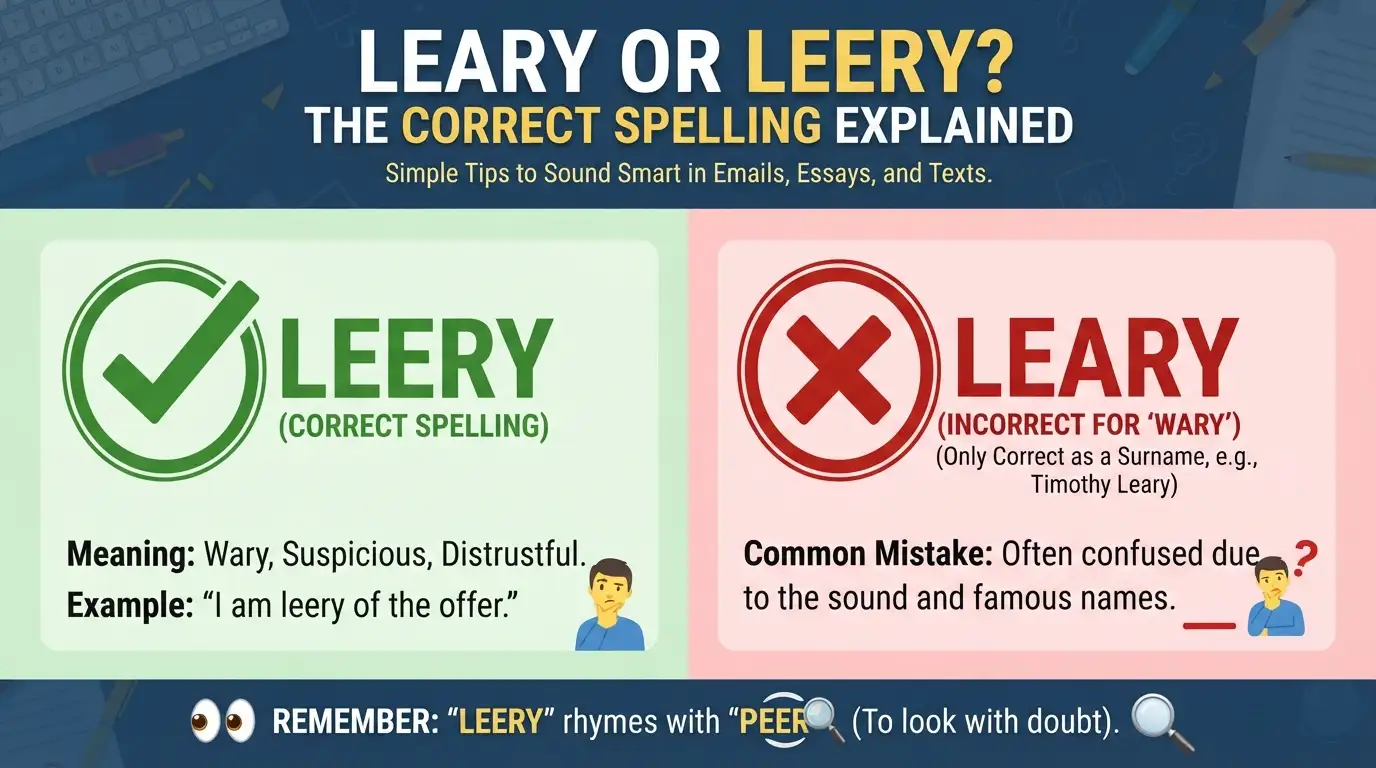
You are typing a sentence. You want to say you do not trust something. Then you stop. Is it “leary” or “leery”?
You are not alone. Many people ask this every month, because both spellings look right. They sound the same too. Say them out loud and you hear no difference.
People search “leary or leery” for one reason. They want a fast, safe answer before they hit send. Maybe it is an email to a boss. Maybe it is a school essay or a blog post. One wrong spelling can make a good message look careless.
This article clears up the confusion. You will get the short answer first. Then you will learn where the word comes from, why people mix it up, and how it is used in the US and UK. You will also see real examples, common mistakes, and a simple table. At the end, you will find seven quick FAQs.
Here is the good news. The answer is easy. Let’s get to it.
Leary or Leery Quick Answer
“Leery” is the correct spelling. It is an adjective. It means careful, wary, or not sure you can trust something.
“Leary” is a mistake when you mean “wary.” It is not a standard English word. The only time you see “Leary” is as a last name, like Timothy Leary or Denis Leary. Names keep their own spelling.
Right:
- I am leery of strange emails.
- She felt leery about the deal.
- He was leery of the old bridge.
Wrong:
- I am leery of strange emails.
- She felt leary about the deal.
Tip: leery has “eer” in the middle. Think of someone who peers at you with doubt. Leery. Peer. Same sound, same “eer.”
The Origin of Leery
“Leery” comes from the word “leer.” To leer is to look at someone from the side, often in a sly or unfriendly way. Think of a sideways glance.
“Leer” is very old. Its roots go back to an Old English word for the cheek or the face. Over time, the word came to mean a certain kind of look. That look was not warm. It was watchful.
Later, people made the adjective “leery.” In its early days, it was a slang word. Over time, the meaning settled on “wary” or “suspicious.” That is how we use it now. If you look at something sideways, you probably do not trust it yet.
Why do people write “leary”? There are three simple reasons.
- The sound. English has many ways to spell the same sound. “Ee,” “ea,” and “ie” can all sound alike.
- The name. Many people know the surname Leary. Their eyes remember that spelling.
- Rare word. We do not write “leery” often. So we do not see it often. Spelling sticks when we see a word a lot.
British English vs American English Spelling
Here is something that may surprise you. There is no British vs American split here. Both use “leery.” Neither accepts “leary” as a spelling of this word.
Many word pairs do differ, like “color” and “colour.” This one does not. So you do not need to switch spelling based on where your reader lives.
One small difference: “leery” feels more common in American writing. British writers often pick words like “wary” or “cautious” instead. Both are fine. But the spelling of “leery” stays the same.
| Word | American English | British English | Correct? |
| Leery | Yes | Yes | ✅ Correct everywhere |
| Leary | No (only as a surname) | No (only as a surname) | ❌ Wrong for “wary” |
| Color / Colour | color | colour | Differs by region |
| Gray / Grey | gray | grey | Differs by region |
| Center / Centre | center | centre | Differs by region |
So “leary or leery” is not like “color or colour.” It is a plain spelling error, not a regional choice.
Which Spelling Should You Use?
Use “leery”. Always. Here is the advice from the audience.
- US readers: Use “leery.” It is a common, natural word here.
- UK and Commonwealth readers: Use “leery.” It is correct. If you want a more familiar word, try “wary” or “cautious.”
- Global readers: Use “leery,” or pick “wary” if your readers may be new to English. Simple words travel well.
- Formal writing: “Leery” is fine in reports and essays. “Wary” sounds a little more formal.
- Casual writing: “Leery” fits emails, blogs, and social posts.
Writing a person’s name? Check how they spell it. Timothy Leary is “Leary.” That is his name, not a mistake.
Common Mistakes with Leery
Mistake 1: Spelling it “leary.”
- ❌ I am leary of that offer.
- ✅ I am leery of that offer.
Mistake 2: Mixing it up with “weary.” “Weary” means tired. “Leery” means wary. They look alike but mean different things.
- ❌ I am weary of online strangers. (This says you are tired of them.)
- ✅ I am leery of online strangers. (This says you do not trust them.)
Mistake 3: Using the wrong small word after it. We usually say “leery of” or “leery about.” Not “leery to.”
- ❌ She is leery to trust him.
- ✅ She is leery of trusting him.
Mistake 4: Changing a person’s name.
- ❌ Timothy Leery
- ✅ Timothy Leary
Mistake 5: Trusting spell check. “Leary” may not always get flagged, because it is a real name. Do not count on your software. Check it yourself.
Leery in Everyday Examples
In an email:
I am a bit leery of the new deadline. Can we talk about it?
In a news headline or story:
Investors stay leery as prices swing up and down.
On social media:
Leery of any deal that sounds too good to be true. 👀
In formal writing:
Many voters remain leery of the new plan until more facts are shared.
In a text to a friend:
I’m leery about that restaurant. The reviews are weird.
In a school essay:
The villagers were leery of the stranger who arrived at night.
Notice the pattern. “Leery” often shows up with “of” or “about.” It also works well with words like “remain,” “stay,” “feel,” and “grow.”
Leery Google Trends & Usage Data
I could not pull live Google Trends numbers for this article. So here is what is generally true, plus how to check it yourself.
What usually holds:
- “Leery” is used more in American English than in British English.
- People in the US also tend to search for spelling help on this word more often.
- Searches often rise during news about money, health, or politics. These are times when people feel unsure.
- Many searches are really spelling checks. People type “leary or leery” to be sure.
How to check for yourself:
- Go to Google Trends.
- Type “leery” and add “leary” to compare.
- Set the region to the United States, the United Kingdom, or Worldwide.
- Change the time range to the last five years.
You will likely see “leery” win by a wide margin. Part of the “leary” interest comes from people looking up the surname or from people unsure of the spelling.
| Variation | Meaning | Typical use |
| Leery | Wary, suspicious | Everyday and formal writing |
| Leary | A surname | Names only |
| Leer | To look sideways, or a sly look | Verb and noun |
| Leering | Looking in a sly or unfriendly way | Adjective or verb form |
| Leeriness | The state of being wary | Noun, less common |
| Weary | Tired | Everyday writing |
FAQs About Leary or Leery
1. Is it leary or leery? It is “leery.” “Leary” is a wrong spelling for this word.
2. What does leery mean? It means careful, wary, or not sure you can trust something or someone.
3. Is leary ever correct? Yes, but only as a surname, like Timothy Leary or Denis Leary. It is not a word for “wary.”
4. Is it British or American? Both. The spelling is the same in the US, the UK, and other English-speaking places. It is a bit more common in American English.
5. What is the difference between leery and weary? “Leery” means wary or distrustful. “Weary” means tired. They sound close but mean different things.
6. What word goes after leery? Use “of” or “about.” For example: “I am leery of that link.” Or: “I am leery about the plan.”
7. What can I use instead of leery? Try “wary,” “cautious,” “suspicious,” “doubtful,” or “careful.”
8. How can I remember the spelling? Think of someone who peers at you with doubt. Leery has “eer,” just like peers.
Conclusion
The answer is simple. “Leery” is the right spelling. It means wary or unsure. “Leary” is not a word for that meaning. It is a surname, and it should stay that way.
Let’s recap the key points. “Leery” grew from the word “leer,” which means a sideways look. That is why it fits so well with doubt. People mix up the spelling because the sounds match and because the name Leary is well known. There is no British vs American split. Both sides write “leery.”
For daily use, keep these tips close:
- Spell it leery, with “eer.”
- Use “of” or “about” after it.
- Do not confuse it with “weary,” which means tired.
- Keep “Leary” for people’s names only.
- Pick “wary” if you want a simpler or more formal word.
Remember the little trick: peer and leery share the same “eer.” If you peer at something with doubt, you are leery of it.
Now you can write with confidence. Send that email. Post that update. Hand in that essay. Your spelling is safe.

Sikandar Hayat is the author and creator of Journalneste.com, a website dedicated to heartfelt wishes, messages, greetings, and inspiring words for every special moment. With a passion for meaningful writing, Sikandar creates warm and thoughtful content that helps readers express their feelings with ease. His goal is to provide beautiful, shareable words for birthdays, celebrations, relationships, and memorable occasions.