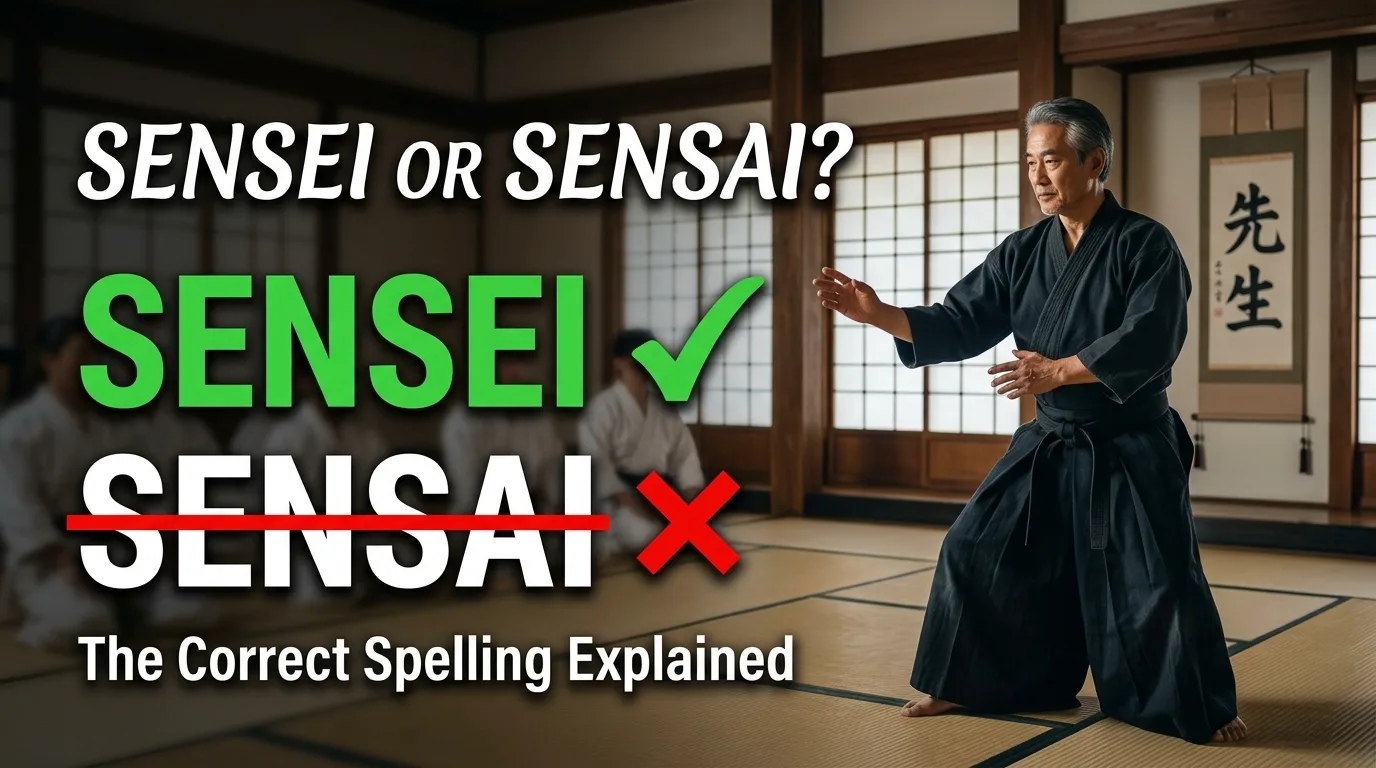
You hear the word in karate movies. You see it in anime and in Japanese class. Then you sit down to write it, and you freeze. Is it sensei or sensai?
You are not alone. Many people search this question every month. The word sounds like “sen-say,” but English spelling makes “ai” look natural. So many people type sensai by mistake.
This guide ends the confusion. You will get the quick answer first. Then you will learn where the word comes from, why people mix up the spelling, and how to use it the right way. We will also look at British and American English, because many people ask if the spelling changes between the two.
Spoiler: it does not. There is one correct spelling. By the end, you will know it, understand it, and be able to explain it to anyone who asks.
Let’s start with the answer.
Sensei or Sensai Quick Answer
The correct spelling is sensei. Sensai is a misspelling.
Sensei is a Japanese word. It means “teacher” or “master.” It is pronounced “sen-say.”
Here are some examples:
- “My karate sensei taught me to bow.”
- “Tanaka-sensei is our Japanese teacher.”
- “She is a sensei in the art of calligraphy.”
Remember it this way: the end of sensei sounds like “say,” and “ei” makes that sound in Japanese.
The Origin of Sensei
Sensei comes from Japanese. It is written 先生 in Japanese characters.
The word has two parts:
- Sen (先) means “before” or “earlier.”
- Sei (生) means “born” or “life.”
Together, they mean “one born before.” In other words, a person who has gone down the road ahead of you. That is why the word shows respect.
Why do spelling differences exist? Japanese does not use the Latin alphabet. To write Japanese in English letters, people use a system called romanization. The most common one is Hepburn romanization. It writes 先生 as sensei.
In Japanese, the “ei” sound is close to the English “ay.” But English readers see the letters “ei” and often guess a different sound. Some then swap in “ai” because it looks familiar. This is how sensai was born. It is a guess, not a real alternative spelling.
British English vs American English Spelling
Many people think sensei or sensai is a British vs American question. It is not.
British and American English differ in words like color and colour. But sensei is a loan word from Japanese. Both the US and the UK borrow it with the same spelling.
| Feature | American English | British English |
| Correct spelling | sensei | sensei |
| Spelling “sensai” | Incorrect | Incorrect |
| Pronunciation | sen-say | sen-say |
| Plural | sensei or senseis | sensei or senseis |
| Used for | Teachers, martial arts coaches | Teachers, martial arts coaches |
The spelling is the same in Canada, Australia, India, and everywhere else English is used.
Which Spelling Should You Use?
Use sensei. The answer is the same for every audience.
- US readers: Sensei. Sensai will look like a typo.
- UK and Commonwealth readers: Sensei. There is no local variant.
- Global audiences: Sensei. It matches Japanese and every major dictionary.
- Formal or professional writing: Sensei. A typo can hurt your credibility.
- Japanese learners: Sensei. It is also the spelling in most textbooks.
Some writers use a macron, as in sensē, in academic work. This is rare. For almost everyone, plain “sensei” is right.
Common Mistakes with Sensei
Mistake 1: Writing “sensai.”
Fix: Use sensei.
Mistake 2: Writing “sensay.”
This follows the sound, but it is not the standard spelling. Fix: Use sensei.
Mistake 3: Pronouncing it “sen-sigh.”
Fix: Say “sen-say.”
Mistake 4: Adding the title wrong.
In Japanese, sensei goes after the name: Tanaka-sensei. Do not write “Sensei Tanaka” in Japanese-style writing. In English martial arts, “Sensei Tanaka” is common, so it depends on your setting.
Mistake 5: Using “senseis” in a Japanese context.
Japanese has no plural form. In English, both “sensei” and “senseis” are accepted. Pick one and stay consistent.
Mistake 6: Using it for yourself.
In Japanese culture, it is polite not to call yourself sensei. It is a title others give you.
Sensei in Everyday Examples
Email:
“Dear Yamada-sensei, thank you for your class last week.”
News:
“The judo sensei trained more than 300 students over 20 years.”
Social media:
“Shoutout to my sensei for today’s belt test! #karate #sensei”
Formal writing:
“The term sensei is used in Japan for teachers, doctors, and other respected experts.”
Casual conversation:
“My coding mentor is basically my sensei.”
In Japan, sensei is also used for doctors, lawyers, and politicians. In English, people often use it for teachers and martial arts coaches. Some also use it playfully for any expert.
Sensei Google Trends and Usage Data
I can’t pull live numbers here, so I won’t invent any. You can check them yourself at trends.google.com. Here is what to look for and what usually shows up.
By country: Interest tends to be strong in English-speaking countries with many martial arts schools and anime fans, such as the US, the UK, Canada, and Australia. It is also strong in countries with big Japanese-learning communities.
By context:
- Martial arts (karate, judo, aikido)
- Anime and manga
- Japanese language study
- TV and film, such as karate shows and movies
What to expect: Searches for “sensei” are far more common than searches for “sensai.” The “sensai” searches mostly come from people checking if they spelled it right. That is the exact question this article answers.
Tip: Compare “sensei” and “sensai” in Google Trends. Set the date range to the past five years and filter by country.
Comparison Table: Spelling Variations
| Variation | Correct? | Notes |
| sensei | ✅ Yes | Standard spelling in all English |
| Sensei (capital S) | ✅ Yes | Use as a title or at the start of a sentence |
| -sensei (after a name) | ✅ Yes | Example: Tanaka-sensei |
| sensai | ❌ No | Common misspelling |
| sensay | ❌ No | Follows the sound, not the standard |
| sensē | ⚠️ Rare | Academic use only |
FAQs
1. Is it sensei or sensai?
It is sensei. Sensei is a misspelling.
2. How do you pronounce sensei?
Say “sen-say.” The first part rhymes with “pen,” and the last part rhymes with “day.”
3. What does sensei mean?
It means “teacher” or “master.” Literally, it means “one born before.”
4. Is sensory ever correct?
No. It has no meaning in Japanese and is not in major dictionaries.
5. Is sensei spelled differently in the UK and the US?
No. Both use sensei.
6. What is the plural of sensei?
In Japanese, the word does not change. In English, “sensei” and “senseis” are both used.
7. Should I capitalize sensei?
Yes, when it is a title before or after a name, such as “Sensei Lee” or “Lee-sensei.” Use lowercase when it is a general noun, as in “my sensei.”
8. Can I call someone sensei if they are not Japanese?
Yes, in martial arts and many other settings. Just be respectful, and follow the customs of the school or group.
Conclusion
The question was simple: sensei or sensai? The answer is just as simple. Sensei is correct. Sensai is a common mistake.
Here are the key points to remember:
- Sensei comes from Japanese. It means “one born before,” or a teacher.
- It is pronounced “sen-say.”
- There is no British or American difference. The spelling is the same everywhere.
- Sensai happens because English readers expect “ai” to look right. It is a guess, not a variant.
- Use sensei in emails, news, social media, and formal writing.
If you write for a global audience, plain “sensei” is always safe. If you write about Japanese culture, remember the small details. Put “-sensei” after a name, and treat it as a title of respect.
Now you know the right spelling and the reason behind it. Next time you type the word, you won’t freeze. And if someone asks you, you can explain it in one sentence: “It’s sensei, with an e, because it sounds like ‘say.'”

Sikandar Hayat is the author and creator of Journalneste.com, a website dedicated to heartfelt wishes, messages, greetings, and inspiring words for every special moment. With a passion for meaningful writing, Sikandar creates warm and thoughtful content that helps readers express their feelings with ease. His goal is to provide beautiful, shareable words for birthdays, celebrations, relationships, and memorable occasions.