You are typing a message. You want to say something gave you chills. Then you stop. Is it scarey or scary?
Many people pause at this word. You are not alone. People search this question every year, and the searches rise each fall as Halloween gets close.
Why the doubt? The word comes from “scare.” And “scare” ends in an e. So it feels natural to keep that e. That is how “scarey” sneaks in. It looks right, but it is not standard English.
This guide gives you the answer fast. Then it explains the history, the spelling rules, and the common mistakes. You will see real examples from emails, news, and social media. You will also get clear advice for US, UK, and global readers.
Spelling errors can hurt trust. A small typo in a work email or a blog post can look careless. So it pays to get this one right. Let’s start with the short answer.
Scarey or Scary Quick Answer
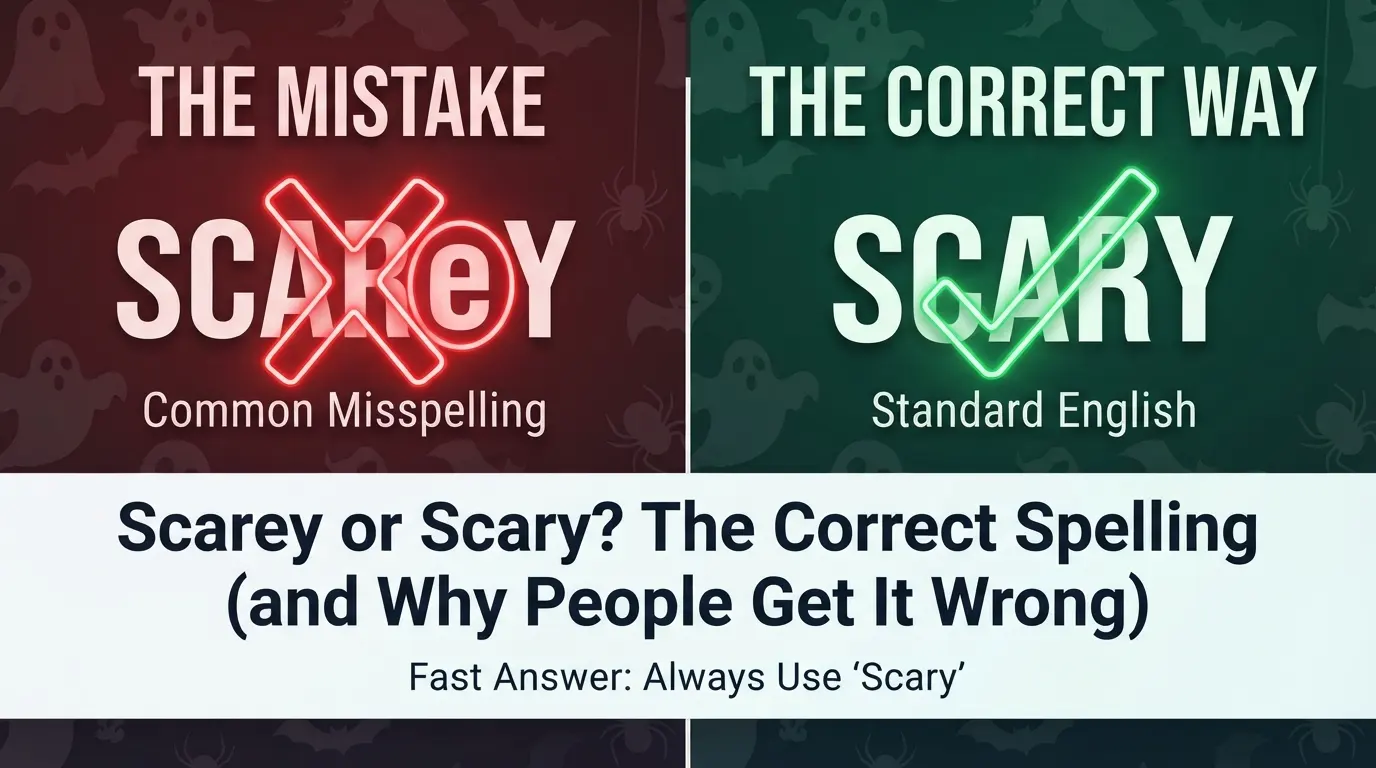
“Scary” is the correct spelling. Use it everywhere. It is correct in American English. This is correct in British English. It is correct in Canada, Australia, and India.
“Scarey” is a misspelling. Dictionaries do not list it as standard.
Here are examples:
- ✅ The movie was scary.
- ✅ That dog looks scary.
- ❌ The movie was scarey.
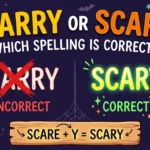
Easy rule: drop the e from “scare,” then add y. Scare becomes scary.
The Origin of Scary
The word “scare” is old. It came into English in the Middle Ages. It grew from an Old Norse word that meant to frighten or to shy away. Over time, English speakers shaped it into “scare.”
Then people added -y to make an adjective. An adjective describes a thing. “Scary” describes something that scares you. This form has been in English since the 1500s.
So why does “scarey” exist? There are three reasons:
- Silent confusion. People see “scare” and want to keep the e.
- Sound. English has no strict link between sound and spelling. Both spellings sound the same: SKAIR-ee.
- Mixed-up patterns. Some words do keep the e before -y, such as “dicey” and “gluey.” People guess “scarey” fits that group.
But “scary” follows the main rule. Most words drop the silent e before -y.
- shade → shady
- bone → bony
- noise → noisy
- scare → scary
British English vs American English Spelling
Here is the good news. There is no US vs UK split for this word. Both use “scary.” Many other words do differ between the two, but this is not one of them.
| Word | American English | British English |
| Frightening | scary | scary |
| More frightening | scarier | scarier |
| Most frightening | scariest | scariest |
| Color | color | colour |
| Favorite | favorite | favourite |
| Theater | theater | theatre |
| Organize | organize | organise (or organize) |
Notice the pattern. Many US and UK differences follow set rules, like -or vs -our. But “scary” has no such rule. It is the same on both sides of the ocean.
“Scarey” is not a British spelling. It is not an American one either. It is just a mistake.
Which Spelling Should You Use?
The answer is simple: always use “scary.”
- US readers: Use “scary.”
- UK, Canada, Australia, and Commonwealth readers: Use “scary.”
- Global or mixed audience: Use “scary.”
There is one small exception. You may see “Scarey” in a brand name, a username, or a title. A writer may pick it on purpose to look playful. Only copy it when you are writing that exact name.
For everything else, choose “scary.” Your emails, school work, blogs, ads, and reports will all look professional.
Common Mistakes with Scary
Here are the most frequent errors and how to fix them.
| Mistake | Correct | Tip |
| scarey | scary | Drop the e from “scare.” |
| scarry | scary | One r only. |
| scarie | scary | End with y, not ie. |
| scareyer | scarier | Change y to i, then add -er. |
| scareyest | scariest | Change y to i, then add -est. |
| scarily (as “scarey-ly”) | scarily | Change y to i, then add -ly. |
| scary vs. scared | depends | See below. |
Scary vs. scared is a different mix-up. The two words mean different things.
- Scary describes the thing that frightens you. The ghost is scary.
- Scared describes how you feel. I am scared.
Wrong: I am very scary of spiders.
Right: I am very scared of spiders. Or: Spiders are very scary.
Scary in Everyday Examples
In an email:
“The deadline is tomorrow. It feels a little scary, but we can do it.”
In a news headline:
“Scary Moment as Storm Hits the Coast”
On social media:
“Just watched the new horror film. So scary! I can’t sleep. 😱”
In formal writing:
“Many children find the dark scary. Parents can help by using a night light.”
In a school essay:
“The scariest part of the book is the final chapter.”
In a product review:
“The ride was not as scary as I thought.”
Notice that every example uses the same spelling. The tone changes, but the spelling does not.
Scary Google Trends & Usage Data
I cannot pull live Google Trends numbers here. So I will describe the patterns that are well known. You can confirm them yourself at trends.google.com by comparing “scary” and “scarey.”
What you will usually see:
- “Scary” is far more popular than “scarey.” This holds in every English-speaking country. Writers use “scary” in books, news, and websites.
- Searches for the “scarey or scary” question are small but steady. They come from people who want to check their spelling.
- Interest rises every autumn. Halloween drives more searches for scary movies, scary stories, and scary costumes. The spelling question rises with them.
- The US, UK, Canada, Australia, and India are main sources. These are large English-speaking markets.
- Context matters. People search the spelling most when they write for school, work, or social media posts.
What this tells us: most people already know the answer. The ones who search are being careful. That is a good habit.
Spelling variations compared:
| Variation | Correct? | Used in Standard English? | Note |
| scary | ✅ Yes | Yes | The standard spelling worldwide |
| scarey | ❌ No | No | Common typo; avoid |
| scarry | ❌ No | No | Extra r; avoid |
| scarie | ❌ No | No | Wrong ending |
| scarier | ✅ Yes | Yes | Comparative form |
| scariest | ✅ Yes | Yes | Superlative form |
| scared | ✅ Yes | Yes | A different word; means “afraid” |
FAQs
1. Is it “scarey” or “scary”?
It is “scary.” “Scarey” is a misspelling.
2. Is “scarey” ever correct?
Not in standard English. You might see it in a brand name or a username. Do not use it in regular writing.
3. Is “scary” spelled differently in the UK and the US?
No. Both use “scary.” Many other words differ, but not this one.
4. Why do people write “scarey”?
They think of the word “scare.” They want to keep silent e. But the rule says to drop it before -y.
5. What is the comparative form of “scary”?
It is “scarier.” The superlative is “scariest.” Change the y to i first.
6. What is the difference between “scary” and “scared”?
“Scary” describes what frightens you. “Scared” describes how you feel. The movie is scary. I am scared.
7. Will spell check catch “scarey”?
Usually yes. Most tools underline it in red. But do not rely on a tool alone. Learn the rule.
8. Is “scarey” a word in any dictionary?
Major dictionaries list “scary” as the standard entry. Treat “scarey” as an error.
Conclusion
Let’s sum it up. The question was “scarey or scary?” The answer is scary. That is true in the US, the UK, and everywhere else English is used.
Here are the key points to remember:
- Drop the silent e from “scare.” Then add y.
- “Scarey” is a common mistake. It is not standard.
- There is no British vs American split for this word.
- Use “scarier” and “scariest” for comparisons.
- Do not mix up “scary” and “scared.” One describes the thing. The other describes the feeling.
When you are unsure, use the pattern words. Shade becomes shady. Bone becomes bony. Scare becomes scary. A simple rule beats a long list.
Good spelling builds trust. Readers notice small errors, and they notice when you get them right. Now you know the answer, the reason, and the rule. Use “scary” in your next email, post, or story, and write with confidence.

Sikandar Hayat is the author and creator of Journalneste.com, a website dedicated to heartfelt wishes, messages, greetings, and inspiring words for every special moment. With a passion for meaningful writing, Sikandar creates warm and thoughtful content that helps readers express their feelings with ease. His goal is to provide beautiful, shareable words for birthdays, celebrations, relationships, and memorable occasions.