You are about to send a text. You stop. Is it tough or tuff? Many people ask this every day. The words sound the same. The spelling is not the same.
People search for this keyword for three reasons. Some saw “stuff” on social media and wondered if it was real. Some write for school or work and want to be right. Others hear the slang and want to know what it means.
Here is the short truth. “Tough” is the correct spelling for strong, hard, or difficult. “Tuff” is a real word too, but it names a type of rock. Online, people also use “tuff” as slang or a playful spelling.
This guide clears up the confusion. You will learn the quick answer and where each word comes from. You will see common mistakes, real examples, and a clear table. If you want a fast answer, read the first section. If you want the full story, keep going. By the end, you will know which spelling to pick and when.
Tough or Tuff Quick Answer
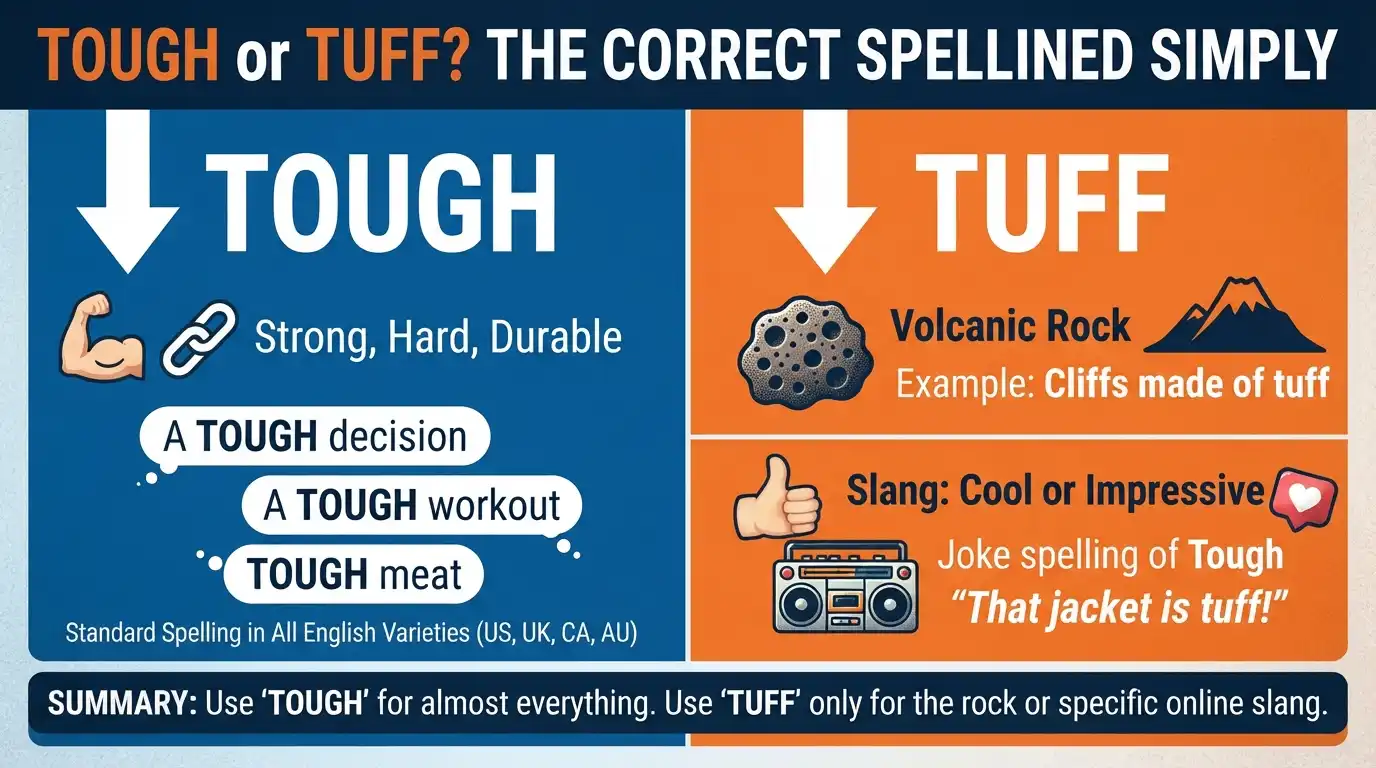
Use “tough.” It is the standard spelling in American, British, Canadian, and Australian English.
“Tough” means:
- Strong and hard to break: a tough boot
- Hard to do: a tough test
- Brave and strong: a tough player
- Hard to chew: tough meat
“Tuff” has two uses:
- A rock. Tuff is rock made from volcanic ash. The old wall is made of tuff.
- Slang. Online, “tuff” can mean cool or impressive. That jacket is tuff. Some people also use it as a joke spelling of “tough.”
If you are not sure, write “tough.” You will never be wrong.
The Origin of Tough and Tuff
Where “tough” comes from. The word is very old. It comes from Old English, where it was spelled tōh. It meant sticky and hard to pull apart. Long ago, the “gh” in the word made a rough sound in the throat, like the “ch” in the Scottish word loch. Over time, English speakers changed that sound to an “f.” The sound changed, but the spelling stayed the same.
That is why “tough” looks odd. The spelling shows the old sound. The mouth moved on.
Where “stuff” comes from. This word came into English from French and Italian. Those words come from Latin. People used it to name a soft rock made from volcanic ash. Builders in Italy used it for centuries.
Why does the spelling difference exist? Two words with different roots ended up with the same sound. English has many words like this. The spelling tells you which word you mean. “Tuff” also shows up in names, such as music labels and brands, because it looks bold and short.
British English vs American English Spelling
Here is the key point. There is no British or American difference for this word. Both use “tough.” Neither treats “tuff” as a regional spelling of it.
Many people think “tuff” is a simple spelling, like “color” for “colour.” It is not. Those pairs follow rules. This one does not.
| Word | American English | British English | Notes |
| Strong or hard (adjective) | tough | tough | Same in both |
| Volcanic rock | tuff | tuff | Same in both |
| Slang or joke spelling | tuff | tuff | Informal only |
| Color / Colour | color | colour | Real US/UK difference |
| Center / Centre | center | centre | Real US/UK difference |
Other “-ough” words trip people up too. Look at how they sound: tough, though, through, cough, bough. Same letters, different sounds. That is why spelling “tough” feels hard.
Which Spelling Should You Use?
If you write for a US audience: Use “tough.” Use “tuff” only for the rock or in casual slang.
If you write for a UK or Commonwealth audience: Use “tough.” The rule is the same.
If you write for a global audience: Use “tough.” It is the form every reader and every spell checker knows.
By type of writing:
- School, work, news, and legal writing: “tough” only.
- Texts and social media with friends: “tuff” is fine as slang, if you know your readers will get it.
- Geology or building: “tuff” for the rock.
- Brand names: Use the spelling the brand uses.
Simple rule: if it is not about rock and not slang, write “tough.”
Common Mistakes with Tough or Tuff
1: Using “tuff” in formal writing.
- Wrong: It was a tuff decision.
- Right: It was a tough decision.
2: Thinking “tuff” is British.
- It is not. Both US and UK writers use “tough.”
3: Mixing up “tough” with “though” or “thought.”
- Wrong: It was a tough choice.
- Right: It was a tough choice.
4: Spelling it “tuf” or “tuph.”
- Neither is correct. Use “tough.”
5: Using “tuff” for the rock with the wrong word.
- The rock is spelled “tuff,” not “tough.” The cave is cut into tuff.
6: Trusting the sound.
- The sound “tuf” is right. The spelling is not. Learn the word by sight.
Tough or Tuff in Everyday Examples
Email:
- Thank you for your patience. It has been a tough week for our team.
- We know this is a tough time to change plans.
News:
- The mayor faces a tough vote on the new budget.
- Workers say the job is tough but fair.
Social media:
- That new song is tuff. (slang, means great)
- Tough day. Need coffee. (standard)
- Gym done. Legs are tuff right now. (playful spelling)
Formal writing:
- The company set tough rules for safety.
- The report describes a tough market for small shops.
Science and building:
- The cliffs are made of tuff, a rock from old volcanoes.
Tough or Tuff Google Trends & Usage Data
I could not pull live Trends data here, so these are general patterns. Check Google Trends to confirm them for your market.
- “Tough” is far more common. It is a daily word in books, news, and speech. “Tuff” is rare in comparison.
- “Tuff” rises in bursts. It tends to spike when a slang meme or trend goes viral, mostly on short-video and chat apps.
- Younger users drive the slang use. Most “tuff” searches about meaning come from people who saw it online.
- English-speaking countries lead. Expect most interest in the US, UK, Canada, Australia, and also countries with many English learners, such as India, Pakistan, and the Philippines.
- Searches split by intent. People search “tough” for definitions, synonyms, and phrases. They search “tuff” to ask what it means, or for the rock.
Variations side by side
| Term | Standard? | Meaning | Best use |
| tough | Yes | Strong, hard, difficult | All writing |
| tuff (rock) | Yes | Volcanic ash rock | Science, building |
| tuff (slang) | No | Cool, impressive, or joke spelling of tough | Casual chat |
| tuf | No | Not a real spelling | Avoid |
| tuph | No | Not a real spelling | Avoid |
FAQs
1. Is it tough or tuff?
Write “tough” for nearly every case. “Tuff” is only for rock or slang.
2. Is “tuff” a real word?
Yes. It is named after a rock made from volcanic ash. It is also used as slang online.
3. Is “tuff” British or American spelling?
Neither. It is not a regional form of “tough.” Both regions write “tough.”
4. What does “tuff” mean in slang?
Usually “cool” or “impressive.” Sometimes it is just a playful way to write “tough.”
5. Why is “tough” spelled with “gh”?
The “gh” once made a throat sound. The sound changed to “f,” but the spelling stayed.
6. Can I use “tuff” in a school essay?
Only if you mean the rock. For everything else, use “tough.”
7. How do I remember the right spelling?
Think: “Tough” has “ough” like “enough.” Both end with the “f” sound.
8. Does a spell checker accept “tuff”?
Often yes, because it is a real word. It will not warn you if you meant “tough.” Always check by meaning.
Conclusion
The answer is simple. Write “tough” when you mean strong, hard, or difficult. That covers almost every use. It is the correct spelling in the US, the UK, and all other English-speaking places. There is no regional trick to learn.
“Tuff” is not a typo in every case. It is a real word for a volcanic rock. It is also casual slang online. Use it for the rock in science or building. Use it as slang only with friends, and only when the tone is relaxed.
Remember the common mistakes. Do not use “tuff” in emails, news, or school work. Do not guess a spelling by sound alone. English hides old sounds inside its letters, and “tough” is a good example.
If you ever doubt yourself, pick “tough.” It is always safe. Clear writing builds trust, and the right spelling is a small part of that.
Now you know the answer, the history, and the rules. Next time you ask “tough or tuff?”, you will know what to type.

Sikandar Hayat is the author and creator of Journalneste.com, a website dedicated to heartfelt wishes, messages, greetings, and inspiring words for every special moment. With a passion for meaningful writing, Sikandar creates warm and thoughtful content that helps readers express their feelings with ease. His goal is to provide beautiful, shareable words for birthdays, celebrations, relationships, and memorable occasions.