You hold an ice cube. It melts. Is that chemical or physical? You burn a log. It turns to ash. Chemical or physical?
Millions of students, parents, and cooks search “chemical or physical” every year. It sounds easy. But it trips people up. Some changes look like both. Rust looks like peeling paint. Boiling water makes bubbles, so it looks like a reaction. It is not.
People search this phrase for homework, tests, and kitchen questions. Some also wonder if the words are spelled the same in British and American English. This guide clears up all of it.
You will get a quick answer first. Then you will learn where the words come from, how spelling works across regions, and which mistakes to avoid. You will also see real examples, usage trends, and answers to common questions.
By the end, you will tell a chemical change from a physical one in seconds. You will also write both words with confidence.
Chemical or Physical Quick Answer
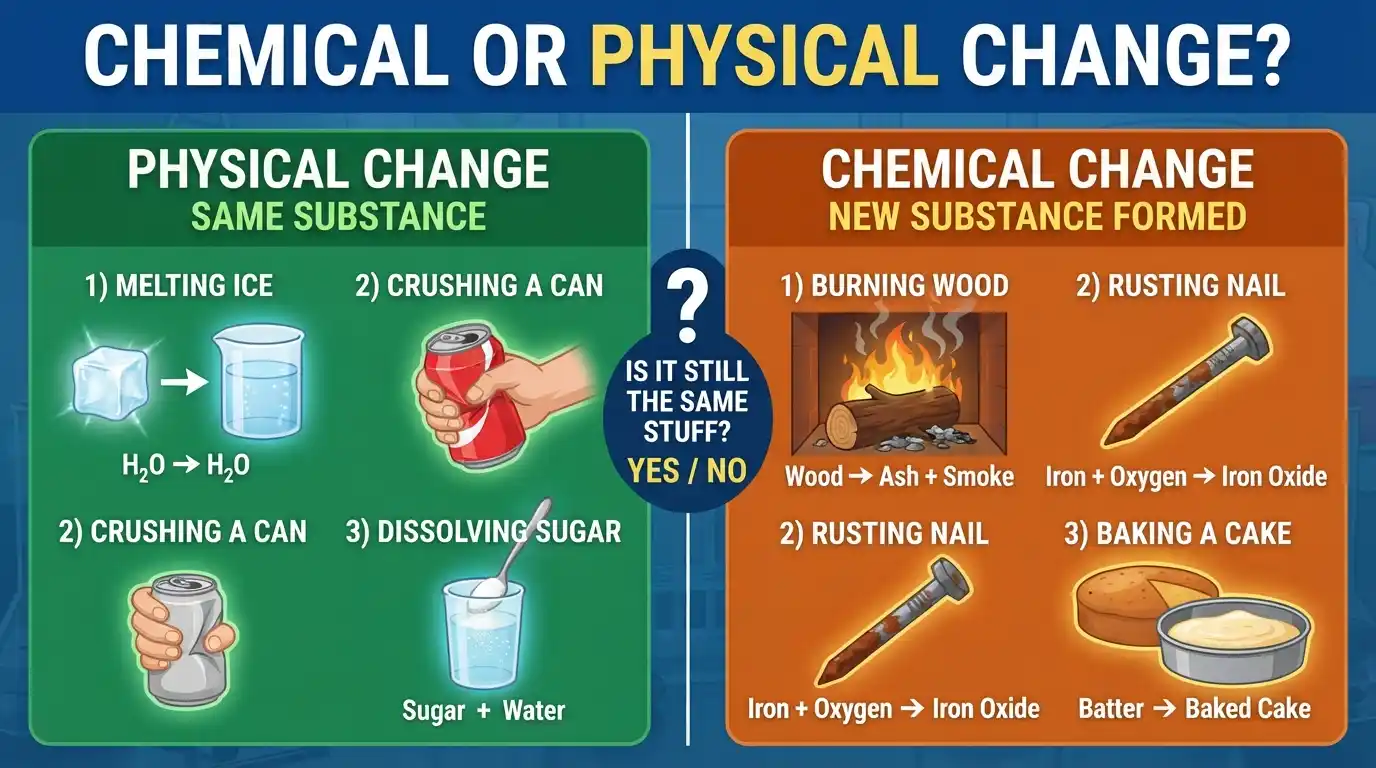
A physical change alters how something looks or feels. The substance stays the same.
A chemical change makes a new substance.
Ask one question: Is it still the same stuff?
- Yes → physical
- No → chemical
Physical examples: melting ice, cutting paper, crushing a can, dissolving sugar in water, boiling water.
Chemical examples: burning wood, rusting iron, baking a cake, milk going sour, an egg cooking.
Signs of a chemical change: new color, new smell, gas bubbles, heat or light, a solid forming in a liquid. Be careful. Some physical changes also show a color shift or bubbles, so use the “same stuff” test as the final check.
The Origin of “Chemical” and “Physical”
Chemical comes from the word chemistry. That word grew from alchemy, the old practice of trying to turn metals into gold. Alchemy came from Arabic (al-kimiya) and may trace back to Greek or Egyptian roots. Over time, “alchemist” became “chemist.”
Physical comes from the Greek word physis, meaning “nature.” Latin turned it into physicus. Early “physics” simply meant the study of nature.
So the two words describe two ways of studying matter:
- Chemical: what things are made of, and how they change into other things.
- Physical: what things are like, such as shape, size, and state.
Both words came into English hundreds of years ago. Their spelling has stayed very steady.
British English vs American English Spelling
Good news: “chemical” and “physical” are spelled the same in the US, UK, Canada, and Australia. No spelling trap here.
The confusion usually comes from other science words that do change. Students often mix these up when writing about chemical and physical changes.
| Word type | American English | British English |
| Element | sulfur | sulphur |
| Element | aluminum | aluminium |
| Property | color | colour |
| Property | odor | odour |
| Lab word | analyze | analyse |
| Lab word | center | centre |
| Lab word | liter | litre |
| Property | gray | grey |
| Our keyword | chemical | chemical |
| Our keyword | physical | physical |
Note: Modern UK science exams now often accept “sulfur” too, because international science bodies use that spelling.
Which Spelling Should You Use?
For “chemical” and “physical,” you never have to choose. For the related words, follow your reader.
- US audience: Use color, odor, sulfur, aluminum, analyze.
- UK and Commonwealth audience: Use colour, odour, sulphur (or sulfur), aluminium, analyse.
- Global audience: Pick one style and stay with it. Many science sites use American spelling because it is common worldwide.
The key rule is consistency. Do not write “color” in one line and “colour” in the next.
Common Mistakes with “Chemical or Physical”
Mistake 1: Thinking dissolving is chemical.
Sugar in water looks like it vanishes. But it is still sugar. You can get it back by letting the water dry. That is physical.
Mistake 2: Thinking boiling is chemical.
Boiling water becomes steam. Steam is still H₂O. Physical.
Mistake 3: Treating bubbles as proof.
Bubbles can mean a gas formed (chemical). They can also be boiling (physical). Check the substance.
Mistake 4: Mixing up “property” and “change.”
- A property describes something: “Iron is shiny.”
- A change is something that happens: “Iron rusts.”
Both can be chemical or physical.
Mistake 5: Thinking “chemical” means “dangerous.”
Water is a chemical. So is salt. In science, the word just means a type of matter.
Mistake 6: Thinking all color changes are chemical.
Heating metal can make it glow red. When it cools, it returns to normal. That can be physical.
“Chemical or Physical” in Everyday Examples
In an email (teacher to class):
“Please sort the items on the sheet. Mark each one chemical or physical.”
In a news headline:
“Wildfire Smoke Poses Both Chemical and Physical Risks to Residents.”
On social media:
“Toasting bread: chemical or physical? Chemical. New taste, new color, no going back. 🍞”
In formal writing (lab report):
“The sample showed a chemical change. A gas formed, and the final substance differed from the starting material.”
In the kitchen:
“Chopping onions is physical. Frying them is chemical.”
In health and safety:
“Employers must check for chemical and physical hazards.”
“Chemical or Physical” Google Trends & Usage Data
I can’t pull live Google Trends numbers here, so check trends.google.com for exact figures. Here is the usual pattern for this kind of science search:
- Back-to-school peaks: Interest rises in autumn and spring, when classes cover matter and change.
- Strong in English-speaking countries: The US, UK, India, Canada, Australia, and the Philippines tend to search it most.
- Student-driven: Most searches come from middle school and early high school topics.
- Common related searches: “chemical or physical change examples,” “chemical or physical property,” and “is melting chemical or physical.”
- Context matters: Outside school, the phrase also shows up in workplace safety (“chemical or physical hazards”) and in health topics (“chemical or physical exfoliation” in skincare).
Tip: Search the phrase in Google Trends, set “Past 5 years,” and compare countries to see these peaks yourself.
Keyword Variations Side by Side
| Phrase | Meaning | Example |
| Chemical change | A new substance forms | Burning paper |
| Physical change | Same substance, new form | Tearing paper |
| Chemical property | How a substance reacts | Iron rusts |
| Physical property | What you can observe or measure | Density, color, melting point |
| Chemical hazard | Risk from a substance | Bleach fumes |
| Physical hazard | Risk from force or objects | Falling boxes |
| Chemical vs. physical exfoliant | Acid vs. scrub | Glycolic acid vs. sugar scrub |
FAQs
1. Is melting ice chemical or physical?
Physical. Ice and water are both H₂O.
2. Is burning chemical or physical?
Chemical. Burning makes new substances, like ash, smoke, and gases.
3. Is dissolving salt in water chemical or physical?
Physical. The salt is still salt. You can get it back by evaporating the water.
4. Is rust chemical or physical?
Chemical. Iron and oxygen combine to make iron oxide, a new substance.
5. Is cooking an egg chemical or physical?
Chemical. Heat changes the proteins, and you cannot undo it.
6. Is the spelling of “chemical” or “physical” different in the UK?
No. Both words are spelled the same in all major English varieties.
7. Can a change be both chemical and physical?
A single change is one or the other. But a process can have both parts. Cooking involves chopping (physical) and heating (chemical).
8. Can a chemical change be reversed?
Usually not easily. Physical changes are often easy to reverse, like refreezing water.
Conclusion
“Chemical or physical” is a simple question with a simple test. Ask yourself: Is it still the same stuff? If yes, the change is physical. If not, it is chemical.
Remember the key signs of a chemical change: a new color, smell, gas, heat, light, or solid. But do not trust one sign alone. Bubbles and color shifts can happen in physical changes too. Always check If a new substance formed.
On spelling, you can relax. Chemical and physical look the same in American, British, and Commonwealth English. Watch the nearby words instead, like color/colour, sulfur/sulphur, and aluminum/aluminium. Pick one style for your audience and keep it the same from start to finish.
Avoid the common traps. Dissolving and boiling are physical. Burning, rusting, and cooking are chemical. And “chemical” does not mean “harmful.”
Use the examples and tables above as a quick guide for homework, lab reports, or work documents. With a little practice, you will sort any change in seconds.

Sikandar Hayat is the author and creator of Journalneste.com, a website dedicated to heartfelt wishes, messages, greetings, and inspiring words for every special moment. With a passion for meaningful writing, Sikandar creates warm and thoughtful content that helps readers express their feelings with ease. His goal is to provide beautiful, shareable words for birthdays, celebrations, relationships, and memorable occasions.