You start to type a word. Your hand stops. Is it jinks or jinx?
You are not alone. Many people ask this every month. The two words sound the same. They look alike. But they do not mean the same thing. That is why people search for it. They want a fast answer. They do not want a typo in an email, a post, or a school paper.
This guide clears it up. You will learn which spelling is right. You will see where each word comes from. You will learn why the phrase “high jinks” uses the other spelling. You will also see real examples, common mistakes, and a simple rule you can keep.
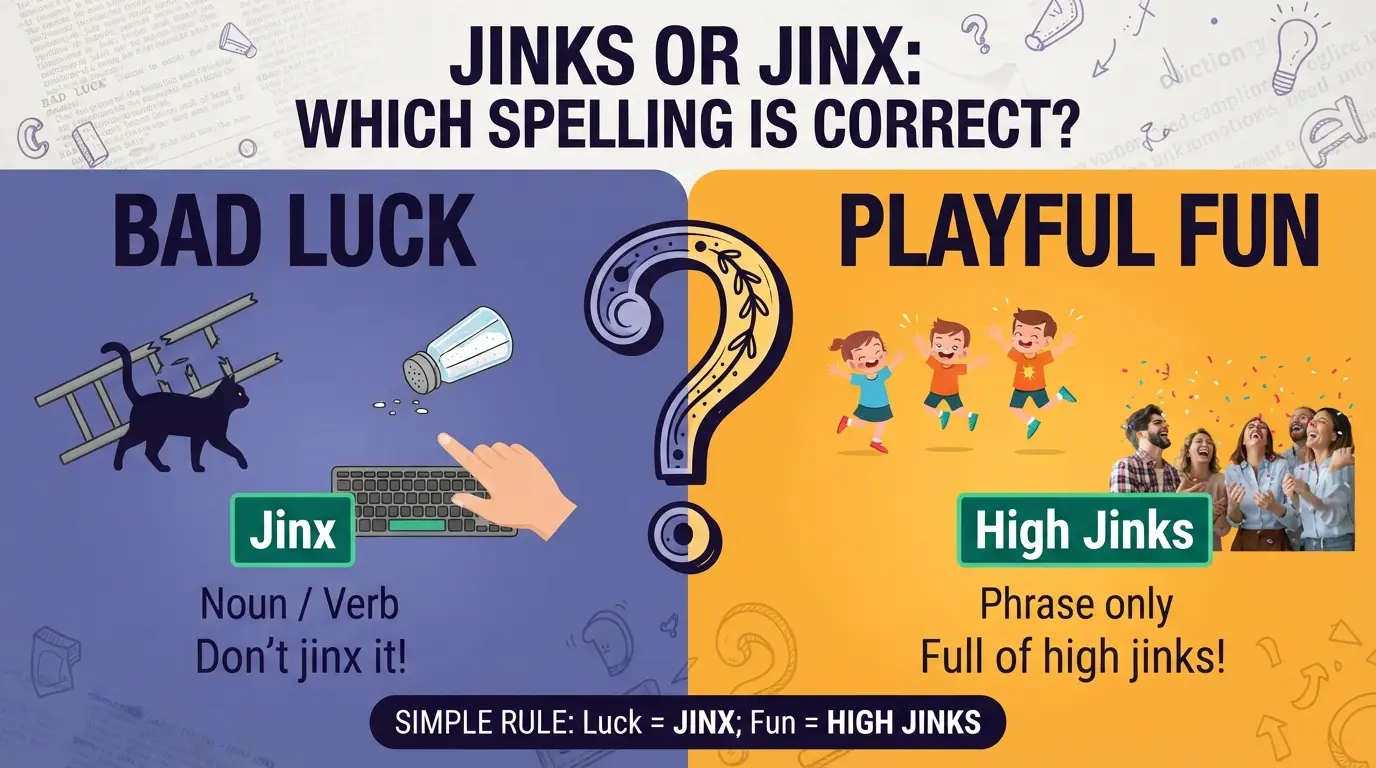
Here is the short version. Jinx is the word for bad luck. Jinks appears mostly in “high jinks,” which means playful fun and mischief. Read on for the full story and a handy FAQ at the end.
Jinks or Jinx Quick Answer
Use “jinx” for bad luck. Use “jinks” only in “high jinks.”
- Noun: “That broken laptop is a jinx on this project.”
- Verb: “Don’t say it out loud. You’ll jinx us.”
- Game: Two people say the same thing at once. One yells, “Jinx!”
- High jinks: “The kids got up to some high jinks at camp.”
Do not write “jinks” when you mean bad luck. That is the most common error.
The Origin of Jinks and Jinx
Jinx came into American English in the early 1900s. Early uses were about baseball. A “jinx” was a person or thing that brought bad luck. The word likely comes from jynx. This was an old English word for the wryneck, a small bird. In ancient Greece, people used this bird in love spells and charms. Over time, the charm became a curse.
Jinks has a different story. It comes from “high jinks.” The phrase began in Scotland in the 1600s. It was a drinking game played with dice. The loser had to do silly things. Later, the phrase came to mean any lively, playful fun. A related word, jink, means to dodge or move quickly. “Jinks” is the plural form.
So why the mix-up? Both words sound alike. Both look alike. And “high jinks” is often spelled “hijinks” or even “high jinx.” Some dictionaries list “high jinx” as a variant. That adds to the confusion.
British English vs American English Spelling
Here is a surprise. Jinx and jinks are not a true British-versus-American spelling split. It is not like color and colour. Both countries use jinx for bad luck. Both use “high jinks” for fun.
The only real difference is style. “Hijinks” (one word) is common in American writing. British writers often keep “high jinks” as two words.
| Term | Meaning | American English | British English |
| jinx | Bad luck, or to bring bad luck | jinx | jinx |
| jinks | Plural of jink (a quick dodge) | rare | rare |
| high jinks | Playful fun or mischief | high jinks or hijinks | high jinks |
| hijinks | Same as high jinks (one word) | common | less common |
| high jinx | Variant spelling | seen, but less standard | seen, but less standard |
Which Spelling Should You Use?
US readers: Use jinx for bad luck. For fun, use high jinks or hijinks. Both are fine.
UK and Commonwealth readers: Use jinx for bad luck. For fun, high jinks is the safe choice.
Global or professional audiences: Choose jinx and high jinks. These are the most widely accepted forms. They work in any style guide.
A simple rule: If it is bad luck, write jinx. If it is playful fun, write high jinks. When unsure, check a trusted dictionary.
Common Mistakes with Jinks and Jinx
- ❌ “That car is cursed. It’s a real jinks.”
✅ “That car is cursed. It’s a real jinx.” - ❌ “Don’t jinks it.”
✅ “Don’t jinx it.” - ❌ “The team had a lot of high jinx at the party.” (Some sources allow it, but it is less standard.)
✅ “The team had a lot of high jinks at the party.” - ❌ “He is jinxs.” (Wrong plural.)
✅ “Those two are jinxes.” (Add -es for the plural of jinx.) - ❌ Mixing both in one piece, like “jinx” and “jinks” for the same idea.
✅ Pick one form and stay with it.
Jinks and Jinx in Everyday Examples
Email: “Fingers crossed the server stays up. I don’t want to jinx it.”
News headline: “Champions Fear Jinx as Season Opens.” Another: “Movie Full of High Jinks Delights Families.”
Social media: “Said it would not rain. Now it’s pouring. I totally jinxed it. 😂”
Formal writing: “Superstitions such as the jinx have long shaped how athletes prepare for games.”
Casual chat: “We both said ‘pizza’ at the same time. Jinx! You owe me a soda.”
Jinks or Jinx Google Trends & Usage Data
I can’t pull live Google Trends numbers here, so I won’t invent any. Here is what usually holds true, and how to check it yourself.
- “Jinx” is the far bigger term. It has many uses: the word itself, the childhood game, and names in pop culture. Jinx is also a popular character in the show Arcane and in the game League of Legends. Interest often rises when new episodes or seasons release.
- “Jinks” gets fewer searches. Many of those come from people checking if it is a spelling error. Some come from “high jinks.”
- English-speaking countries lead. The US, UK, Canada, Australia, and India are common places for these searches.
- Context matters. Searches for the spelling usually come from writers and students. Searches for “jinx” alone often come from gamers and fans.
To check it yourself, open Google Trends. Type “jinx” and “jinks” side by side. Compare by country and by date.
Keyword Variations Side by Side
| Variation | Correct? | Best Use | Example |
| jinx | ✅ Yes | Bad luck; to bring bad luck | “Don’t jinx it.” |
| jinxed | ✅ Yes | Past tense of the verb | “We jinxed the game.” |
| jinxes | ✅ Yes | Plural noun or verb form | “Two jinxes in a row.” |
| jinks | ⚠️ Only in a phrase | “High jinks” | “Camp was full of high jinks.” |
| high jinks | ✅ Yes | Playful fun | “The party had high jinks.” |
| hijinks | ✅ Yes | Same as high jinks | “Hijinks followed.” |
| high jinx | ⚠️ Variant | Less standard | Avoid formal writing. |
Frequently Asked Questions
1. Is it jinks or jinx?
For bad luck, it is jinx. Jinks appears mainly in “high jinks.”
2. Is “jinks” ever correct?
Yes. It is correct in “high jinks.” It is also the plural of jink, a rare word that means a quick dodge.
3. Is “high jinks” or “high jinx” right?
“High jinks” is the standard form. “High jinx” is a variant that some dictionaries list, but it is less common.
4. What does “jinx” mean?
It means bad luck, or a person or thing that brings it. As a verb, it means to bring bad luck by speaking too soon.
5. Is “jinx” a British or American word?
Its first known uses are American, from the early 1900s. Today, people use it in both countries.
6. What is the past tense of jinx?
It is jinxed. Example: “I jinxed myself.”
7. What does it mean when you say “jinx” to someone?
It is a game. When two people say the same thing together, the first to say “jinx” wins. The other person must stay quiet, or sometimes buy a drink.
8. What is the plural of jinx?
It is jinxes.
Conclusion
Let’s wrap it up. The answer is simple. Use jinx when you mean bad luck. Use high jinks when you mean playful fun. That is all most people need.
Remember a few key points. Jinx works as a noun and a verb. Its forms are jinxed and jinxes. Jinks is not a spelling of bad luck. It lives mostly inside “high jinks.” And there is no big UK-versus-US split here. Both sides use the same words. The only small difference is that Americans often write “hijinks” as one word.
For professional writing, stick with jinx and high jinks. These are safe in emails, news, school work, and business copy. If you ever feel unsure, pause and ask one question: Is this about luck or about fun? Luck gets jinx. Fun gets high jinks.
Now you can type with confidence. No more hand-stopping. Share this guide with a friend who keeps mixing them up. You might save them from a typo.

Sikandar Hayat is the author and creator of Journalneste.com, a website dedicated to heartfelt wishes, messages, greetings, and inspiring words for every special moment. With a passion for meaningful writing, Sikandar creates warm and thoughtful content that helps readers express their feelings with ease. His goal is to provide beautiful, shareable words for birthdays, celebrations, relationships, and memorable occasions.