You are writing an email. You type “traveler.” Then you stop. Does it look wrong? Maybe it should be “traveller.” You are not alone. Every day, many people search for “traveller or traveler” to settle this small but annoying question.
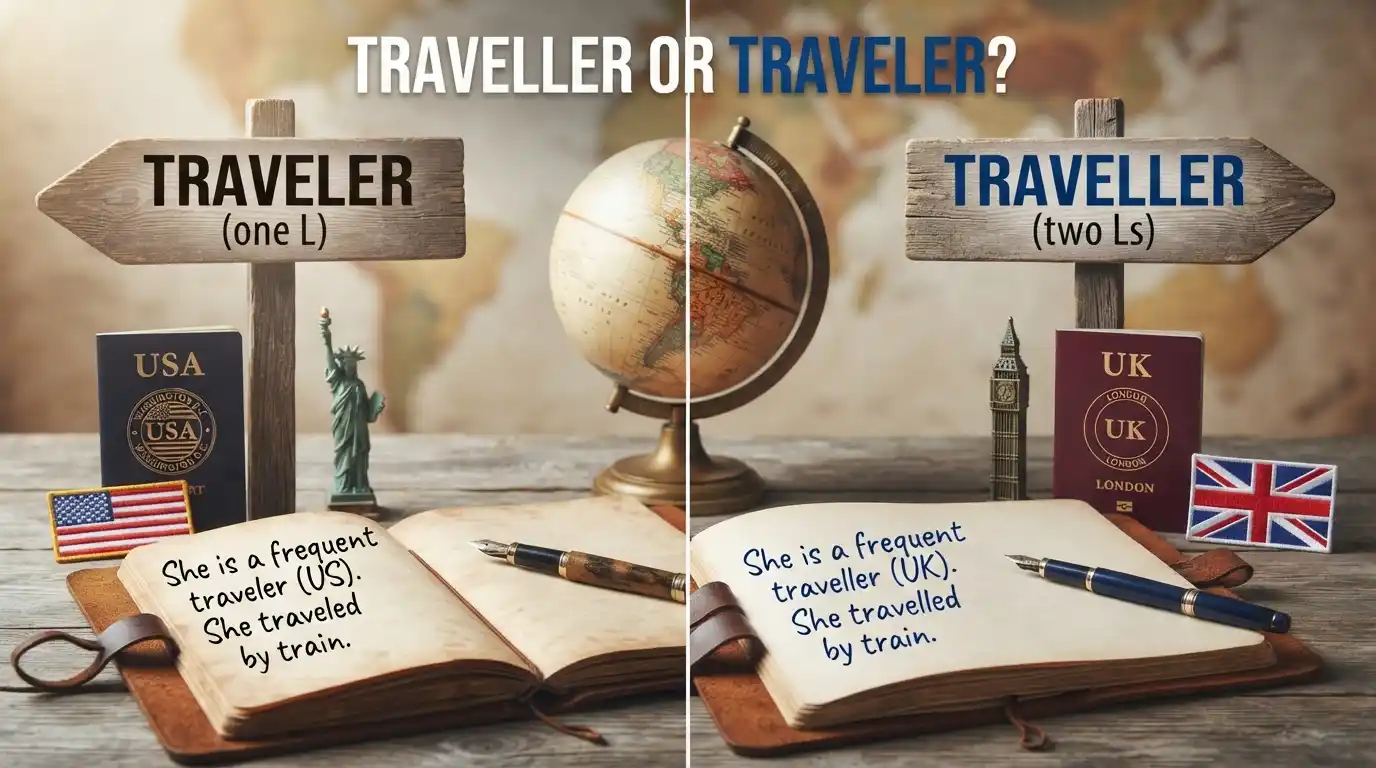
The good news is simple. Both spellings are correct. They are just used in different places. Americans write traveler with one L. People in the UK, Canada, Australia, and most other English-speaking countries write traveler with two.
People search for this keyword for many reasons. Some are writing a résumé or a blog. Some run a travel website. Some are students. Others just want to avoid a silly mistake. Getting it right makes you look careful and professional.
This guide clears up the confusion. You will get a quick answer, the history behind the two spellings, clear rules, a comparison table, real examples, and answers to common questions. Let’s begin.
Traveller or Traveler Quick Answer
Traveler (one L) is American English.
Traveller (two Ls) is British English.
Neither one is a mistake. Pick the one that fits your reader and stay with it.
Examples:
- American: “She is a frequent traveler.”
- British: “She is a frequent traveller.”
The same rule applies to related words:
- traveling (US) and travelling (UK)
- traveled (US) and travelled (UK)
The Origin of Traveller or Traveler
The word “travel” is old. It comes from the Old French word travailler, which meant “to work hard” or “to suffer.” That word likely goes back to a Latin word, tripalium, which named a tool of torture. Long ago, a journey was hard work. It could be slow, tiring, and unsafe. So “travel” and “travail” started as the same word.
Over time, the meaning changed. “Travel” came to mean going from place to place. Then the word “traveller” appeared for the person who makes the trip.
So why two spellings? In English, a word often doubles its last letter when you add an ending. Think of “run” and “running.” British English kept that habit for “travel,” so we get “travelled” and “traveller.”
In the early 1800s, an American writer named Noah Webster wanted spelling to be simpler. His dictionary dropped many extra letters. The doubled L in “travel” went away. His choices spread across the United States. That is why Americans write “traveler” today.
British English vs American English Spelling
Here is the main rule.
- British English: double the L when you add an ending, such as -ed, -ing, or -er.
- American English: keep one L when the stress is not on the last part of the word.
This rule works for many words, not only “travel.”
| Base Word | British English | American English |
| travel | travelled, travelling, traveller | traveled, traveling, traveler |
| cancel | cancelled, cancelling | canceled, canceling |
| label | labelled, labelling | labeled, labeling |
| model | modelled, modelling | modeled, modeling |
| level | levelled, levelling | leveled, leveling |
| counsel | counsellor | counselor |
Note: “cancelled” with two Ls is also common in the US. Still, “canceled” is the standard American form.
Which Spelling Should You Use?
Think about who will read your writing.
If your readers are in the US: use traveler.
If your readers are in the UK, Canada, Australia, New Zealand, India, South Africa, or Ireland: use traveller.
If your readers are from all over the world: pick one and be consistent. Many global brands choose the spelling of their main market. If most of your visitors come from the US, use traveler. If most come from the UK or Commonwealth countries, use a traveller.
A few more tips:
- Match the rest of your spelling. If you write “colour,” write “traveller.” If you write “color,” write “traveler.”
- Follow the style guide of your school, company, or client.
- Use the same spelling in your headings, text, and web page titles.
Common Mistakes with Traveller or Traveler
Mixing spellings in one document.
- Wrong: “The traveler enjoyed her travelling.”
- Right: “The traveler enjoyed her traveling.” Or: “The traveller enjoyed her travelling.”
Using two Ls in American writing.
- Wrong: “Every traveller needs a passport.” (in a US article)
- Right: “Every traveler needs a passport.”
Adding extra letters.
- Wrong: “travelor” or “travellor”
- Right: “traveler” or “traveller”
Changing the spelling of a brand name. Names stay as their owners wrote them. Condé Nast Traveler uses one L. Australian Traveller uses two. Do not “fix” a name.
Forgetting the apostrophe.
- One person: “a traveler’s bag”
- Many people: “travelers’ bags”
Traveller or Traveler in Everyday Examples
Email (US):
“Dear Ms. Lee, thank you for booking with us. As a first-time traveler, you may have questions.”
Email (UK):
“Dear Ms. Lee, thank you for booking with us. As a first-time traveller, you may have questions.”
News headline (US):
“More Travelers Choose Trains This Summer”
News headline (UK):
“More Travellers Choose Trains This Summer”
Social media:
“Solo traveler tips that changed my trips! ✈️” (US)
“Solo traveller tips that changed my trips! ✈️” (UK)
Formal writing:
“The study followed 500 business travelers over two years.” (US)
“The study followed 500 business travellers over two years.” (UK)
Everyday phrases:
- US: traveler’s check, frequent traveler program
- UK: traveller’s cheque, travelling light
Traveller or Traveler Google Trends and Usage Data
I have not pulled live numbers for this article, so no exact figures are shown here. The patterns below are general and widely seen. You can confirm them on Google Trends in a minute.
- United States: “traveler” is the main spelling.
- United Kingdom, Australia, New Zealand, Ireland, India: “traveller” is the main spelling.
- Canada: “traveller” is common, though people see both spellings.
- Global searches: both spellings get steady interest. Many searches come from people unsure which one to use.
Context matters too. People often search “traveler” with words like insurance, tips, and reviews. People search “traveller” with words like guide, backpacker, and rail.
To check the data yourself, open Google Trends, type both words, and compare them by country and date range.
Quick comparison of keyword variations
| Term | Region | Example |
| traveler | US | “A smart traveler packs light.” |
| traveller | UK, Canada, Australia, NZ, India | “A smart traveller packs light.” |
| traveling | US | “I am traveling to Texas.” |
| travelling | UK and others | “I am travelling to Wales.” |
| traveled | US | “She traveled to Peru.” |
| travelled | UK and others | “She travelled to Peru.” |
| traveler’s check | US | “He cashed a traveler’s check.” |
| traveller’s cheque | UK and others | “He cashed a traveller’s cheque.” |
Frequently Asked Questions
1. Is it traveller or a traveler?
Both are correct. “Traveler” is American. “Traveller” is British and used in most other English-speaking countries.
2. Which spelling is more common?
It depends on the country. “Traveler” leads in the US. “Traveller” leads in the UK and most of the Commonwealth.
3. Is “traveller” wrong in American English?
Most American readers will understand it. But it looks British, and US style guides prefer “traveler.”
4. What about “traveling” and “travelling”?
The same rule applies. “Traveling” is American. “Travelling” is British.
5. How do you spell it in Canada?
Canadians usually write “traveller” and “travelling.” But you will see both. Follow the style guide of your reader or client.
6. Does the spelling change the meaning?
No. Both words mean a person who travels.
7. Does spelling affect SEO?
Search engines know the two spellings are the same word. Still, use the spelling your audience searches for. Do not mix the two on one page.
8. Should I use “voyager” or “tourist” instead?
Those words are not exact matches. A tourist travels for fun. A traveler can travel for any reason, including work.
Conclusion
So, traveller or traveler? The answer is easy. Both are right. The only question is who will read your words.
Here are the key points:
- Traveler (one L) is American English.
- Traveller (two Ls) is British English and is used in the UK, Canada, Australia, New Zealand, India, and many other places.
- The split began in the early 1800s, when Noah Webster simplified many American spellings.
- The same rule applies to traveling/travelling and traveled/travelled.
- Brand names keep their own spelling.
Here is my professional advice. Know your audience first. Choose the matching spelling. Then use it every time, in your title, headings, text, and links. Do not mix the two in one piece of writing. Match your other words too, like color and colour.
Small details build trust. A clean, steady spelling tells readers you care about your work. Now you know the rule, so write with confidence.

Sikandar Hayat is the author and creator of Journalneste.com, a website dedicated to heartfelt wishes, messages, greetings, and inspiring words for every special moment. With a passion for meaningful writing, Sikandar creates warm and thoughtful content that helps readers express their feelings with ease. His goal is to provide beautiful, shareable words for birthdays, celebrations, relationships, and memorable occasions.