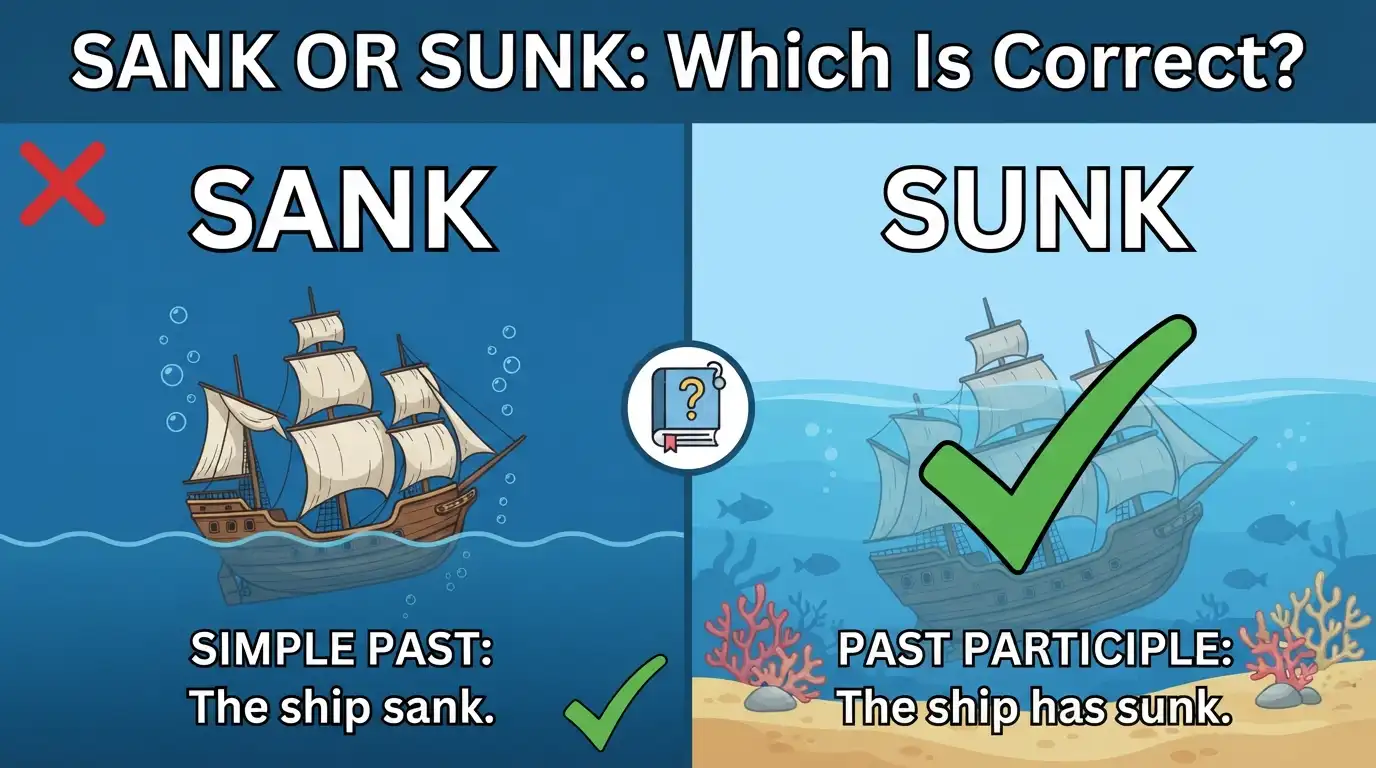
The ship sank. The ship has sunk. Both sound right. So which one do you pick?
You are not alone. Every day, people search “sank or sunk.” They want a fast answer. They are writing an email, a school essay, or a post. They do not want to make a mistake.
The confusion is real. “Sink” is an irregular verb. It does not add “-ed.” It changes its middle sound instead. That gives us two past forms: sank and sunk. They look alike. They mean almost the same thing. But they are used in different places.
Many people also hear “sunk” used in speech for something that happened in the past. Songs, movies, and friends do it. That adds more doubt.
This guide clears it up. You get a quick answer first. Then you see the history, the US and UK view, common mistakes, real examples, and FAQs. By the end, you will know which word to use every time.
Sank or Sunk Quick Answer
Use “sank” for the simple past. Use it when there is no helper verb.
- The boat sank last night.
- My phone sank to the bottom of the lake.
Use “sunk” with a helper verb. Helper verbs include have, has, had, was, were, and been.
- The boat has sunk.
- My phone was sunk in the lake.
- They had sunk the old ship years ago.
Easy test: If a helper verb comes before it, use “sunk.” If not, use “sank.”
Memory trick: The pattern matches other verbs.
- sing, sang, sung
- drink, drank, drunk
- sink, sank, sunk
The Origin of Sank and Sunk
“Sink” comes from the Old English word sincan. It is a very old verb. It belongs to a group called strong verbs. These verbs change their vowel to show time, instead of adding “-ed.”
In Old English, the verb had several past forms. They changed with the number of people and the tense. Over time, English dropped many word endings. The old forms blurred together.
In older English, writers often used “sunk” for the simple past, too. Over the years, the rules settled. Most modern dictionaries and style guides now list “sank” as the standard simple past and “sunk” as the past participle.
So why do people still mix them up? Because the old pattern left behind two similar words. Speakers also tend to make irregular verbs simpler. That is why “sunk” still shows up in casual speech.
One important point: this is not really a spelling difference. It is a grammar choice. Both words are spelled the same in every English-speaking country.
British English vs American English Spelling
Good news: there is no major British vs American split here. Both follow the same rule. Using “sunk” as the simple past is informal in both. You may hear it a bit more in casual American speech, but it is not standard in either place.
| Use | American English | British English | Example |
| Simple past | sank | sank | The ship sank. |
| Past participle | sunk | sunk | The ship has sunk. |
| Adjective (before a noun) | sunken | sunken | A sunken ship |
| “Sunk” as simple past | Informal, avoid | Informal, avoid | “The ship sunk.” (not standard) |
| Idiom | sunk cost | sunk cost | A sunk cost is lost money. |
The same rule works in Canada, Australia, India, Pakistan, and other places that use English.
Which Spelling Should You Use?
The answer is the same for everyone. Here is the advice from the audience.
US readers: Use “sank” for the simple past. Use “sunk” after a helper verb. Avoid “sunk” alone in formal writing.
UK and Commonwealth readers: Use the same rule. Teachers and editors in these places mark “the ship sunk” as an error.
Global readers: Follow the standard rule. It is safe everywhere. Your writing will look clear and professional.
Rule of thumb: When in doubt, add “have” and test it. “The ship have sunk” works, so “sunk” fits there. “The ship has sunk” sounds wrong, so “sank” does not.
Common Mistakes with Sank or Sunk
Here are the most frequent errors and how to fix them.
- ❌ The ship has sank. ✅ The ship has sunk.
- ❌ The ship sunk yesterday. ✅ The ship sank yesterday.
- ❌ The ship was sank by a storm. ✅ The ship was sunk by a storm.
- ❌ He sinked the ball. ✅ He sank the ball. (Or: He has sunk the ball.)
- ❌ The sank ship is old. ✅ The sunken ship is old.
- ❌ That is a sank cost. ✅ That is a sunk cost.
Watch out for “sunken.” It is an adjective. Use it before a noun: a sunken treasure. Do not use it as the main verb: “The ship has sunken” is wrong.
Sank or Sunk in Everyday Examples
- “The deal sank after the budget changed.”
- “I think we have sunk too much time into this.”
News headline
- “A fishing boat sank off the coast.”
- “Two vessels were sunk in the storm.”
Social media
- “My heart sank when I saw the price.”
- “I have totally sunk into this new show.”
Formal writing
- “The company sank into debt in 2020.”
- “The funds already sunk into the project cannot be recovered.”
Notice the last example. Here “sunk” works like an adjective (“funds already sunk”). That is fine because it comes from the past participle.
Sank or Sunk Google Trends and Usage Data
I can’t quote exact figures here. Trend numbers change often, so check them yourself. What you can expect is a general pattern.
By country: Interest in this question is usually strongest in countries where English is a main or second language, such as the US, UK, Canada, Australia, India, Pakistan, and Nigeria. Learners and students search for it often.
By context:
- Students and writers search for the grammar rule.
- Business readers search for “sunk cost.”
- News readers see “sank” and “sunk” in stories about ships and markets.
How to check Google Trends yourself:
- Open Google Trends.
- Type “sank or sunk.”
- Compare it with “sank vs sunk.”
- Filter by country and time.
- Look at the “Related queries” box.
Keyword Variations Side by Side
| Phrase | Correct? | Why |
| The ship sank. | ✅ Yes | Simple past |
| The ship has sunk. | ✅ Yes | Past participle with “has” |
| The ship sunk. | ⚠️ Informal | Not standard in writing |
| The ship has sank. | ❌ No | Needs “sunk” after “has” |
| The sunken ship | ✅ Yes | Adjective |
| Sunk cost | ✅ Yes | Fixed phrase |
| The ship sinked. | ❌ No | Wrong verb form |
FAQs
1. Is it “sank” or “sunk”?
Both are correct in different places. Use “sank” for the simple past. Use “sunk” after have, has, had, was, or were.
2. Is “sunk” ever correct as a simple past verb?
You will hear it in casual speech. Some older writing used it that way. In modern formal writing, use “sank.”
3. What is the past tense of “sink”?
The past tense is “sank.” The past participle is “sunk.”
4. Is there a difference between British and American English?
No big one. Both use “sank” and “sunk” the same way.
5. What is the difference between “sunk” and “sunken”?
“Sunk” is a verb form: The ship has sunk. “Sunken” is an adjective: the sunken ship.
6. Is it “sunk cost” or “sank cost”?
It is “sunk cost.” This is a set phrase in business and economics.
7. What does “I’m sunk” mean?
It means you are in deep trouble or have no chance. Here “sunk” works like an adjective.
8. Is “sinked” a word?
No. “Sink” is irregular. Use “sank” or “sunk.”
Conclusion
The rule for “sank or sunk” is simple. Use “sank” when the action happened in the past and no helper verb is nearby. Use “sunk” when a helper verb like have, has, had, was, or were comes first.
Here are the key points to remember:
- Sank is the simple past: The boat sank.
- Sunk is the past participle: The boat has sunk.
- Sunken is an adjective: the sunken boat.
- Sunk cost is a fixed phrase.
- British and American English follow the same rule.
- “Sunk” as a simple past is common in speech but not standard in writing.
If you are unsure, try the helper verb test. Add “have” before the word and see if it fits. If it does, use “sunk.” If it does not, use “sank.”
Follow this rule and your emails, essays, and posts will look clear and professional. Readers in any country will understand you.

Sikandar Hayat is the author and creator of Journalneste.com, a website dedicated to heartfelt wishes, messages, greetings, and inspiring words for every special moment. With a passion for meaningful writing, Sikandar creates warm and thoughtful content that helps readers express their feelings with ease. His goal is to provide beautiful, shareable words for birthdays, celebrations, relationships, and memorable occasions.