You just typed “stuffie” into a text to a friend. Then you paused. Is it spelled stuffie or stuffy? Both look right. Both look wrong. This tiny word causes real confusion, and you are not alone in wondering about it.
People search for “stuffie or stuffy” for a few reasons. Some are writing to a child and want to get it right and some are shopping online and the results look different depending on the spelling. Some just want to know if they have been saying it wrong their whole life.
Here is the short version: both spellings exist, and both are used to mean a stuffed toy. But the word has other meanings too, and the “correct” spelling can depend on where you live and who you are talking to.
This article gives you the quick answer, the history behind the word, and clear rules for choosing the right spelling every time. No guessing needed by the end.
Stuffie or Stuffy Quick Answer
Both spellings are used and both are correct, depending on context.
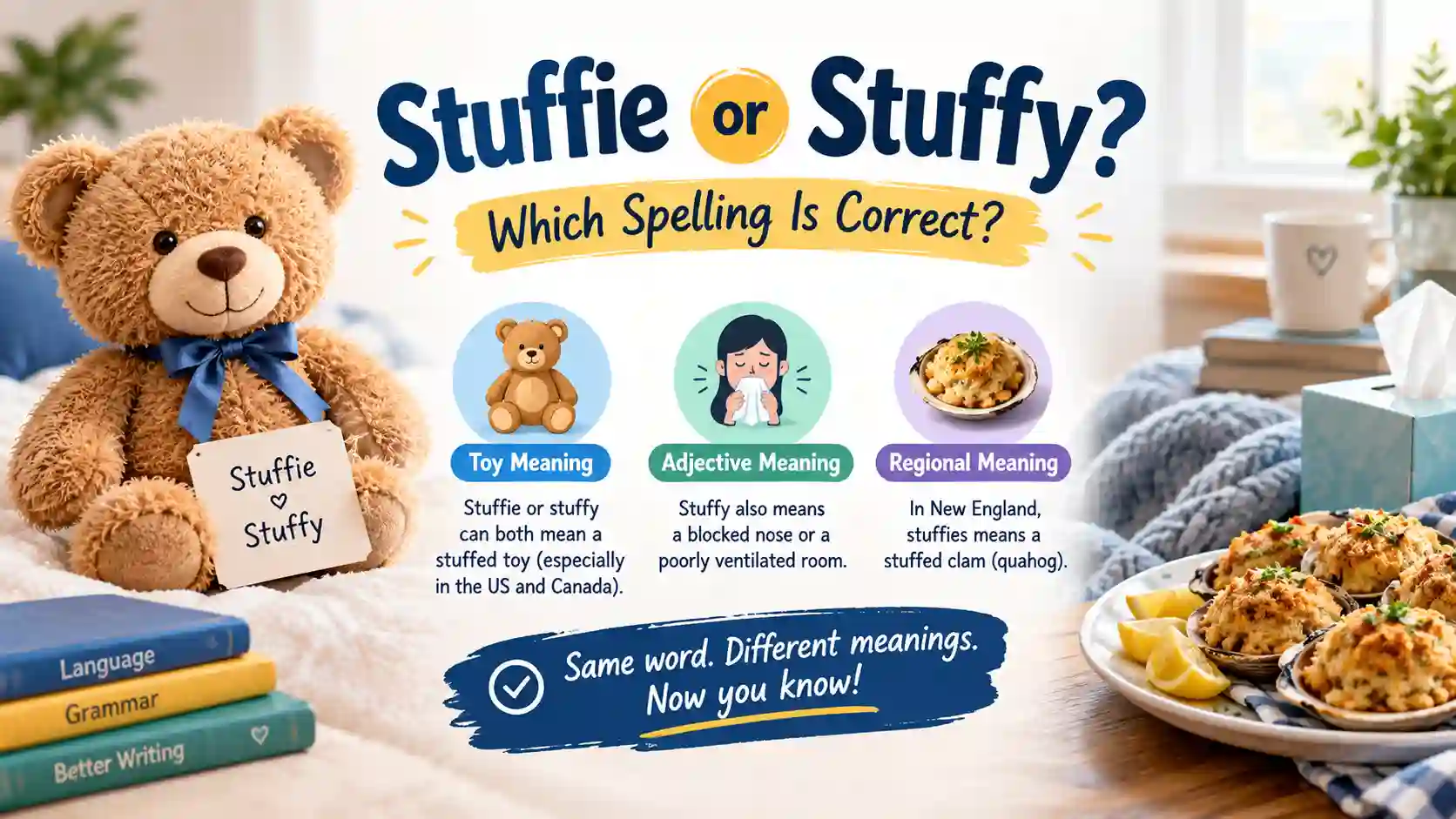
- Stuffie (or stuffy, plural stuffies) most often means a stuffed toy animal, like a teddy bear. Merriam-Webster defines a stuffie as a toy covered in fabric, such as plush, and filled with soft material.
- Stuffy on its own is also a common adjective meaning “poorly ventilated” (a stuffy room) or “blocked” (a stuffy nose).
- In New England, stuffie has a totally different meaning: a stuffed clam, usually a quahog.
Example sentences:
- “Grab your stuffie before we leave for Grandma’s house.” (toy)
- “It’s so stuffy in here, can we open a window?” (adjective)
- “We ordered stuffies as an appetizer at the seafood shack.” (New England clam dish)
The Origin of Stuffie or Stuffy
The root word is simple: stuff. It comes from the Old French word estoffe, meaning quilted material or furnishings. In English, “stuff” first referred to quilted material worn under chain mail around the 1330s, and later came to mean material used in various trades.
From there, English speakers added the suffix -y to make an adjective. “Stuffy” appeared in the 1550s, first meaning “full of substance,” a sense that is now obsolete. By 1831, it took on its modern meaning for rooms: poorly ventilated and musty. The meaning for a blocked nose followed in 1871, and the sense of a “stuffy” person, meaning formal or self-satisfied, showed up around 1895.
The toy meaning came much later and grew from a different habit: adding a cute “-ie” ending to a noun, the same way “dog” becomes “doggie.” “Stuff” plus “-ie” gives us “stuffie,” a soft nickname for a stuffed animal. Some people simply shortened this to “stuffy” instead, since it sounds nearly the same and was already a familiar word. That is why both spellings survive side by side today.
British English vs American English Spelling
Spelling habits differ by region, and this word is no exception. The core issue is the ending: -ie versus -y.
English has a long pattern of using “-ie” for informal, affectionate nicknames (movie, cookie, birdie). Both American and British English use this pattern, but preferences shift by country and even by household.
| Feature | American English | British English / Commonwealth |
| Common spelling for the toy | Stuffie or stuffed animal | Soft toy or cuddly toy |
| “Stuffy” used for toy? | Sometimes, casually | Less common |
| Word for nasal congestion | Stuffy nose | Stuffy nose (same) |
| Regional twist | “Stuffie” means stuffed clam in New England | Not used this way |
| General term preferred | Stuffed animal | Soft toy |
Notice that outside North America, many people skip “stuffie” and “stuffy” altogether. In Britain and Australia, stuffed toys are more often called soft toys or cuddly toys.
Which Spelling Should You Use?
The right spelling depends on your audience.
If you are in the US or Canada: “Stuffie” is the more common spelling for a stuffed toy, especially in casual writing, parenting blogs, and children’s media. “Stuffy” also works but can be confused with the adjective meaning “stale” or “blocked.”
If you are in the UK, Australia, or another Commonwealth country: Skip both. Use “soft toy” or “cuddly toy” instead. These are the terms most readers will recognize right away.
If you are writing for a global audience: Use “stuffed animal” or “plush toy.” These terms are understood everywhere and avoid any confusion with the adjective “stuffy.”
If you are talking about a blocked nose or a stale room: Always use “stuffy.” This is the only correct spelling for the adjective. “Stuffie” is never used this way.
Common Mistakes with Stuffie or Stuffy
- Mistake: Using “stuffy” to mean a toy in formal writing.
Fix: Use “stuffed animal” or “plush toy” for clarity in professional or global content. - Mistake: Writing “stuffies” when you mean a stuffy nose.
Fix: “Stuffies” is a noun for toys (or clams). A blocked nose is always “stuffy,” used as an adjective. - Mistake: Assuming “stuffie” is slang or incorrect.
Fix: It is a recognized word. Dictionaries list it as a valid term for a stuffed toy. - Mistake: Using “stuffie” outside the US or Canada and expecting everyone to understand.
Fix: Use “soft toy” for UK and Commonwealth readers. - Mistake: Mixing spellings within the same piece of writing.
Fix: Pick one spelling and stay consistent throughout your document.
Stuffie or Stuffy in Everyday Examples
In a text message:
“Don’t forget Teddy’s stuffie for the sleepover!”
The in a parenting blog:
“Our toddler won’t nap without her favorite stuffie tucked under one arm.”
In a product listing:
“Soft toy elephant, machine washable, perfect for babies and toddlers.”
In a news article:
“Doctors recommend saline spray to ease a stuffy nose during the cold season.”
On social media:
“POV: you’re 30 and still sleep with your childhood stuffy 🧸”
In formal writing:
“The stuffed animal was donated to the children’s hospital’s comfort program.”
On a restaurant menu (New England):
“Baked stuffies, market price.”
Stuffie or Stuffy Google Trends & Usage Data
Search interest in this word varies a lot by country and by what people mean.
- In the United States and Canada, “stuffie” sees steady search interest, driven mostly by parents, toy shoppers, and social media posts about childhood keepsakes.
- In the United Kingdom and Australia, searches lean toward “soft toy” and “cuddly toy” instead, with much lower use of “stuffie.”
- Searches for “stuffy nose” spike seasonally, rising every year during cold and flu season and allergy season.
- New England food searches for “stuffies” (the clam dish) cluster around coastal Massachusetts and Rhode Island, especially in summer.
The takeaway: context drives the numbers. A single word is doing three different jobs across different regions and seasons.
Keyword Variations Compared
| Term | Meaning | Common Region | Formality |
| Stuffie | Stuffed toy | US, Canada | Casual |
| Stuffy | Stuffed toy (variant) or blocked/stale | US, Canada | Casual (toy) / Neutral (adjective) |
| Soft toy | Stuffed toy | UK, Australia | Neutral |
| Cuddly toy | Stuffed toy | UK | Casual |
| Stuffed animal | Stuffed toy | Global | Neutral |
| Plush toy | Stuffed toy, often higher quality | Global | Neutral to formal |
| Stuffies (clam) | Stuffed quahog dish | New England, US | Casual |
FAQs
Is “stuffie” a real word?
Yes. It appears in Merriam-Webster and is widely used to describe a stuffed toy, especially in the US and Canada.
Is “stuffy” the same as “stuffie”?
They can mean the same thing when referring to a toy. But “stuffy” is also a common adjective for a blocked nose or a poorly ventilated room, so it carries more risk of confusion.
What do the British call a stuffie?
Most British speakers say “soft toy” or “cuddly toy” instead of “stuffie” or “stuffy.”
Why does “stuffie” mean a clam in New England?
It is a regional food term, short for a stuffed clam, usually a quahog. It has nothing to do with the toy’s meaning and was developed separately.
Which spelling is better for a children’s book?
“Stuffie” is a safe, common choice in North American children’s media and avoids confusion with the adjective “stuffy.”
Can I use “stuffy” for a toy in professional writing?
It is better to use “stuffed animal” or “plush toy” in formal or global content, since “stuffy” as an adjective has a different, well-known meaning.
Is there a plural for “stuffie”?
Yes, the plural is “stuffies,” used for multiple stuffed toys.
Conclusion
So, stuffie or stuffy? Both are correct, and both are common, but they are not interchangeable in every context. “Stuffie” and “stuffy” can each mean a stuffed toy, mostly in the US and Canada. “Stuffy” also stands alone as an adjective for a blocked nose or a stale room, a meaning that goes back to the 1550s. And in New England, “stuffies” means something else entirely: a baked, stuffed clam.
The word you choose should match your audience. The use “stuffie” for casual, North American writing about toys. Use “soft toy” or “cuddly toy” for UK and Commonwealth readers. Use “stuffed animal” or “plush toy” when writing for a global audience or a formal setting. And always use “stuffy,” never “stuffie,” when you mean a blocked nose or an airless room.
Once you know the three meanings behind this small word, the confusion disappears. Pick the spelling that fits your reader, stay consistent, and you will never second-guess yourself again.

Sikandar Hayat is the author and creator of Journalneste.com, a website dedicated to heartfelt wishes, messages, greetings, and inspiring words for every special moment. With a passion for meaningful writing, Sikandar creates warm and thoughtful content that helps readers express their feelings with ease. His goal is to provide beautiful, shareable words for birthdays, celebrations, relationships, and memorable occasions.