Have you ever stopped mid-sentence, unsure If to write “I have a bias” or “I am biased”? You’re not alone. Thousands of people search for “bias or biased” every month because English gives us two closely related words that look similar but work differently in a sentence.
The confusion makes sense. Both words come from the same root. Both deal with unfair leaning toward one side. But one is a noun. The other is an adjective. Mixing them up is an easy mistake, even for confident writers.
This guide clears up the confusion for good. You’ll get a quick answer first, then a deeper look at where the words came from, how to use each one correctly, and the mistakes to avoid. By the end, you’ll never second-guess “bias or biased” again.
Bias or Biased – Quick Answer
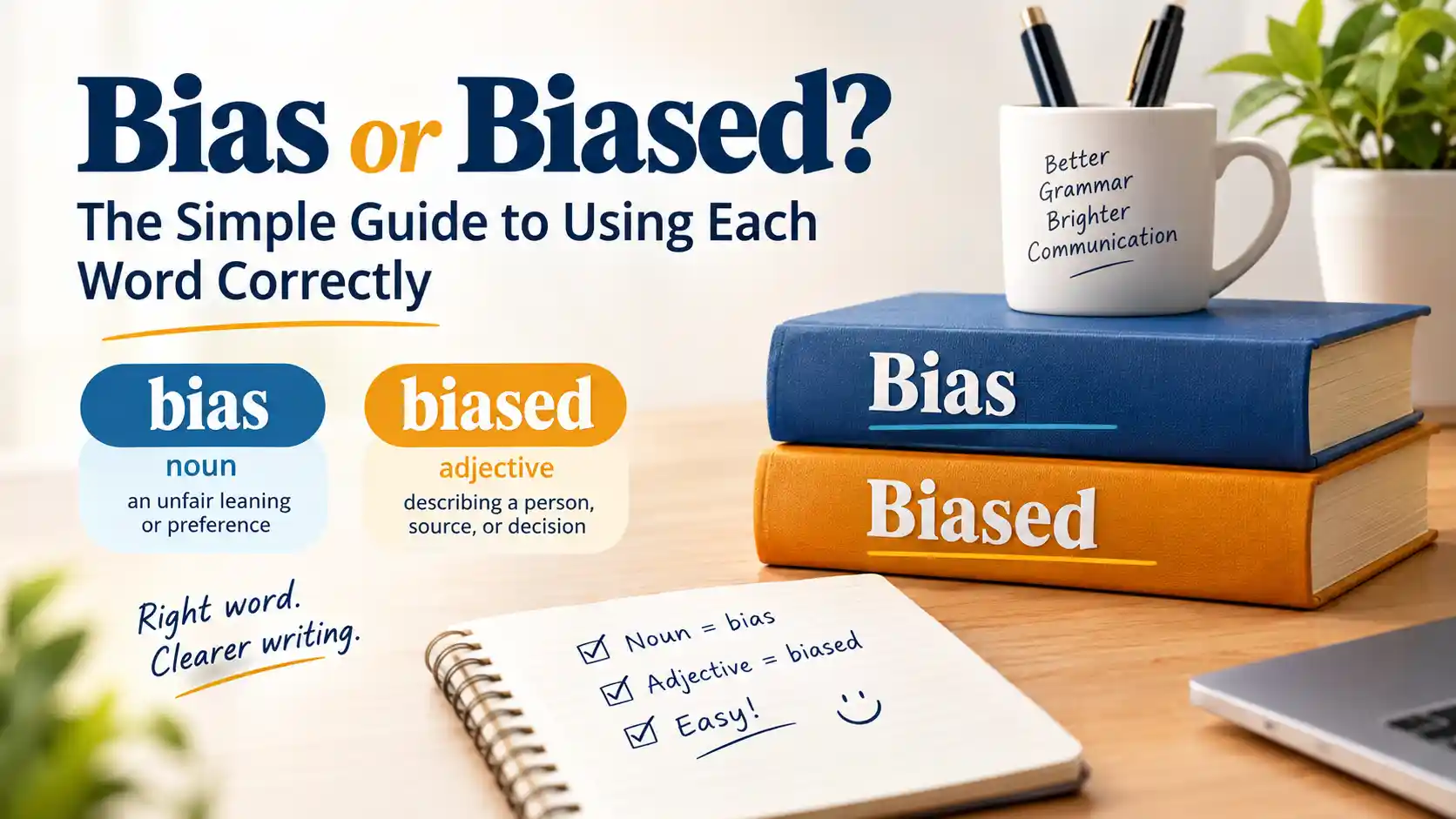
Use bias as a noun. It names the thing itself an unfair leaning or preference.
- “The report showed clear bias toward one candidate.”
- “Everyone has some bias, even if they don’t notice it.”
Use biased as an adjective. It describes a person, source, or decision.
- “The judge seemed biased in this case.”
- “That news article is biased.”
Simple rule: if you can replace the word with “unfairness,” use bias. If you can replace it with “unfair” or “one-sided,” use bias.
The Origin of Bias and Biased
The word “bias” entered English in the 1500s from the French word “biais,” meaning a slant or oblique line. It first appeared in the game of bowls, where a ball was weighted to curve rather than roll straight. Over time, “bias” moved from describing a curved path to describing a mental “slant” a tendency to favor one side over another.
“Biased” is simply “bias” with the “-ed” ending added. This is a normal pattern in English. Nouns often become adjectives or past-tense verb forms by adding “-ed” (compare “color” → “colored,” or “talent” → “talented”). So “biased” isn’t a separate word with its own history. It’s a natural grammatical extension of “bias.”
This is also why people sometimes search for spelling differences. They assume “bias” and “biased” split along British and American lines, the way “color” and “colour” do. But that’s not the case here the difference is grammatical, not regional.
British English vs American English Spelling
Here’s the good news: bias and biased are spelled the same way in both British and American English. There’s no UK version or US version, unlike words such as “colour/color” or “organise/organize.”
Where spelling does get tricky is with related word forms, especially the verb “to bias” and its past tense.
| Form | British English | American English |
| Noun | bias | bias |
| Adjective | biased | biased |
| Verb (present) | bias | bias |
| Verb (past tense) | biased or biassed | biased |
| Verb (-ing form) | biasing or biassing | biasing |
The double-“s” forms (“biassed,” “biassing”) are older British spellings. They still appear in some UK dictionaries and older texts, but modern British English has largely dropped them in favor of the single-“s” spelling, matching American usage. So today, “biased” and “biasing” are the safe, standard choices almost everywhere.
Which Spelling Should You Use?
Since spelling isn’t really the issue, the real question is which word form fits your sentence and your audience.
- US writers: Use “biased” and “biasing.” These are standard in every major American style guide.
- UK and Commonwealth writers: Use “biased” and “biasing” too. The older “biassed” spelling is now considered outdated, even in Britain.
- Global or business writing: Stick with “biased” and “biasing.” They’re understood everywhere and look modern and professional.
- Academic or legal writing: Choose “bias” (noun) or “biased” (adjective) based on grammar, not region. Precision matters more than style here.
In short, the word you need depends on the job it does in your sentence, not on where your reader lives.
Common Mistakes with Bias or Biased
Mistake 1: Using “bias” where an adjective is needed.
Wrong: “The article was very bias.”
Right: “The article was very biased.”
Mistake 2: Using “biased” where a noun is needed.
Wrong: “There is a lot of biased in the media.”
Right: “There is a lot of bias in the media.”
Mistake 3: Writing “bias towards” when you mean “against,” or vice versa.
Both “bias toward” and “bias against” are correct they just point in opposite directions. Make sure the direction matches your meaning.
Mistake 4: Confusing “bias” with “biases” (plural).
“Bias” can be countable when referring to specific types. “She has several biases about money” is correct when talking about more than one kind of bias.
Mistake 5: Using “biassed” in modern writing.
This older British spelling can look like a typo to most readers today. Stick with “biased.”
Bias or Biased in Everyday Examples
In emails:
“I want to flag a possible bias in how we’re reviewing these applications.”
The news writing:
“Critics say the network’s coverage was biased toward one political party.”
In social media posts:
“Everyone has bias. The key is knowing yours and checking it.”
In formal or academic writing:
“The study controlled for selection bias by randomizing participant groups.”
In workplace feedback:
“This performance review seems biased it doesn’t reflect her actual results.”
Bias or Biased – Google Trends & Usage Data
Search interest in “bias” and “biased” has grown steadily over the past several years, driven largely by conversations about media fairness, workplace hiring, and artificial intelligence. Searches spike around major news events, election cycles, and discussions of AI systems making unfair decisions.
“Bias” tends to dominate searches related to psychology, science, and data (for example, “cognitive bias” or “algorithmic bias”). “Biased” shows up more often in searches judging people, media, or institutions (for example, “is this news source biased?”).
Usage is strong across the US, UK, Canada, Australia, and India, with little regional variation in spelling. The main difference between countries isn’t spelling it’s context: American searches lean toward media and politics, while UK searches lean slightly more toward workplace and institutional bias.
Word Variations Compared
| Word | Part of Speech | Example |
| bias | noun | “The test has a built-in bias.” |
| biased | adjective | “The test is biased.” |
| biases | plural noun | “We all carry unconscious biases.” |
| bias (verb) | verb | “Past experience can bias your judgment.” |
| unbiased | adjective (opposite) | “We need an unbiased opinion.” |
| biasedly | adverb (rare, avoid) | Not standard avoid using this form. |
FAQs
1. Is “bias” a noun or a verb?
It’s usually a noun, but it can also work as a verb: “Don’t let emotion bias your decision.”
2. Is “biased” always negative?
Almost always, yes. “Biased” implies unfairness, even if the person doesn’t realize it.
3. Can something be “unbiased”?
Yes. “Unbiased” means free from bias fair and neutral.
4. Is “biassed” a spelling mistake?
Not technically it’s an older British spelling. But it’s rarely used today and may look like an error to most readers.
5. What’s the difference between “bias” and “prejudice”?
“Bias” often refers to a leaning that can be unconscious or based on limited information. “Prejudice” usually implies a stronger, often unfair judgment formed without full knowledge.
6. How do you use “bias” in a sentence correctly?
Use it as a noun: “There was clear bias in the selection process.”
7. Why do people confuse “bias” and “biased”?
Because they share a root and look similar, but one names the concept (noun) and the other describes something (adjective).
Conclusion
“Bias” and “biased” aren’t a British-versus-American spelling issue they’re two different parts of speech doing two different jobs. “Bias” is the noun, naming an unfair leaning. “Biased” is the adjective, describing something or someone affected by that leaning. Both are spelled the same way worldwide, though older British writing sometimes uses “biassed” and “biasing” with a double “s.”
The easiest way to choose correctly is to test the sentence. If you’re naming a concept, use “bias.” If you’re describing a person, article, or decision, use “biased.” Watch for the classic mix-up of typing “bias” where an adjective belongs, and skip the outdated double-“s” spellings unless you’re deliberately writing in a traditional style.
Once you know the difference between the noun and the adjective, this word pair becomes easy. Use “bias” to name the problem. Use “biased” to describe it. That’s the whole rule.

Sikandar Hayat is the author and creator of Journalneste.com, a website dedicated to heartfelt wishes, messages, greetings, and inspiring words for every special moment. With a passion for meaningful writing, Sikandar creates warm and thoughtful content that helps readers express their feelings with ease. His goal is to provide beautiful, shareable words for birthdays, celebrations, relationships, and memorable occasions.