You are typing a sentence. You stop. Is it “time heals” or “time heels”? Is it “the cut heals fast” or “the cut heels fast”? You are not alone. Many people search “heals or heels” because these two words sound the same.
Your ear cannot tell them apart. Only your eyes can. Spell check often won’t help either, because both are real words. It sees the correct spelling and moves on.
Some people think this is a British vs American spelling issue. It is not. Both countries spell these words the same way. The real issue is meaning. One word is about getting better. The other is about feet and shoes.
This guide clears up the confusion fast. Bilkul, meaning same rahega, lekin har sentence ko different wording se start kar sakte hain:
A quick answer comes first, followed by the word’s history and easy examples. Common mistakes are also explained, along with simple ways to correct them. Real-life sentences show how the word is used naturally, while answers to frequently asked questions help clear up any remaining confusion.
Agar aap chahen, main isay aur zyada natural aur SEO-friendly bhi bana sakta hoon.. By the end, you will know which word to use every time.
Heals or Heels Quick Answer
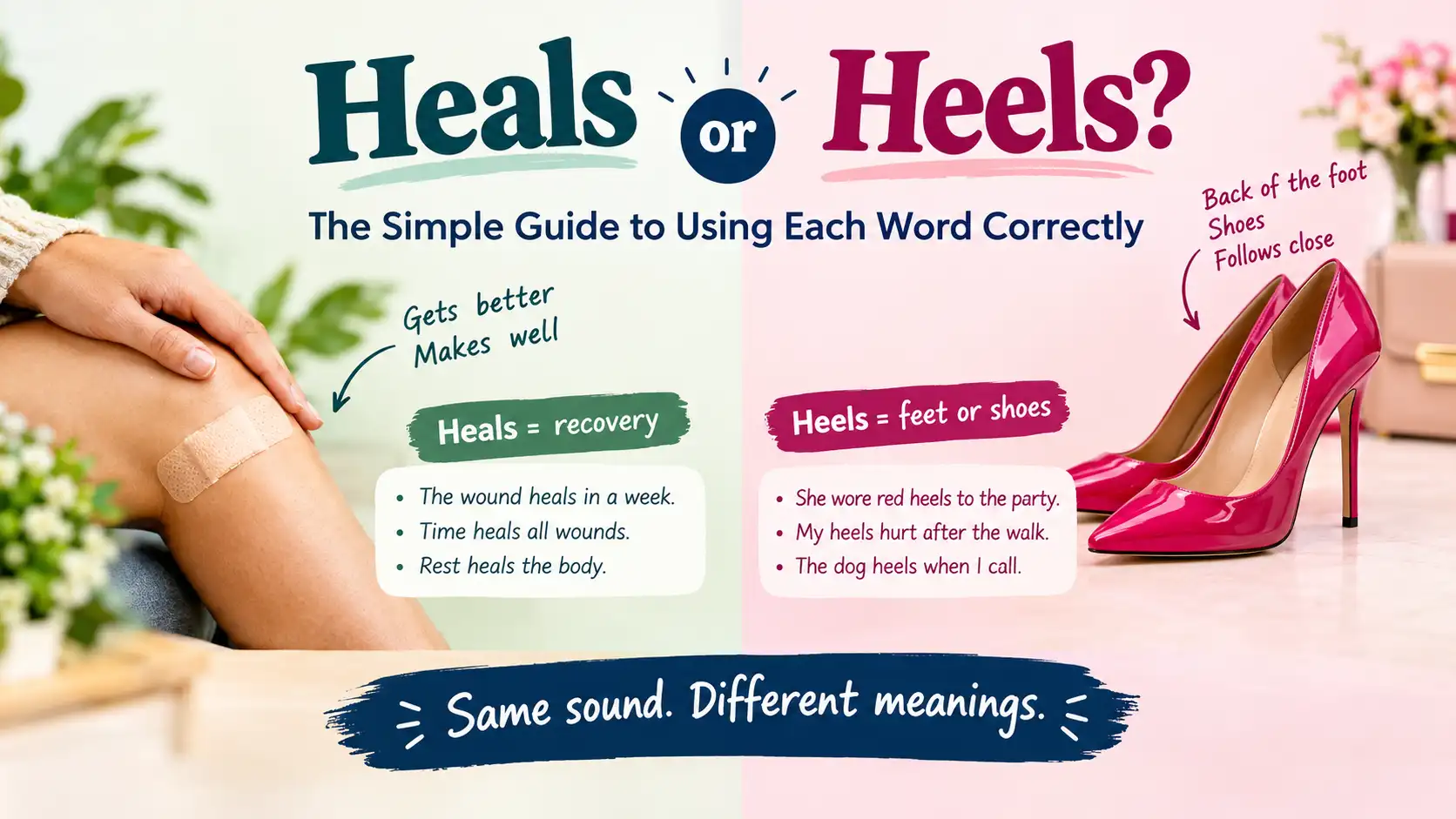
Heals means “gets better” or “makes well.” It is a verb.
Heels means the back part of your foot or shoe. It is usually a noun. It can also be a verb.
Here is a simple trick: heal has “ea” like “health.” Both are about getting well.
Examples with “heals”:
- The wound heals in a week.
- Time heals all wounds.
- Rest heals the body.
Examples with “heels”:
- She wore red heels to the party.
- My heels hurt after the walk.
- The dog heels when I call.
The Origin of Heals and Heels
The two words come from different roots. They only sound alike today.
Heal comes from Old English hǣlan. It means “to make whole.” It is close to the old word hāl, which gave us “whole,” “hale,” and “health.” That is why “heal” and “health” look alike.
Heel comes from Old English hēla. It is named the back of the foot. It is linked to an older word for the hock or hough, the back joint of an animal’s leg.
There is a second “heel” too. To “heel” a ship means to lean over to one side. It comes from a different Old English word. Later, “heel” also became slang for a rude or dishonest person.
Why do the spellings differ? English kept old spellings even as the sounds changed. Over time, “ea” and “ee” came to sound the same in these words. The spellings stayed different. That is why we now have two words that sound alike but mean very different things.
British English vs American English Spelling
Here is the good news. There is no British vs American difference here. Both spell it “heals” and “heels.” Neither country uses a different form.
| Word | American English | British English | Meaning |
| Heals | heals | heals | Gets better; makes well |
| Heels | heels | heels | Back of the foot; high-heeled shoes |
| Healed | healed | healed | Got better (past tense) |
| Heeled | heeled | heeled | Fitted with heels; leaned over |
Some words do change between the two countries, like “color” and “colour.” These two words do not. If you see “heals” in a London paper or a New York paper, it means the same thing.
Which Spelling Should You Use?
Pick by meaning, not by country.
- US readers: Use “heals” for recovery. Use “heels” for feet, shoes, or dog commands.
- UK and Commonwealth readers: The rule is the same. Use “heals” for recovery. Use “heels” for feet and shoes.
- Global readers: The rule is the same. Ask one question: Am I talking about getting better, or about feet?
Getting better = heals. Feet or shoes = heels.
Common Mistakes with Heals and Heels
1: Using “heels” for recovery.
- Wrong: Time heels all wounds.
- Right: Time heals all wounds.
2: Using “heals” for shoes.
- Wrong: She bought new heals for the wedding.
- Right: She bought new heels for the wedding.
3: Mixing up sayings.
- Wrong: Head over heals in love.
- Right: Head over heels in love.
4: Writing “Achilles heal.”
- Wrong: Pride is his Achilles heal.
- Right: Pride is his Achilles heel.
Mistake 5: Trusting spell check.
Both words are real. Spell check will not flag the wrong one. Always re-read for meaning.
Heals and Heels in Everyday Examples
Emails
- “Thanks for your patience while my ankle heals.”
- “I will be back once my foot heals.”
News
- “The city heals after the storm.”
- “The star walked the red carpet in silver heels.”
Social media
- “Sunsets heal me. 🌅” (verb, no “s” form needed here)
- “New heels, who dis? 👠”
- “Time heals, but it takes time.”
Formal writing
- “The bone typically heals within six to eight weeks.”
- “The company’s weak supply chain was its Achilles heel.”
- “Dig in your heels” is a common phrase in business writing. It means to refuse to change.
Heals or Heels Google Trends and Usage Data
I did not pull live Google Trends numbers for this article, so treat the points below as general patterns, not exact data.
- Where people search: The confusion shows up in English-speaking countries such as the US, UK, Canada, Australia, and India. Homophone mix-ups happen wherever people write English.
- Context differs: “Heals” is usually searched with health topics like wounds, injuries, and recovery. “Heels” are usually searched with fashion, foot care, and sayings.
- Timing: Fashion searches for “heels” often rise around wedding and party seasons. Health-related searches for “heals” often follow injury and skincare topics.
To check live data: Go to Google Trends. Type “heals” and “heels” as two search terms. Compare them by country and date range. Add “heals or heels” as a third term to see how often people search for the confusion itself.
Keyword variations side by side:
| Term | Part of speech | Main meaning | Example |
| Heal | Verb | Get better | Cuts heal quickly. |
| Heals | Verb | Gets better | The cut heals. |
| Healed | Verb | Got better | It healed fast. |
| Heel | Noun / verb | Back of foot; lean over | My heel hurts. |
| Heels | Noun / verb | Feet; shoes; follows close | She wore heels. |
| Heeled | Verb / adjective | Fitted with heels | Well-heeled guests came. |
Frequently Asked Questions
1. Is it “heals” or “heels”?
It depends on the meaning. Use “heals” for getting better. Use “heels” for feet and shoes.
2. Is it “head over heals” or “head over heels”?
It is “head over heels.” The saying once meant “heels over head,” which described a flip. Your heels are on your feet, not your health.
3. Is it “Achilles heel” or “Achilles heal”?
It is “Achilles heel.” It comes from the Greek myth. Achilles could only be hurt on his heel.
4. Is “heals” a different spelling in British English?
No. British and American English both use “heals.” The same is true for “heels.”
5. Do “heals” and “heels” sound the same?
Yes. They are homophones. That is why people mix them up.
6. How can I remember the difference?
“Heal” and “health” both have “ea.” Also, “heels” has two e’s, like two feet side by side.
7. Is “heal” also used for feelings?
Yes. You can say “she heals from a loss.” The word works for the body and the heart.
Conclusion
Now you know the rule. “Heals” and “heels” sound the same, but they mean different things. They are not a British vs American spelling pair. Both countries use both words the same way.
Use “heals” when something gets better. A wound heals. A heart heals. Time heals.
Use “heels” for the back of the foot, for shoes, or for phrases like “head over heels” and “Achilles heel.” A dog also heels when it walks close to its owner.
Here are the key tips to remember. First, ask if you mean “getting better” or “feet.” Second, link “heal” with “health.” Third, do not trust spell check for homophones. Read your sentence again and check the meaning. Fourth, learn the common sayings: “time heals,” “head over heels,” “Achilles heel,” and “dig in your heels.”
With these simple steps, you will pick the right word every time. Your emails, posts, and reports will look clean and professional.

Sikandar Hayat is the author and creator of Journalneste.com, a website dedicated to heartfelt wishes, messages, greetings, and inspiring words for every special moment. With a passion for meaningful writing, Sikandar creates warm and thoughtful content that helps readers express their feelings with ease. His goal is to provide beautiful, shareable words for birthdays, celebrations, relationships, and memorable occasions.