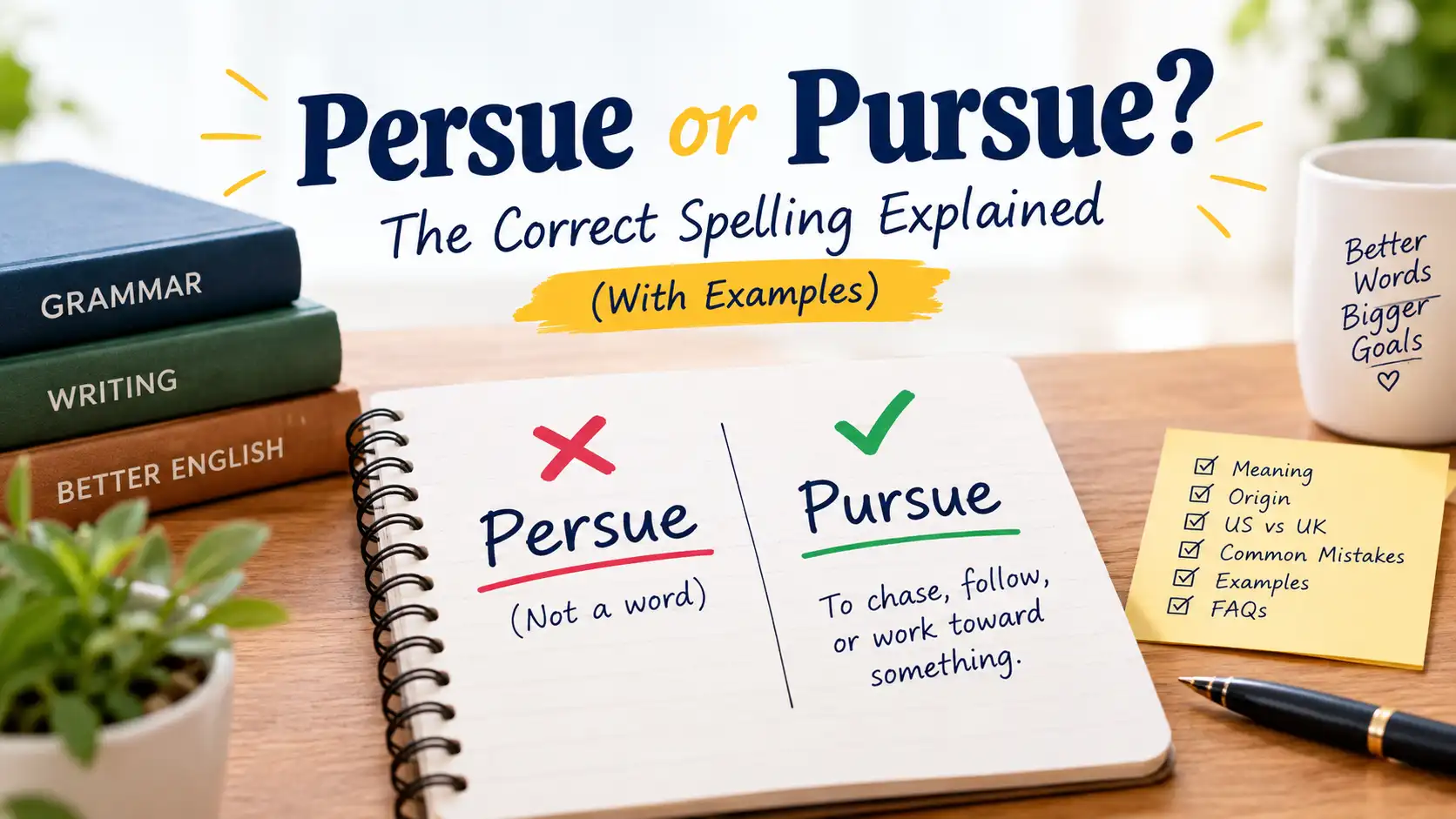
You are typing a sentence. You want to say you will chase a dream. Then you stop. Is it “persue” or “pursue”?
You are not alone. Many people search this exact question every month. The two spellings look close, and they sound close too. So the mix-up is easy.
Here is the good news: “pursue” is the correct spelling. “Persue” is a common typo. It is not a word in standard dictionaries.
People search this keyword for a few reasons. Some want a fast answer before they send an email. Some are writing a résumé or cover letter. Others are students or English learners. Spellcheck does not always help, because “persue” looks almost right.
This article clears up the confusion. You will get a quick answer first. Then you will learn where the word comes from, how US and UK spelling compare, and which mistakes to avoid. You will also see real examples, usage trends, and a full FAQ. By the end, you will never second-guess this word again.
Persue or Pursue Quick Answer
Pursue is correct. Persue is wrong.
Pursue means to chase, follow, or work toward something.
Examples:
- She wants to pursue a career in nursing.
- The police pursued the car.
- He will pursue his goals this year.
- I am pursuing a degree in law.
Now look at the wrong versions:
- ❌ She wants to persue a career in nursing.
- ❌ He is persuing his goals.
Same rule everywhere. Every form of this word starts with purs-.
The Origin of Pursue
The word “pursue” is very old. It came into English about 700 years ago, through Anglo-French and Old French. The French forms looked like pursuer and porsuir. Those come from the Latin word prosequi. It means “to follow forward.”
Break it down:
- pro = forward
- sequi = to follow
So the word has meant “follow forward” for a very long time. Over the years, the spelling changed as it moved from Latin to French to English. Old texts show many spellings. Spelling was not fixed back then. Later, dictionaries settled on pursue.
Why do people write “persue”? There are three simple reasons:
- Sound. Say “pursue” fast. It sounds like “per-SOO.” The first syllable sounds like “per.”
- Look-alike words. Many English words start with “per-“: persist, person, perform, persuade, perceive. The brain guesses “per-.”
- Weak spellcheck memory. If a typo looks close, we often miss it.
Here is a trick: pursue has the word “purse” hiding inside it. Think of someone chasing a thief who grabbed a purse. You pursue the purse thief.
British English vs American English Spelling
Here is a surprise. There is no difference. Both British and American English spell it pursue.
Many spelling fights are about US and UK style, like color and colour. This is not one of them. “Persue” is not the British spelling. It is not a spelling used in any country’s standard English.
| Word | American English | British English | Note |
| Chase or follow | pursue | pursue | Same in both |
| Chasing | pursuing | pursuing | Same in both |
| Chased | pursued | pursued | Same in both |
| Hobby or chase | pursuit | pursuit | Same in both |
| Favorite color | color | colour | Real US/UK difference |
| To organize | organize | organise (or organize) | Real US/UK difference |
| A place to stay | center | centre | Real US/UK difference |
Australian, Canadian, Indian, Pakistani, Nigerian, and South African English also use pursue. So the rule is global.
Which Spelling Should You Use?
Always use pursue. Here is the advice by audience:
- United States: Use pursue.
- United Kingdom, Ireland, and the Commonwealth: Use pursue.
- Global or ESL readers: Use pursue.
- Business, school, and legal writing: Use pursue. A typo here can hurt your image.
There is only one correct choice. You do not need to pick a regional style. Just remember the “purs-“ start.
Common Mistakes with Pursue
| Mistake | Correction | Why it happens |
| persue | pursue | Sounds like “per-“ |
| persuit | pursuit | Same “per-” habit |
| persued | pursued | Wrong spelling carried into past tense |
| persuing | pursuing | Wrong spelling carried into “-ing” |
| pursuade | persuade | Mixing up two different words |
| persuade (when you mean chase) | pursue | Two words with different meanings |
The biggest mix-up: pursue vs. persuade.
- Pursue = chase or work toward. I will pursue my dream.
- Persuade = convince someone. I will persuade my boss.
Quick memory tip: persuade has “suade” like “sweet talk.” Pursue has “purse” like “chase.”
Another error is dropping the “u” in “pursuit.” The right spelling is pursuit, not “pursit.”
Pursue in Everyday Examples
In an email:
- “I would like to pursue this opportunity with your team.”
- “We plan to pursue the next step on Monday.”
In the news:
- “Police pursued the suspect across town.”
- “The company will pursue new markets next year.”
On social media:
- “Time to pursue my dreams. Wish me luck! 🚀”
- “Never stop pursuing what makes you happy.”
In formal writing:
- “The applicant intends to pursue a master’s degree.”
- “The court will pursue the claim.”
In a cover letter:
- “I am eager to pursue a role in project management.”
Persue or Pursue Google Trends & Usage Data
I can’t pull live Google Trends numbers here, so I won’t invent any. Here is what searchers and writers usually see. You can confirm it yourself at trends.google.com.
- “Pursue” is used far more than “persue” in books, news, and websites.
- “Persue” shows up mostly as a typo and as a “how do I spell it?” search.
- Search interest comes mainly from English-speaking countries. That includes the US, UK, Canada, Australia, India, Pakistan, Nigeria, and the Philippines.
- Interest often rises during school and job seasons. People write applications, essays, and resumes then.
- The search “persue or pursue” is a spelling-check search. People want a quick, trusted answer.
Try this: open Google Trends. Type “pursue” and “persue” side by side. Then filter by country and time. You will see “pursue” leads by a wide margin.
Keyword variations side by side:
| Version | Correct? | Part of speech | Example |
| pursue | ✅ Yes | Verb | I will pursue my goal. |
| pursued | ✅ Yes | Verb (past) | She pursued a degree. |
| pursuing | ✅ Yes | Verb (-ing) | He is pursuing a dream. |
| pursuit | ✅ Yes | Noun | The pursuit of happiness. |
| pursuer | ✅ Yes | Noun | The pursuer ran fast. |
| persue | ❌ No | — | Typo |
| persuit | ❌ No | — | Typo |
| persuade | ✅ Yes (different word) | Verb | I will persuade him. |
FAQs
1. Is it “persue” or “pursue”?
It is pursue. “Persue” is a typo.
2. Is “persue” a word in British English?
No. British English also uses pursue.
3. Is “persue” a word in American English?
No. American English uses pursue too.
4. What does “pursue” mean?
It means to chase, follow, or work toward something. You can pursue a person, a goal, or a career.
5. What is the difference between “pursue” and “persuade”?
Pursue means to chase or work toward. Persuade means to convince. They sound a bit alike but mean different things.
6. How do you spell the noun form?
It is pursuit. Example: “the pursuit of success.”
7. What are the other forms of “pursue”?
Pursues, pursued, pursuing, and pursuer.
8. What is an easy way to remember the spelling?
Think of a purse thief. You pursue the purse thief. Every form starts with “purs-“.
Conclusion
Let’s sum it up. “Pursue” is the only correct spelling. “Persue” is a typo, and it is not accepted in any country’s standard English.
Here are the key points:
- Pursue means to chase, follow, or work toward something.
- The word comes from the Latin prosequi, “to follow forward,” through French.
- People write “persue” because the word sounds like “per-” and looks like persist or persuade.
- American and British English spell it the same way. There is no regional split.
- The related forms are pursued, pursuing, pursuit, and pursuer.
- Do not mix it up with persuade, which means to convince.
My advice is simple. Use pursue in every email, essay, résumé, and post. Remember the purse trick: you pursue the purse thief. Check the first letters, “purs-“, before you hit send.
A small spelling error can make a big first impression. Now you know the right one. Go ahead and pursue your goals with confidence.

Sikandar Hayat is the author and creator of Journalneste.com, a website dedicated to heartfelt wishes, messages, greetings, and inspiring words for every special moment. With a passion for meaningful writing, Sikandar creates warm and thoughtful content that helps readers express their feelings with ease. His goal is to provide beautiful, shareable words for birthdays, celebrations, relationships, and memorable occasions.