You are writing an email. You type “jobsite.” Then you stop. Should it be “job site” instead? You are not alone. Many people ask this every month.
People search “jobsite or job site” for simple reasons. They want to look professional. They write safety plans, contracts, reports, and job posts. One small spelling slip can make a document look sloppy.
There is another problem. “Job site” can mean two things. It can be the place where work happens, like a building site. It can also be a website that lists jobs, like Indeed. That makes the spelling feel even more confusing.
This article clears it up. You will get a quick answer first. Then you will learn where the words came from. You will see how US and UK writers differ. You will read real examples, common mistakes, and a handy table. At the end, you will find answers to common questions.
By the time you finish, you will know which spelling to use. You will also know when to use it. Let’s begin.
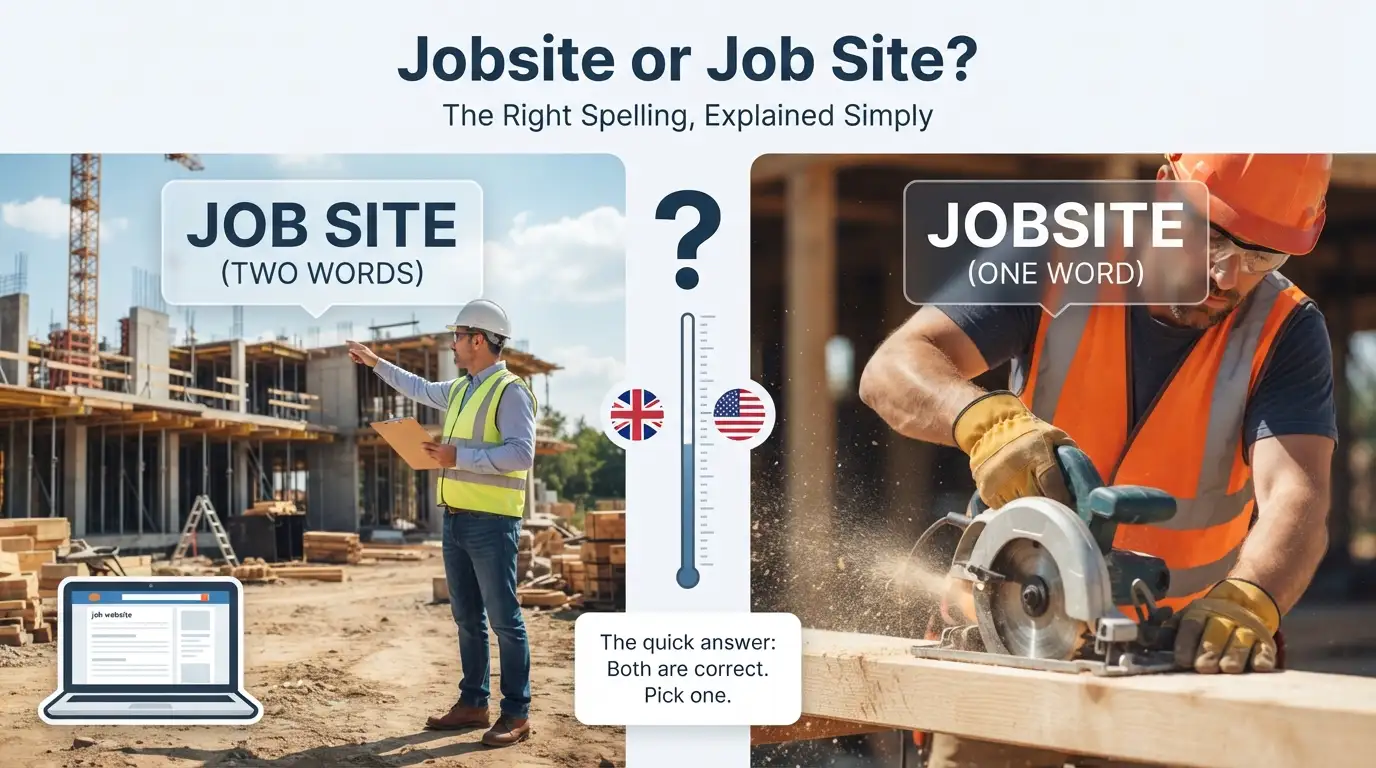
Jobsite or Job Site Quick Answer
Both spellings are used. Neither one is a big mistake.
- Jobsite (one word) is common in US construction and trade writing.
- Job site (two words) is the safer, more traditional form. It works almost everywhere.
Examples:
- “Wear a hard hat on the jobsite.”
- “Wear a hard hat on the job site.”
- “I found the role on a job site.” (Here you must use two words. It means a website.)
Simple rule: When in doubt, use job site. Pick one spelling and stick with it in the same document.
The Origin of Jobsite or Job Site
Let’s look at each word.
Job is an old English word. It showed up in the 1500s. It first meant a small piece of work. Its exact roots are not clear. Over time, it came to mean any task or paid work.
Site comes from the Latin word situs. That means “place” or “position.” It came into English through French. It means the spot where something is or happens.
Put them together and you get “the place where a job happens.”
Why two spellings? English has a common pattern. New word pairs start as two words. Then people add a hyphen. Later, many become one word. Think of “web site,” which became “website.” Or “under way,” which many now write “underway.”
“Jobsite” is in the middle of that trip. Some writers have moved to one word. Others have not. That is why you see both.
British English vs American English Spelling
Here is the twist. This is not a classic US vs UK spelling gap like “color” and “colour.” There is no special rule for it. It is more about habit and industry.
- In the US, “jobsite” is popular in construction, trades, and tool brands. “Job site” is still common in formal writing.
- In the UK and Commonwealth (like Australia, Canada, and India), people often say “building site,” “construction site,” or “worksite.” When they do say “job site,” it is usually two words.
| Feature | American English | British / Commonwealth English |
| Most common form | Job site or jobsite | Job site (or another term) |
| One-word “jobsite” | Common in trades | Less common |
| Popular alternatives | Work site, construction site | Building site, construction site, worksite |
| Website meaning | Job site (two words) | Job site or “jobs website” |
| Safe choice | Job site | Job site |
Key point: The real difference is word choice, not spelling rules.
Which Spelling Should You Use?
Think about who will read your writing.
US audience:
Either spelling works. For trades, construction, and marketing, “jobsite” is fine. For legal, formal, or school writing, choose “job site.”
UK and Commonwealth audience:
Use “job site” if you use the phrase. Or use a more local term, like “building site” or “construction site.”
Global audience:
Use “job site.” Two words are easy to read for everyone. Non-native English readers will also find it clearer.
Search and SEO:
People search both ways. Use “job site” as your main form. Use “jobsite” once or twice if your readers are in US trades.
Company style guides:
If your company has a style guide, follow it. It beats any general rule.
Common Mistakes with Jobsite or Job Site
1. Mixing both spellings in one document.
Wrong: “Check the jobsite. Then leave the job site.”
Right: Pick one. “Check the job site. Then leave the job site.”
2. Using “jobsite” for a job website.
Wrong: “I posted my resume on a jobsite.”
Right: “I posted my resume on a job site.”
(Two words are much clearer here.)
3. Writing “job-site” with a hyphen.
Wrong: “The job-site was busy.”
Right: “The job site was busy.” Use a hyphen only when the phrase acts as one describing word before a noun, and even then most style guides skip it.
4. Splitting it wrong: “jo bsite” or “jobs site.”
Right: “job site.”
5. Forgetting the “b” in “job.”
Sounds silly, but typos happen. Always proofread.
Jobsite or Job Site in Everyday Examples
Email:
“Hi Sam, please send the safety checklist to the job site by noon.”
News:
“Police said no one was hurt at the job site.”
Social media:
“Early start at the jobsite today. Coffee is a must. ☕”
Formal writing (contract):
“The contractor must keep the job site clean and safe at all times.”
Job search:
“Many people find work on a job site like LinkedIn or Indeed.”
Safety sign:
“Authorized people only. All visitors must sign in at the job site office.”
Notice how casual writing (social media) often uses one word. Formal writing often uses two.
Jobsite or Job Site Google Trends & Usage Data
I can’t pull live Google Trends numbers here, so I won’t make any up. Here is what usually holds true, and how you can check it yourself.
Where “jobsite” does well:
The United States. It shows up often in construction, tool, and safety content.
Where “job site” does well:
Everywhere. It has wide use in the US, UK, Canada, Australia, and beyond. It is also the form people use when they mean a job-listing website.
What the searches mean:
People who search “job site” may want a work location or a job board. People who search “jobsite” usually mean a work location.
How to check it:
- Go to Google Trends.
- Type “jobsite” and “job site” as two search terms.
- Set the country and time range.
- Compare the two lines.
Try filtering by “Construction” or “Jobs & Education” categories. You will see how meaning changes with context.
Variations side by side:
| Variation | Meaning | Where used most | Best for |
| Job site | Work location or job website | Worldwide | Most writing |
| Jobsite | Work location | US trades | Casual, industry writing |
| Job-site | Work location (rare) | Some older texts | Avoid |
| Worksite | Work location | US, UK, Commonwealth | Formal, safety writing |
| Building site | Construction location | UK, Commonwealth | UK audiences |
| Construction site | Construction location | Worldwide | Clear, formal writing |
Frequently Asked Questions
1. Is it “jobsite” or “job site”?
Both are used. “Job site” is the safer choice. “Jobsite” is fine in US trade writing.
2. Is “jobsite” a real word?
Yes. Many writers and companies use it. Some dictionaries and style guides prefer two words, so check yours.
3. Is “job site” one word or two?
Traditionally, two words. Many people now write it as one, mostly in the US.
4. What is the difference between a job site and a worksite?
They mean nearly the same thing. Both are places where work happens. “Worksite” is common in formal and safety writing.
5. Does “job site” mean a website for jobs?
It can. Sites like Indeed are often called job sites. Context tells you which meaning is used.
6. Do British people say “jobsite”?
Not often. They usually say “building site,” “construction site,” or “worksite.”
7. Should I use a hyphen in “job-site”?
No. Skip the hyphen. Write “job site” or “jobsite.”
8. Which spelling is best for SEO?
Use “job site” as your main term. Add “jobsite” once or twice if you write for US trades.
Conclusion
Here is what you need to remember.
“Jobsite” and “job site” both exist. Neither is a shocking error. Language grows and changes, and writers are still deciding which form they like.
If you want the safest choice, use job site. It works in the US, the UK, and around the world. It also works when you mean a job-listing website.
If you write for US builders or trades, “jobsite” is fine. Many tool makers and contractors use it. Just be sure to stay consistent.
Avoid the hyphen. Avoid mixing forms in one document. And when in doubt, check your style guide or your reader’s habits.
Think about your reader first. A clear word beats a fancy one every time. Short, simple, and steady wins.
Now you can write your email, contract, or safety plan with confidence. Choose your spelling. Use it well. Move on to the next task.

Sikandar Hayat is the author and creator of Journalneste.com, a website dedicated to heartfelt wishes, messages, greetings, and inspiring words for every special moment. With a passion for meaningful writing, Sikandar creates warm and thoughtful content that helps readers express their feelings with ease. His goal is to provide beautiful, shareable words for birthdays, celebrations, relationships, and memorable occasions.