You are planning a wedding. You start a text to your friends. Then you stop. Is it “groomsman” or “groomsmen”? You type both. Neither looks right.
You are not alone. Many people search for this every year. The two words look almost the same. Only one letter is different. But that letter changes the meaning.
People search for this phrase for different reasons. People use these words when preparing wedding invitations, giving speeches, creating gift lists, or writing social media posts. Others are students or writers who want to get it right. Many also wonder if it is a US versus UK spelling issue.
Here is the good news. It is not. Both countries use the same two words. The difference is simple. One word is for a single man. The other is for many men.
In this guide, you get a quick answer first. Then you will learn where the words come from, see common mistakes, and read real examples. By the end, you will never mix them up again.
Groomsman or Groomsmen Quick Answer
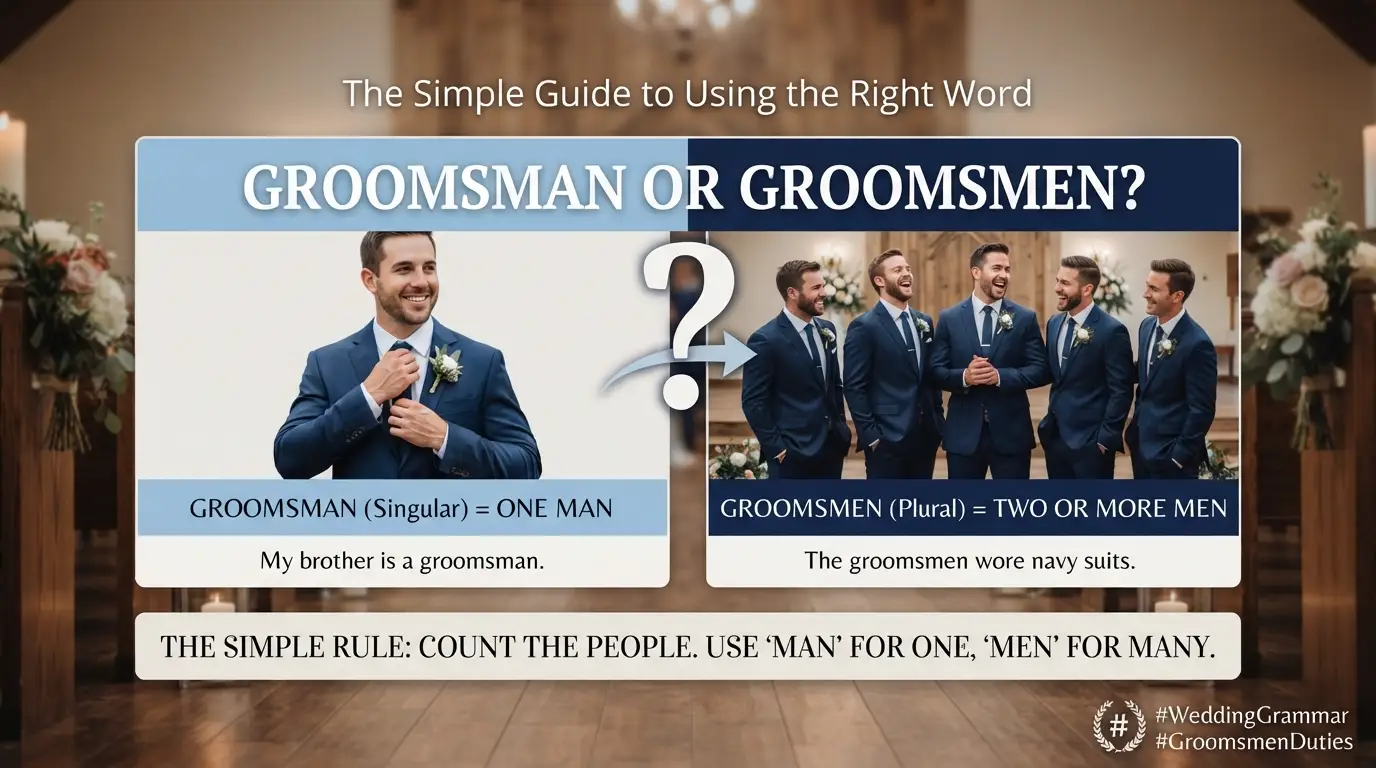
Groomsman means one man. Groomsmen means two or more men.
Both words describe men who stand with the groom at a wedding.
Examples:
- “My brother is a groomsman.” (one man)
- “The groomsmen wore navy suits.” (many men)
- “He asked five friends to be groomsmen.” (many men)
- “Each groomsman got a watch.” (one man at a time)
Easy trick: if you can count more than one, use groomsmen.
The Origin of Groomsman and Groomsmen
The word “groom” has an old story. In Old English, the word guma meant “man.” Later, people said bridegome, which meant “the bride’s man.”
Over time, the word “home” faded out. People began to say “bridegroom” instead. The word “groom” also looked like another old word, “groom,” which meant a boy or servant. The two words blended together.
Then came “groomsman.” It simply means “a man who helps the groom.”
Why is the plural “groomsmen”? Because “man” is an irregular noun. It does not add an “s.” It changes to “men.” Other words work the same way:
- businessman → businessmen
So “groomsmans” is not a word. English just does not work that way.
Some say groomsmen began as helpers who guarded the bride from kidnappers. This is a popular story, but historians are not sure it is true. Today, groomsmen support the groom and help on the wedding day.
British English vs American English Spelling
Many people think “groomsman” and “groomsmen” are US and UK versions of each other. They are not. They are singular and plural forms. Both countries spell them the same way.
Some words do change between US and UK spelling. This pair does not.
| Word Type | American English | British English | Same or Different? |
| One helper of the groom | groomsman | groomsman | Same |
| Many helpers of the groom | groomsmen | groomsmen | Same |
| The groom’s best friend | best man | best man | Same |
| Groom’s helpers (common UK term) | groomsmen | ushers or groomsmen | Different word choice |
| Color example | color | colour | Different |
| Center example | center | centre | Different |
Notice the last two rows. They show real US and UK spelling gaps. The groomsman words do not have this gap.
There is one small difference. In the UK, the men who assist guests at a wedding are often called “ushers.” In the US, “groomsmen” is the term used more commonly. However, “groomsmen” is also heard in the UK.
Which Spelling Should You Use?
Use the word that matches your meaning, not your country.
- If you mean one man: use “groomsman.”
- If you mean two or more men: use “groomsmen.”
Advice by audience:
- US readers: Use “groomsman” and “groomsmen.” They are standard.
- UK and Commonwealth readers: Use the same words. You may also use “ushers” if that fits your local style.
- Global readers: Stick with “groomsman” and “groomsmen.” Everyone understands them.
If a woman stands on the groom’s side, you can say “groomswoman.” Some couples also use “groomsperson” or “groom’s attendant.” Pick the term that fits your wedding.
Common Mistakes with Groomsman and Groomsmen
Here are the errors people make most often.
1: Using “groomsman” for a group
- Wrong: “All my groomsmen wore black shoes.”
- Right: “All my groomsmen wore black shoes.”
2: Using “groomsmen” for one person
- Wrong: “He is my groomsman.”
- Right: “He is my groomsman.”
3: Writing “groomsmans”
- Wrong: “The groomsmen arrived early.”
- Right: “The groomsmen arrived early.”
4: Writing “groomsmens”
- Wrong: “The groomsmens gifts are ready.”
- Right: “The groomsmen’s gifts are ready.”
5: Wrong apostrophe
- One man: “the groomsman’s tie”
- Many men: “the groomsmen’s ties”
Mistake 6: Capital letters
- Use small letters in normal writing. Only capitalize at the start of a sentence or in a title.
Groomsman and Groomsmen in Everyday Examples
Email:
“Hi all, our groomsmen need to pick up their suits by Friday. Please tell me if any groomsman cannot make it.”
News:
“The bride and groom stood with six bridesmaids and six groomsmen at the church.”
Social media:
“Proposing to my groomsmen with these fun boxes! #groomsmenproposal”
“Shoutout to my best groomsman for saving the rings.”
Formal writing (invitation or program):
“The groomsmen will escort the bridesmaids down the aisle.”
“Mr. James Carter will serve as groomsman.”
Speech:
“To my groomsmen, thank you for standing by me. And to my best man, you are a true brother.”
Groomsman and Groomsmen Google Trends & Usage Data
I did not pull live Google Trends numbers for this article. The patterns below are the general ones, and you can check current data yourself at trends.google.com.
Which word gets more searches?
Searches with the plural “groomsmen” are usually much higher. Most searches are about groups. Common ones include “groomsmen gifts,” “groomsmen proposal,” and “groomsmen attire.”
By country:
The United States shows strong interest because large wedding parties are common there. The UK, Canada, Australia, and other Commonwealth countries also search these words. In some of these places, people also search for “ushers.”
By season:
Interest rises in the wedding season. In the Northern Hemisphere, that is spring through early autumn. Interest often rises again before the holidays, when many couples get engaged.
By context:
Shopping searches lead the way. Style and etiquette searches come next. Grammar searches, like “groomsman or groomsmen,” are smaller but steady.
Keyword Variations Side by Side
| Variation | Correct? | Meaning | Example |
| groomsman | Yes | One male attendant | “He is a groomsman.” |
| groomsmen | Yes | Two or more male attendants | “The groomsmen smiled.” |
| groomsman’s | Yes | Belonging to one groomsman | “The groomsman’s tie was red.” |
| groomsmen’s | Yes | Belonging to many groomsmen | “The groomsmen’s shoes matched.” |
| groomswoman | Yes | One female attendant on the groom’s side | “She is a groomswoman.” |
| groomswomen | Yes | Many female attendants on the groom’s side | “The groomswomen wore blue.” |
| groomsmans | No | Not a word | Use “groomsmen.” |
| groomsmens | No | Not a word | Use “groomsmen’s” or “groomsmen.” |
Frequently Asked Questions
1. Is it groomsman or groomsmen?
Both are correct. “Groomsman” is one man. “Groomsmen” is two or more men.
2. Is groomsmen the plural of groomsman?
Yes. “Man” becomes “men” in the plural, so “groomsman” becomes “groomsmen.”
3. Is “groomsman” British or American spelling?
Neither. Both countries use the same spelling. The words differ by number, not by country.
4. Can a woman be a groomsman?
Many people say “groomswoman” or “groomsperson” for a woman on the groom’s side. Some couples still use “groomsman” for anyone in the role. Choose what fits your wedding.
5. How many groomsmen should a groom have?
There is no rule. Many couples choose about the same number of groomsmen as bridesmaids. Small weddings may have only one or two.
6. What does a groomsman do?
A groomsman supports the groom. He may help plan events, greet guests, and stand with the groom at the ceremony. Duties vary by wedding.
7. Is it “groomsmen’s” or “groomsmens'”?
It is “groomsmen’s.” Since “groomsmen” already ends in “n,” you add an apostrophe and “s.”
8. What is the difference between a groomsman and a best man?
The best man is the groom’s main supporter. He often gives a toast and holds the rings. Groomsmen are the other men in the wedding party.
Conclusion
The choice between “groomsman” and “groomsmen” is easy once you know the rule. It is about numbers, not countries.
Use a groomsman for one man. Use groomsmen for two or more. Both the US and the UK spell them the same way. The word “groomsmans” is never right. For a group’s belongings, write “groomsmen’s.”
Here is your quick checklist:
- Count the people. One? Use “groomsman.” More than one? Use “groomsmen.”
- Check for possession. Add “‘s” to show what belongs to them.
- Never add an extra “s” to “groomsmen.”
- Use “groomswoman” or “groomsperson” if that fits your wedding.
- In the UK, “ushers” may also fit, but “groomsmen” works everywhere.
With these tips, your invitations, emails, and speeches will read clean and correct. You can now plan your big day with one less worry.

Sikandar Hayat is the author and creator of Journalneste.com, a website dedicated to heartfelt wishes, messages, greetings, and inspiring words for every special moment. With a passion for meaningful writing, Sikandar creates warm and thoughtful content that helps readers express their feelings with ease. His goal is to provide beautiful, shareable words for birthdays, celebrations, relationships, and memorable occasions.