You typed a word. Then you paused. Is it “savior” or “saviour”? You are not alone. This word trips up many writers, students, and professionals every day.
The confusion is simple. English has two main versions: American and British. Each version spells many words differently. “Savior or saviour” is one of the most searched spelling questions online. People search it before writing emails, essays, resumes, and social posts. They want to sound correct. They want to match their audience.
This guide gives you a fast answer. Then it explains the full story. You will learn the history, the spelling rules, and real examples. You will also see a comparison table and answers to common questions.
By the end, you will know exactly which spelling to use — and why.
Savior or Saviour Quick Answer
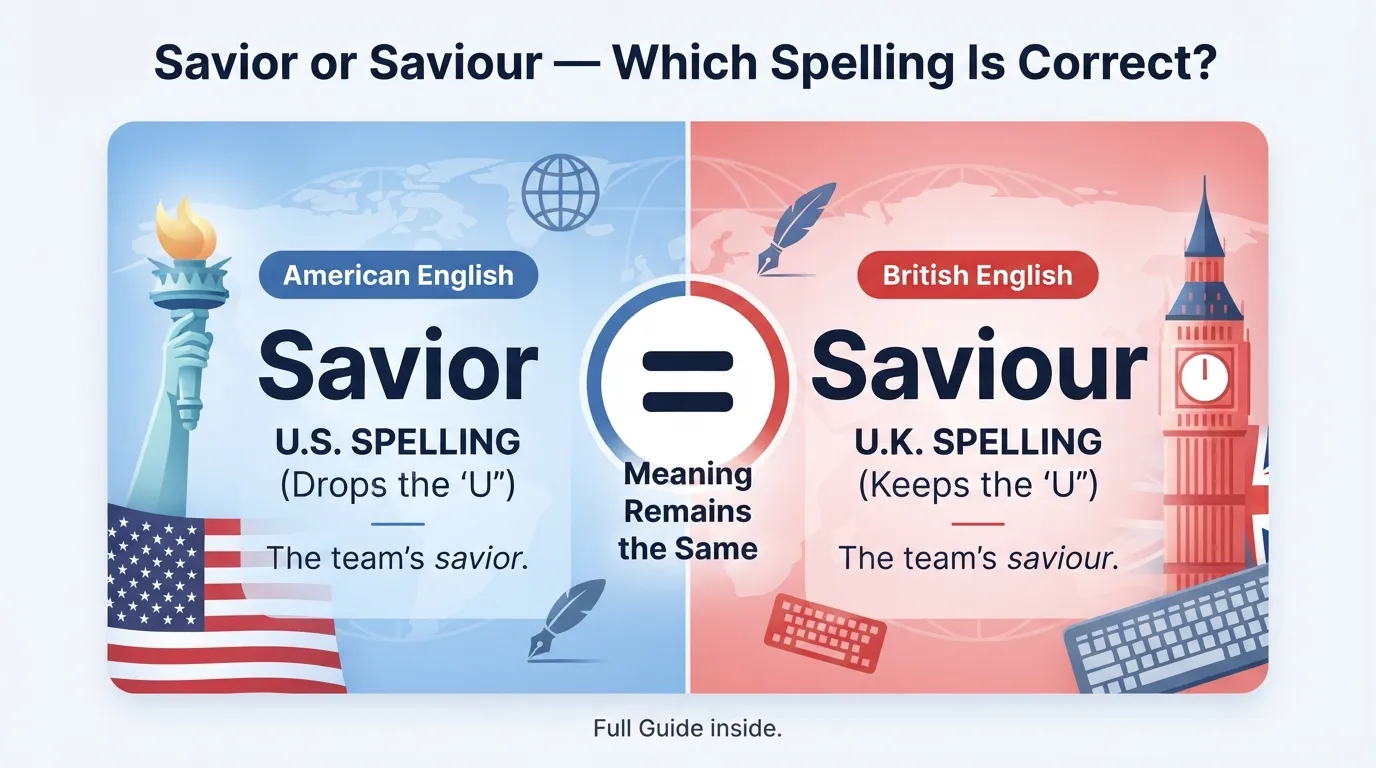
Both spellings are correct. They just belong to different English versions.
- Savior is the American English spelling.
- Saviour is the British English spelling.
Example:
- American: “He was seen as the team’s savior.”
- British: “He was seen as the team’s saviour.”
The meaning never changes. Only the spelling changes based on your audience.
The Origin of Savior or Saviour
Both words come from the same root. They trace back to the Latin word salvator, meaning “one who saves.” This passed into Old French as sauveour, then entered English.
English later split into two major branches. American English simplified many word endings. British English kept the older, more traditional spellings.
Noah Webster, an American lexicographer, pushed these changes in the early 1800s. He wanted American English to look distinct and simpler. He dropped the “u” from many words. “Saviour” became “savior.” “Colour” became “color.” “Honour” became “honor.”
This is why spelling differences exist today. It is not a mistake. It is history.
British English vs American English Spelling
The core difference sits in the “-or” versus “-our” ending. This pattern appears in many similar words, not just this one.
| Word Type | American Spelling | British Spelling |
| Savior | savior | saviour |
| Color | color | colour |
| Honor | honor | honour |
| Favor | favor | favour |
| Neighbor | neighbor | neighbour |
American English drops the “u.” British English keeps it. Once you learn this pattern, you can predict the spelling of many related words.
Which Spelling Should You Use?
Your choice depends on your audience, not personal taste.
Use “savior” if:
- You write for a U.S. audience.
- Your company or publication follows American English style guides (like AP or Chicago).
- You are writing for U.S. schools, businesses, or media.
Use “saviour” if:
- You write for the UK, Ireland, Australia, New Zealand, or other Commonwealth countries.
- Your publication follows British English standards (like Oxford style).
- You work for a British or Commonwealth-based company.
If your audience is global or mixed:
- Pick one spelling and stay consistent throughout your document.
- Check your brand or company style guide first.
- Match the spelling used elsewhere on the same website or document.
Common Mistakes with Savior or Saviour
- Mixing both spellings in one document. This looks careless. Pick one and stick with it.
- Using the wrong version for your audience. A British newspaper using “savior” looks off-brand. So does a U.S. company using “saviour.”
- Assuming one spelling is “more correct.” Neither is wrong. They are regional choices, not grammar errors.
- Ignoring spellcheck warnings. Many spellcheckers default to American English. Always check your settings if you write in British English.
- Forgetting related words. If you use “saviour,” also use “colour,” “honour,” and “favour” for consistency.
Savior or Saviour in Everyday Examples
In emails:
- American: “Thank you for being our savior during the project deadline.”
- British: “Thank you for being our saviour during the project deadline.”
The news headlines:
- American: “New CEO Seen as Company’s Savior”
- British: “New CEO Seen as Company’s Saviour”
In social media posts:
- American: “This app is a total savior for busy parents.”
- British: “This app is a total saviour for busy parents.”
In formal writing:
- American: “The policy acted as an economic savior for small businesses.”
- British: “The policy acted as an economic saviour for small businesses.”
Notice the sentence structure stays the same. Only the spelling shifts.
Savior or Saviour Google Trends & Usage Data
Search data shows a clear pattern by country. “Savior” dominates searches in the United States. “Saviour” leads in the UK, Australia, Canada, and India.
Canada is a mixed case. Canadian English often blends both American and British spelling rules, so both versions appear there.
Usage also shifts by context. Religious and historical texts often lean toward “saviour,” especially in older or British-published material. Modern American media, tech, and business writing almost always use “savior.”
Comparison Table: Keyword Variations Side by Side
| Feature | Savior | Saviour |
| Region | United States | UK, Ireland, Australia, Canada, NZ |
| Style Guide | AP, Chicago Manual | Oxford, British Council |
| Common Use | Business, tech, U.S. media | News, literature, Commonwealth media |
| Related Spelling Pattern | color, honor, favor | colour, honour, favour |
| Search Volume Leader | United States | United Kingdom, Australia |
FAQs
1. Is “savior” or “saviour” more correct?
Neither is more correct. “Savior” is American English. “Saviour” is British English. Both are grammatically valid.
2. Can I use both spellings in the same document?
No. Pick one spelling and use it consistently throughout your writing.
3. Which spelling does the Bible use?
Older and British-published Bibles often use “saviour.” American Bible translations typically use “savior.”
4. Does Microsoft Word flag one spelling as wrong?
Only if your language setting doesn’t match. Set your document language to “English (US)” or “English (UK)” to avoid false flags.
5. Which spelling should I use for a global audience?
Choose based on your primary audience or brand style guide. If unsure, “savior” is more common in international business and tech writing.
6. Is “saviour” used in Canada?
Yes, though Canadian English mixes both styles. Many Canadian publications use “saviour,” but American influence adds variation.
7. Does the spelling change the word’s meaning?
No. Both spellings mean the same thing: a person or thing that saves someone from harm or difficulty.
Conclusion
“Savior” and “saviour” mean the exact same thing. The only difference is regional spelling. American English uses “savior.” British and Commonwealth English use “saviour.”
This split comes from history, not error. Noah Webster simplified many word endings in the 1800s to shape American English. British English kept the original French-influenced spelling.
To choose correctly, think about your audience. Writing for the U.S.? Use “savior.” Writing for the UK, Australia, or other Commonwealth countries? Use “saviour.” Writing for a mixed or global audience? Pick one spelling and stay consistent across your entire document.
This same “-or” versus “-our” pattern applies to many other words, like “color/colour” and “honor/honour.” Once you understand this rule, you can spell dozens of similar words with confidence.
Whichever version you choose, consistency matters more than which one you pick. Match your audience, match your style guide, and your writing will always look professional.

Sikandar Hayat is the author and creator of Journalneste.com, a website dedicated to heartfelt wishes, messages, greetings, and inspiring words for every special moment. With a passion for meaningful writing, Sikandar creates warm and thoughtful content that helps readers express their feelings with ease. His goal is to provide beautiful, shareable words for birthdays, celebrations, relationships, and memorable occasions.