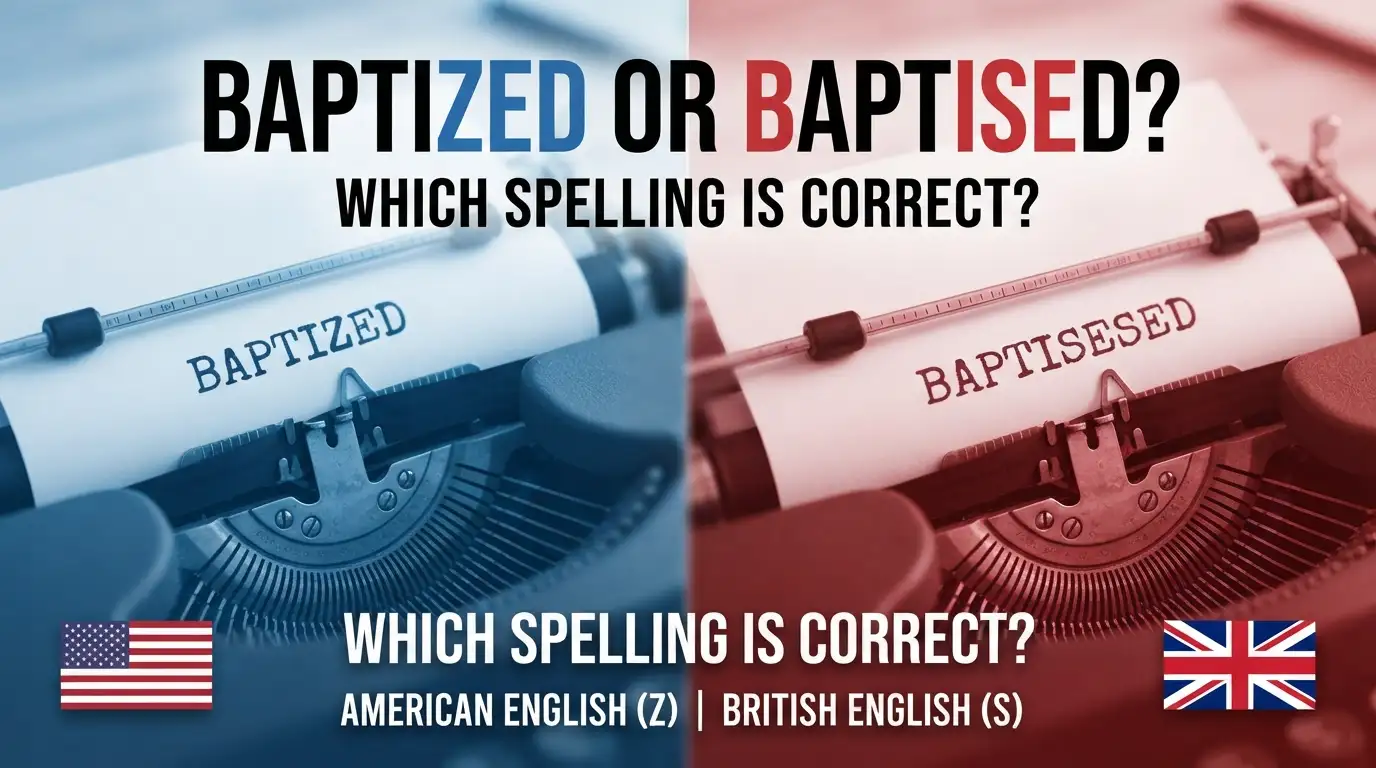
You are writing an invitation, a blog post, or a school paper. You type the word “baptized.” Then you pause. Is it spelled with a “z” or an “s”? Both look correct. Both feel familiar. This small spelling puzzle trips up writers, parents, and students every day.
The confusion comes from one simple fact: English has two main versions. American English and British English do not always agree on spelling. Words that sound the same often look different on the page. “Baptized” and “baptised” are a perfect example.
People search for this term because they want to get it right. A wedding program, a church bulletin, a news article, or a college essay all need consistent spelling. Using the wrong version in the wrong context can look like a typo, even when it is not.
This article gives you the quick answer first. Then it explains the history behind the spelling split, shows you exactly when to use each version, and answers the most common questions people ask.
Baptized or Baptised Quick Answer
Both spellings are correct. The difference depends on where you are, not what you mean.
Example sentences:
- “The baby was baptized last Sunday in Texas.” (American)
- “The baby was baptised last Sunday in London.” (British)
Same meaning. Same pronunciation. Different spelling rule.
The Origin of Baptized or Baptised
The word comes from the Greek baptizein, meaning “to dip” or “to immerse.” It entered English through Latin and Old French centuries ago. Back then, spelling was not standardized at all. Writers spelled words however they liked.
Standard spelling rules came later. In the 1700s and 1800s, dictionary makers on both sides of the Atlantic tried to fix English spelling. In America, Noah Webster wanted simpler, more logical spelling. He dropped extra letters and changed some endings. One of his changes swapped the letter “s” for “z” in many words that came from Greek roots.
This is why American English often uses “z” in words like organize, realize, and baptize. British English kept the older French-influenced “s” spelling, giving us organise, realise, and baptise.
So the split is not random. It comes from two different dictionary traditions that grew apart over time.
British English vs American English Spelling
This “s” versus “z” pattern shows up in many words, not just “baptized.” Once you learn the rule, you can spot it everywhere.
American English tends to use “z” for words ending in -ize or -ized. British English tends to use “s” for the same words, ending in -ise or -ised. This applies to hundreds of English verbs with Greek or Latin roots.
Here is a quick comparison:
| Word Meaning | American Spelling | British Spelling |
| To baptize | baptized | baptised |
| To organize | organized | organised |
| To realize | realized | realised |
| To recognize | recognized | recognised |
| To apologize | apologized | apologised |
| To criticize | criticized | criticised |
Note: Some British style guides actually accept “-ize” endings too (this is called Oxford spelling), but “-ise” remains far more common in everyday British writing.
Which Spelling Should You Use?
The right spelling depends on your audience, not personal taste.
Writing for a US audience:
Use “baptized.” This includes American newspapers, schools, churches, and businesses.
Writing for a UK, Australian, or Commonwealth audience:
Use “baptised.” This includes British newspapers, Australian schools, and most former British colonies.
Writing for a global or mixed audience:
Pick one spelling and stay consistent throughout your entire document. Many international brands and websites choose American spelling because it reaches the largest audience. Others choose British spelling for a more formal or traditional tone.
Writing for a specific church or organization:
Check their style guide. Many churches follow their home country’s spelling convention, but some prefer one style regardless of location.
The golden rule: never mix both spellings in the same piece of writing. Consistency matters more than which version you pick.
Common Mistakes with Baptized or Baptised
Mistake 1: Mixing spellings in one document.
Wrong: “She was baptized in 2019 and later baptised her son in 2022.”
Right: Pick one spelling and use it every time.
Mistake 2: Wrong spelling for the target audience.
Wrong: Using “baptised” in a US church newsletter meant for American readers.
Right: Match the spelling to your readers’ country.
Mistake 3: Misspelling the root word entirely.
Wrong: “baptised” written as “babtised” or “baptized” written as “babtized.”
Right: The correct root is “bapt-,” not “babt-.”
Mistake 4: Confusing the noun and verb forms.
The noun is “baptism,” not “baptizement” or “baptisement.” Only the verb form changes between “baptized” and “baptised.”
Mistake 5: Assuming spellcheck will catch it.
Spellcheck tools often default to one country’s dictionary. They may mark the correct spelling as wrong if your settings do not match your intended audience.
Baptized or Baptised in Everyday Examples
In emails:
“We are so happy to share that our daughter was baptized this past weekend.” (American email)
In news articles:
“The prince was baptised at a private ceremony attended by close family.” (British news style)
In social media posts:
“Blessed day! Our little one was baptized today. 🙏” (American caption)
“So proud — our little one was baptised today. 🙏” (British caption)
In formal writing:
“Church records confirm the child was baptized on the 14th of March, 1892.” (American academic paper)
“Parish records confirm the child was baptised on the 14th of March, 1892.” (British academic paper)
Across all these formats, the meaning never changes. Only the spelling shifts based on regional style.
Baptized or Baptised – Google Trends & Usage Data
Search data shows a clear geographic pattern. “Baptized” dominates searches in the United States, Canada, and the Philippines, where American English spelling is standard in schools and media.
“Baptised” leads searches in the United Kingdom, Australia, New Zealand, Ireland, India, and South Africa, where British English spelling conventions are taught and used.
Globally, “baptized” tends to show higher overall search volume. This is largely due to the size of the US population and the widespread use of American English online, in software, and in international media. However, “baptised” remains the standard and expected spelling across most Commonwealth nations.
Context also matters. Religious and church-related content often follows the denomination’s home country style, while news outlets almost always follow their national style guide without exception.
Keyword Variations Comparison Table
| Spelling Variation | Region | Common Use Case |
| Baptized | US, Canada, Philippines | Everyday US English, American media |
| Baptised | UK, Australia, NZ, India, South Africa | Everyday British/Commonwealth English |
| Baptism | Global (noun form) | Same in both American and British English |
| Baptismal | Global (adjective form) | Same in both American and British English |
FAQs
1. Is “baptized” or “baptised” more correct?
Neither is more correct. “Baptized” is standard American English, and “baptised” is standard British English. Both are fully accepted in their respective regions.
2. Which spelling does the Bible use?
Bible translations vary by publisher and target market. American Bible editions typically use “baptized,” while British editions typically use “baptised.”
3. Can I use “baptized” in the UK?
You can, but it will look slightly out of place in formal British writing. Most UK readers expect “baptised.”
4. Does Microsoft Word or Google Docs mark one as wrong?
Yes, sometimes. Your spellcheck language setting determines which spelling it accepts. Switch your document language to “English (UK)” or “English (US)” to match your needs.
5. Is the noun spelled differently too?
No. “Baptism” is spelled the same way in both American and British English. Only the verb form (“baptized” vs. “baptised”) changes.
6. Which spelling should I use for a global website?
Most global websites choose American spelling because it has the widest reach, but this is a style choice, not a strict rule. Pick one and stay consistent.
7. Why does English have two spelling systems at all?
Different dictionary traditions developed in the US and UK starting in the 1700s and 1800s. Noah Webster’s American dictionary simplified many words, creating the split we still use today.
Conclusion
“Baptized” and “baptised” mean exactly the same thing. The only difference is regional spelling. American English uses “baptized” with a “z.” British and Commonwealth English use “baptised” with an “s.” This pattern follows a wider rule that applies to many English verbs, including organize/organise and realize/realise.
The most important rule is consistency. Choose the spelling that matches your audience, and use it throughout your entire document, website, or social media post. Never mix both versions in the same piece of writing.
If you write mainly for American readers, use “baptized.” If you write for UK, Australian, or Commonwealth readers, use “baptised.”If your audience is global, pick one style and stick with it across everything you publish.
Understanding this simple regional rule removes the guesswork. Now you can write with confidence, no matter which version of English your readers expect.

Sikandar Hayat is the author and creator of Journalneste.com, a website dedicated to heartfelt wishes, messages, greetings, and inspiring words for every special moment. With a passion for meaningful writing, Sikandar creates warm and thoughtful content that helps readers express their feelings with ease. His goal is to provide beautiful, shareable words for birthdays, celebrations, relationships, and memorable occasions.