You are not alone. Millions of people ask this every year. The two words look different, but they mean the same thing. Both name the rubber ring around a wheel. So why two spellings?
People search “tire or tyre” for a few good reasons. Blog writers may want to use the correct spelling in their posts. Online sellers of car parts may use the right term to help more buyers find their products. When communicating with clients in another country, writers may also need to choose the spelling commonly used there. Others just got corrected by a friend and want to know who was right.
This confusion is easy to solve. It comes down to one thing: where your reader lives.
In this guide, you will get a quick answer first. Then you will learn where each spelling came from, how US and UK English differ, and which one to pick. You will also see common mistakes, real examples, and answers to common questions.
Let’s clear it up.
Tire or Tyre Quick Answer
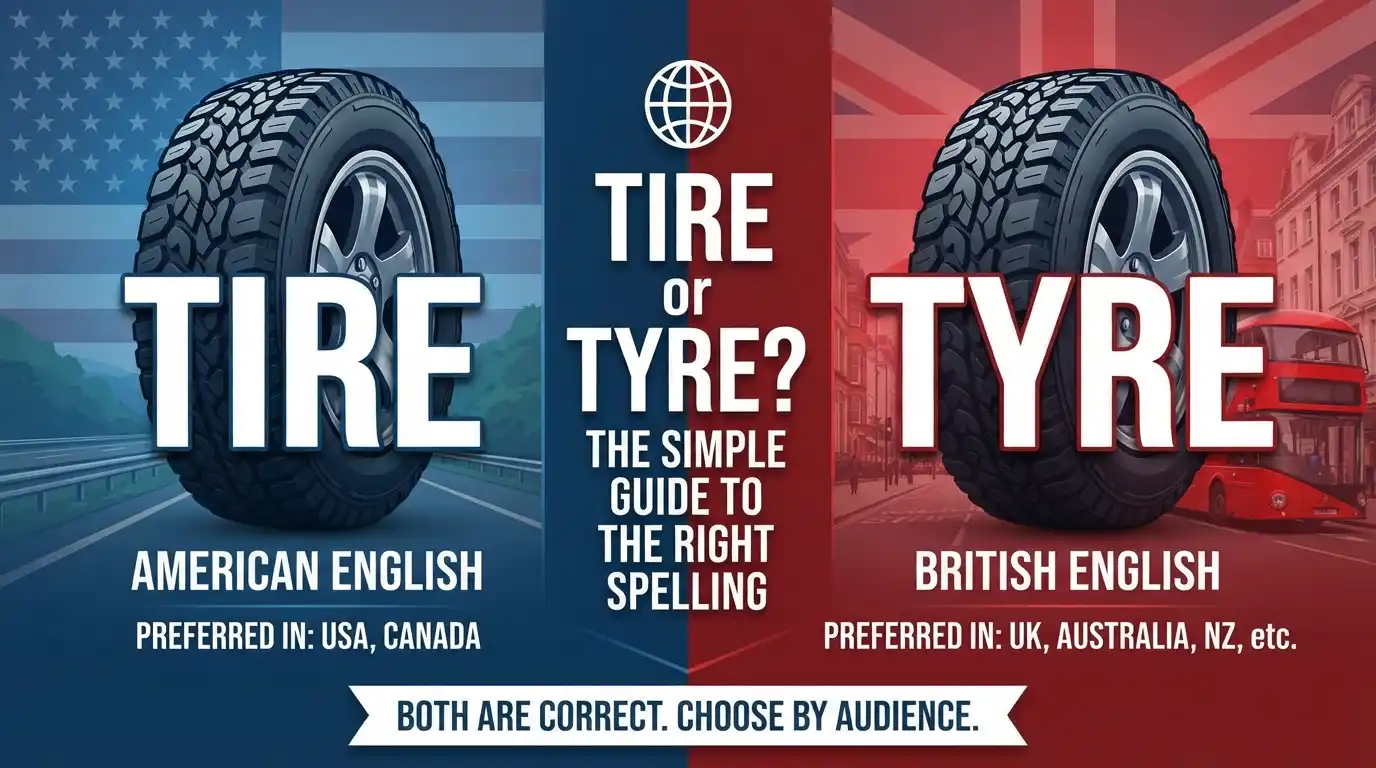
Both are correct. They are two spellings of the same word.
- Tire is the American English spelling. It is also common in Canada.
- Tyre is the British English spelling. It is used in the UK, Australia, New Zealand, India, Pakistan, South Africa, and Ireland.
Examples:
- “I need a new tire for my truck.” (American)
- “I need a new tyre for my lorry.” (British)
- “The car has a flat tyre.” (British)
- “The car has a flat tire.” (American)
The rule is simple: use “tire” for a US audience. Use “tyre” for a UK or Commonwealth audience. Never mix them in one text.
The Origin of Tire or Tyre
The word has a long story.
Many experts link “tire” to the old word “attire.” Attire means to dress or to equip. Long ago, wheels were made of wood. Workers put an iron band around the wooden wheel. This band “dressed” the wheel. People began calling that band a “tire.”
In the old days, English had no fixed spelling. People wrote “tire,” “tyre,” and “tyer” as they pleased. Both forms were in use for hundreds of years.
Then came the air-filled rubber tire. John Boyd Dunlop made a popular one in the late 1800s. Cars and bikes spread fast. Printers, makers, and writers needed one clear spelling.
Here is where the paths split:
- In Britain, “tyre” became the standard in the early 1900s. Many people think it looked more “proper.”
- In the United States, people kept “tire.” It was shorter and matched the older spelling.
So neither spelling is new or wrong. The UK simply settled on one form, and the US settled on the other.
A fun note: the verb “to tire,” meaning to get sleepy or worn out, has a different origin. It comes from an Old English word. Its spelling is always “tire,” even in the UK. So a British writer can write: “Long drives tire me, so I changed my tyres.”
British English vs American English Spelling
Many words are spelled in two ways across the Atlantic. Tire and tyre is one of the most common pairs. American English often drops extra letters. British English often keeps older forms.
| Word Meaning | American English | British English |
| Rubber wheel cover | tire | tyre |
| Middle point | center | centre |
| Shade of black and white | gray | grey |
| Hue (red, blue) | color | colour |
| Car fuel | gas | petrol |
| To get sleepy (verb) | tire | tire |
A few things to remember:
- The verb “tire” (to get tired) is the same in both countries.
- Only the wheel’s meaning changes spelling.
- Other words follow the same pattern: “center/centre,” “color/colour,” “gray/grey.”
If you know that pattern, you will spot the right choice faster.
Which Spelling Should You Use?
Choose by audience. Ask: who will read this?
For a US audience Use tires. This includes US websites, US shops, and US customers. Google also treats “tire” as the main form for people in the States.
For a UK or Commonwealth audience Use tyre. This covers the UK, Ireland, Australia, New Zealand, India, Pakistan, and South Africa. Readers there expect it. “Tire” may look like a typo to them.
For Canada, use tires. Canadian English follows American usage here.
For a global audience Pick one and stay with it. Many global brands use the spelling of their main market. Some also add the other spelling once, in a title or a tag, so more people find them.
For SEO If you sell to both regions, make two pages. Write one with “tire” and one with “tyre.” Your text will read well, and each group will find the page that fits.
For formal writing Follow the style guide of your school, company, or publisher. If there is none, follow your reader’s country.
Common Mistakes with Tire or Tyre
Here are the errors people make most often.
1. Mixing both spellings in one text
- Wrong: “Check each tire. A worn tyre is unsafe.”
- Right: “Check each tyre. A worn tyre is unsafe.”
2. Using “tyre” for the verb
- Wrong: “Long walks tyre me out.”
- Right: “Long walks tire me out.”
3. Mixing up “tire” and “tier”
- “Tier” means a level or row. Example: “a three-tier cake.”
- “Tire” is the wheel part or the verb.
4. Thinking one spelling is “wrong”
- Neither one is wrong. They are regional choices.
5. Using the wrong spelling for your audience
- A shop in London that writes “tire” may look foreign. A shop in Texas that writes “tyre” may look odd.
6. Forgetting related words
- Keep the same style across terms: “tyre pressure,” “tyre shop,” “tyre tread” (UK) or “tire pressure,” “tire shop,” “tire tread” (US).
7. Trusting spell check blindly
- Your tool may be set to US English or UK English. Check the language setting
Tire or Tyre in Everyday Examples
Here is how each spelling looks in real life.
Emails
- US: “Hi Mark, the new tires arrive Friday. Please confirm the time.”
- UK: “Hi Mark, the new tyres arrive Friday. Please confirm the time.”
News headlines
- US: “Tire recall affects 200,000 trucks”
- UK: “Tyre recall affects 200,000 lorries”
Social media
- US: “Just got my tires changed. Smooth ride again! #cartalk”
- UK: “Just got my tyres changed. Smooth ride again! #cartalk”
Formal writing
- US: “All vehicles must pass a tire inspection every year.”
- UK: “All vehicles must pass a tyre inspection every year.”
Product pages
- US: “All-season tires for SUVs. Free shipping.”
- UK: “All-season tyres for SUVs. Free delivery.”
School essays
- Follow your teacher’s guide. If your school uses British English, write “tyre.”
Notice that the rest of the sentence often changes too. “Lorry” and “truck,” “delivery” and “shipping.” Keep the whole text in one style.
Tire or Tyre Google Trends & Usage Data
Search habits follow geography. Here is the general pattern. (For exact numbers, check Google Trends yourself, since results change over time.)
- United States and Canada: “Tire” is the main search term. People rarely type “tyre.”
- United Kingdom and Ireland: “Tyre” is the main search term.
- Australia and New Zealand: “Tyre” leads by a wide margin.
- India, Pakistan, and South Africa: “Tyre” is the usual form. English there follows the British style.
- Global total: “Tire” often shows higher worldwide volume because the US has a huge online audience. But “tyre” is very strong across many countries.
Context matters too:
- Searches like “tire pressure,” “tire size,” and “tire near me” are common in the US.
- Searches like “tyre pressure,” “tyre prices,” and “tyre shop” are common in the UK and South Asia.
- Searches that show up for the keyword itself, such as “tire or tyre,” come from people who are unsure. They come from all countries.
Tip: Open Google Trends, type both words, and set the country filter. In under a minute, you will see which one your readers use.
Side-by-Side Comparison
| Feature | Tire | Tyre |
| Type of English | American, Canadian | British, Commonwealth |
| Main countries | USA, Canada | UK, Ireland, Australia, NZ, India, Pakistan, South Africa |
| Meaning (wheel) | Rubber cover on a wheel | Rubber cover on a wheel |
| Verb “to get tired” | tire | tire |
| Pronunciation | Same (“tahyr”) | Same (“tahyr”) |
| Example phrase | “tire pressure” | “tyre pressure” |
| Best for | US/Canada readers | UK/Commonwealth readers |
| Seen as an error? | Only in UK-style texts | Only in US-style texts |
FAQs About Tire or Tyre
1. Is it a tire or tyre? Both are right. “Tire” is American. “Tyre” is British.
2. Do they sound different? No. They are said the same way.
3. Which spelling is older? Both are old. English used both forms for hundreds of years. The UK later picked “tyre” and the US kept “tire.”
4. Is “tyre” a typo in American English? In US writing, yes, it may look like one. In UK writing, it is correct.
5. What do Australians, Indians, and Pakistanis write? They write “tyre,” following British English.
6. What do Canadians write? Most Canadians write “tire.”
7. Does the verb “to tire” change in the UK? No. The verb is “tire” everywhere.
8. Which one is better for SEO? Use the spelling your target country searches. For both, make two pages.
9. Can I use both on one page? Avoid it. Pick one for the main text. You may mention the other ones, such as “tire (tyre in UK English).”
Conclusion
The answer is clear: “tire” and “tyre” are both correct. They name the same thing. The only difference is where you live and who you write for.
Here are the key points to keep:
- Tire is the American and Canadian spelling.
- Tyre is the British and Commonwealth spelling. This includes India, Pakistan, Australia, and New Zealand.
- The two words sound the same.
- The verb “to tire” is spelled the same everywhere.
- Both spellings come from the same old word, tied to “attire.”
- The split grew in the early 1900s, when the UK chose “tyre” and the US kept “tire.”
Your advice is simple. Know your reader. Pick one spelling. Use it from start to end. Match related words too, like “center” or “centre.”
For websites, check Google Trends for your country. If you sell in many places, build a page for each spelling.
Now you can write “tire” or “tyre” with full confidence.

Sikandar Hayat is the author and creator of Journalneste.com, a website dedicated to heartfelt wishes, messages, greetings, and inspiring words for every special moment. With a passion for meaningful writing, Sikandar creates warm and thoughtful content that helps readers express their feelings with ease. His goal is to provide beautiful, shareable words for birthdays, celebrations, relationships, and memorable occasions.