Have you ever paused mid-sentence, unsure if you should write “aesthetic” or “esthetic”? You’re not alone. This tiny spelling gap trips up writers, students, and marketers every day.
The confusion is simple. Both spellings mean the same thing. Both sound the same when you say them out loud. But one small letter that “a” at the start changes based on where you live and who you’re writing for.
People search for this term for many reasons. Some are writing a school essay. Some are naming a beauty business. Some just want to sound polished in an email or social post. And most people find outdated advice or vague explanations that don’t clear things up.
This guide fixes that. You’ll get a quick answer first. Then you’ll learn the history, the spelling rules, and real examples. By the end, you’ll know exactly which version to use and why.
Aesthetic or Esthetic – Quick Answer
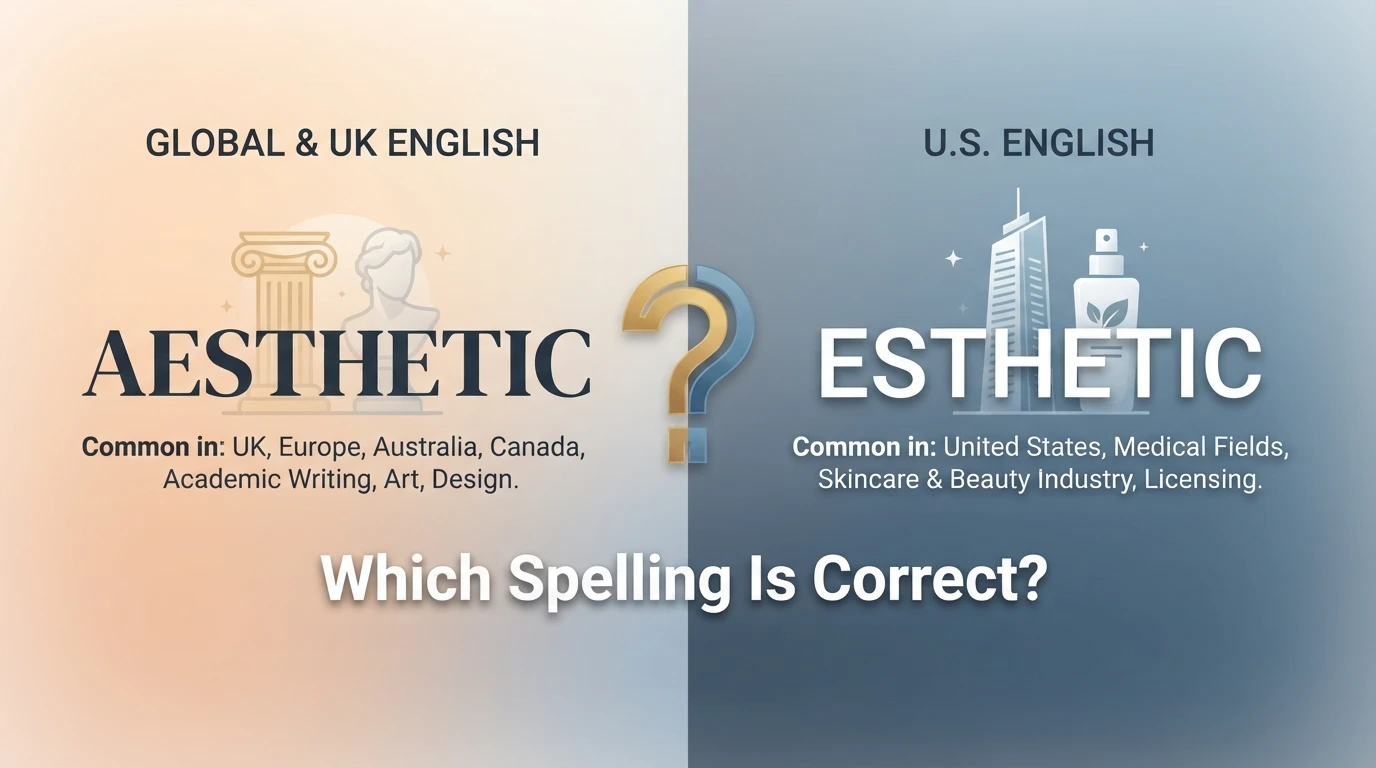
Use “aesthetic” if you write in British English or for a global audience. This spelling is used in the UK, Canada, Australia, and most of the world.
Use “esthetic” if you write in American English, especially in medical or skincare fields. This spelling is common in the U.S., though “aesthetic” is also accepted there.
Examples:
- “The hotel has a modern aesthetic.” (UK, global)
- “She works as an esthetician.” (US, beauty industry)
When in doubt, “aesthetic” is the safer, more widely recognized choice.
The Origin of Aesthetic
The word comes from the Greek term aisthetikos, meaning “of sense perception.” It relates to how we experience beauty through our senses, sight, sound, and feeling.
The word entered English in the 1800s through German philosophy. German writers used “Ästhetik” to describe the study of beauty and art. English scholars borrowed this word and kept the “ae” spelling, which reflects its Greek and Latin roots.
Spelling differences exist because of a bigger pattern in English. British English tends to keep older Latin and Greek spellings, like “ae” and “oe.” American English often simplifies these to just “e.” This same pattern shows up in other word pairs, like “encyclopaedia” versus “encyclopedia.”
So “esthetic” isn’t a mistake. It’s part of a wider American trend to simplify complex spellings.
British English vs American English Spelling
Spelling rules differ because American English went through deliberate reform in the 1800s. Lexicographer Noah Webster wanted simpler, more phonetic spelling for American readers. He dropped many silent letters and unusual letter pairs.
This reform changed many word pairs, not just “aesthetic.” Here’s how the pattern plays out:
| British English | American English | Meaning |
| Aesthetic | Esthetic | Related to beauty |
| Colour | Color | Hue or shade |
| Analyse | Analyze | To examine closely |
| Theatre | Theater | Place for performances |
| Encyclopaedia | Encyclopedia | Reference book |
Notice the pattern. British spelling often keeps extra letters from Latin or Greek. American spelling trims them for simplicity.
Which Spelling Should You Use?
Your audience decides your spelling. Here’s a simple breakdown:
Writing for a U.S. audience:
Use “esthetic,” especially in medical, dermatology, or skincare contexts. Many U.S. beauty schools and clinics use this spelling officially.
Writing for UK, Canada, Australia, or Commonwealth countries:
Use “aesthetic.” This is the standard spelling in these regions, across all industries.
Writing for a global or mixed audience:
Use “aesthetic.” It’s the more universally recognized spelling and rarely looks wrong, even to American readers.
Writing in academic or philosophical contexts:
Use “aesthetic,” even in the U.S. This spelling dominates in art, design, and philosophy writing worldwide.
Common Mistakes with Aesthetic
Many writers make small errors with this word. Here are the most frequent ones:
Mixing spellings in one document. Pick one spelling and stick with it throughout your text.
Using “esthetic” in academic writing. Most journals and universities prefer “aesthetic,” even in the U.S.
Misspelling as “asthetic” or “athestic.” These are simple typos, but spell-check often misses them if autocorrect assumes you meant something else.
Confusing “aesthetic” with “esthetician” rules. Some U.S. states legally require the spelling “esthetician” for licensing, even if the person prefers “aesthetician.” Always check local rules for business names.
Overusing the word as a vague compliment. “That’s so aesthetic” is trendy slang, but in formal writing, be specific about what looks appealing and why.
Aesthetic in Everyday Examples
The In emails:
“We’d like the new office design to match a minimalist aesthetic.”
News articles:
“Critics praised the film’s bold visual aesthetic and use of color.”
Social media captions:
“Cottagecore aesthetic is trending again this fall 🍂”
In formal writing:
“The study explores the aesthetic principles behind classical architecture.”
The in business names (U.S.):
“Glow Esthetics Skincare Clinic”
In business names (UK/global):
“Pure Aesthetics Studio”
Aesthetic – Google Trends & Usage Data
Search data shows “aesthetic” is searched far more often worldwide than “esthetic.” It dominates in the UK, Australia, Canada, India, and most non-U.S. countries.
In the United States, both spellings appear in search results, but “aesthetic” still leads in general use. “Esthetic” spikes specifically around beauty, skincare, and licensing topics, like “esthetician license” or “medical esthetics.”
Social media platforms show a similar pattern. The word “aesthetic” trends heavily on Pinterest, Instagram, and TikTok, often describing a visual style, like “dark academia aesthetic” or “clean girl aesthetic.” This usage rarely switches to “esthetic,” even among American users.
Keyword Variation Comparison
| Term | Common Region | Common Field |
| Aesthetic | Global, UK, Academic | Art, design, philosophy, general use |
| Esthetic | United States | Skincare, medical, beauty licensing |
| Esthetician | United States | Beauty industry job title |
| Aesthetician | UK, global | Beauty industry job title |
Frequently Asked Questions
Is “esthetic” a real word?
Yes. It’s a valid American English spelling, especially common in skincare and medical fields.
Which spelling is more correct, aesthetic or esthetic?
Neither is wrong. “Aesthetic” is more widely used and accepted globally. “Esthetic” is standard in specific U.S. industries.
Why do skincare businesses use “esthetic” instead of “aesthetic”?
Many U.S. states use “esthetic” and “esthetician” in official licensing and legal documents, so businesses follow that spelling for consistency.
Can I use “aesthetic” in the U.S.?
Yes. Americans understand and often use “aesthetic,” especially outside the medical and beauty industries.
What’s the plural of aesthetic?
The plural is “aesthetics,” which also refers to the branch of philosophy that studies beauty and art.
Does spell-check flag “esthetic” as wrong?
Some spell-checkers set to British English will flag it. Set your language preference to U.S. English if you want to use this spelling without warnings.
Is “aesthetics” the same as “esthetics”?
Yes, they mean the same thing. The spelling choice depends on your region and industry, not the meaning.
Conclusion
The “aesthetic or esthetic” question comes down to one thing: your audience. Both spellings are correct. Both mean the same thing something related to beauty, style, or visual appeal.
Choose “aesthetic” if you write for a UK, global, or academic audience. It’s the more common and widely recognized spelling worldwide. Choose “esthetic” if you write for a U.S. audience, especially in skincare, medical, or licensing contexts, where this spelling is often required by law or industry standard.
The most important rule is consistency. Pick one spelling and use it throughout your entire piece of writing. Mixing both looks careless and unprofessional.
Now you know the history behind this spelling split, the regional rules, and real examples for emails, social media, and formal writing. Use this guide anytime you’re unsure which version fits your project.

Sikandar Hayat is the author and creator of Journalneste.com, a website dedicated to heartfelt wishes, messages, greetings, and inspiring words for every special moment. With a passion for meaningful writing, Sikandar creates warm and thoughtful content that helps readers express their feelings with ease. His goal is to provide beautiful, shareable words for birthdays, celebrations, relationships, and memorable occasions.