Ever paused mid-sentence, unsure If someone has “flair” or “flare” for design? You’re not alone. These two words sound identical but mean completely different things, and mixing them up is one of the most common English spelling mix-ups. People search “flair or flare” because spell-check won’t catch the error if both words are spelled correctly, just used wrong. This confusion trips up writers, students, and even professionals in emails and articles.
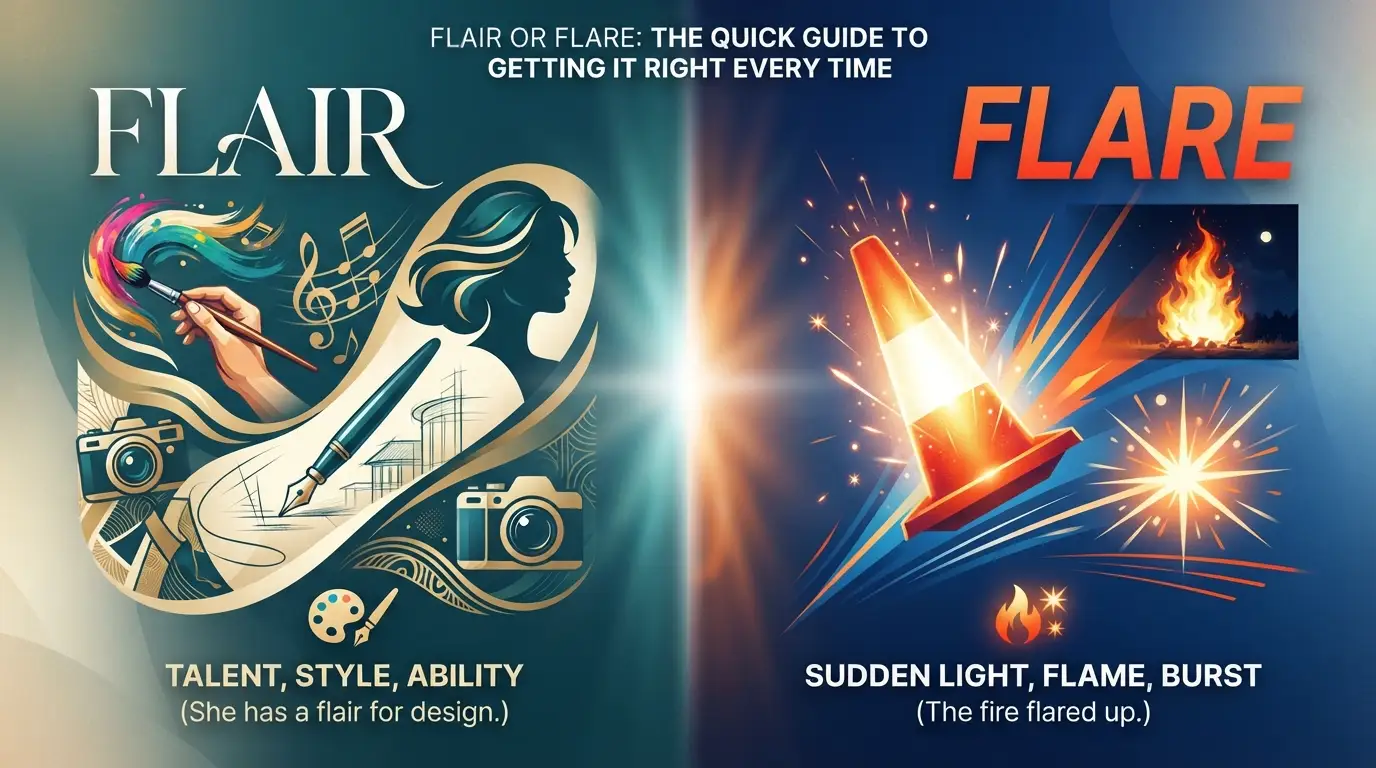
The good news: once you learn the difference, you’ll never confuse them again. “Flair” refers to a natural talent or stylish quality, think “she has a flair for cooking.” “Flare,” on the other hand, describes a sudden burst of light, flame, or emotion like “the flare lit up the night sky” or “tempers began to flare.”
This guide gives you a quick answer, the word origins, spelling rules across English dialects, common mistakes, real-world examples, and a full FAQ section so you can use the right word with confidence every time.
Flair or Flare – Quick Answer
Here’s the simple rule:
- Flair = talent, style, or a natural ability. “He writes with real flair.”
- Flare = a sudden flame, burst of light, or sudden increase in emotion/pain. “The road flares warned drivers of danger ahead.”
Quick memory trick: Flair rhymes with “hair” thinking of a stylish hairstyle. Flare rhymes with “stare” , think of a bright light making you stare.
The Origin of Flair or Flare
Both words trace back to French and Latin, but through very different paths.
Flair comes from the Old French word flair, meaning “sense of smell” or “instinct.” It entered English in the late 1800s, originally used to describe a keen instinct for something like a talent for spotting quality. Over time, it shifted to mean stylish talent or natural skill.
Flare has murkier origins. It likely comes from the Latin flagrare, meaning “to blaze” or “burn.” It first appeared in English in the 1500s, describing a spreading flame or sudden burst of light. This meaning has stayed fairly consistent for centuries.
Because the words developed independently and only became homophones by coincidence, spelling confusion is common especially since neither word looks obviously connected to its meaning.
British English vs American English Spelling
Unlike many British-American spelling differences (like “colour” vs “color”), flair and flare are spelled the same way in both British and American English. There’s no regional variation here; this isn’t a “-ize” vs “-ise” situation.
The confusion isn’t about dialect. It’s about meaning. Both UK and US speakers must choose the correct word based on context, not location.
| Feature | Flair | Flare |
| Meaning | Talent, style, natural ability | Sudden flame, light, or burst |
| Part of speech | Noun | Noun / Verb |
| US spelling | Flair | Flare |
| UK spelling | Flair | Flare |
| Example | “She has a flair for design.” | “The engine flared up suddenly.” |
| Word origin | Old French (flair – sense of smell) | Latin (flagrare – to blaze) |
Which Spelling Should You Use?
Since spelling doesn’t change by region, your only job is picking the right word for the right meaning:
- For US writers: Use “flair” for talent, style, or personality. Use “flare” for fire, light, or sudden bursts (anger, pain, symptoms).
- For UK and Commonwealth writers: Same rule applies: no regional exception exists here.
- For global/international audiences: Stick to context. If you’re describing someone’s creative ability, it’s “flair.” If you’re describing something igniting or intensifying, it’s “flare.”
There is one nuance: pant styles are sometimes called “flares” (as in “flared jeans”), referring to the flared, widening shape, not a spelling variant of “flair.”
Common Mistakes with Flair or Flare
- “She has a flare for fashion.” ❌ → Should be “flair” (talent).
- “His temper began to flair up.” ❌ → Should be “flare” (sudden emotion).
- “The chef added his own flare to the dish.” ❌ → Should be “flair” (style).
- “A road flare lit up the highway.” ❌ → Should be “flare” (the object).
- “Her back pain started to flair.” ❌ → Should be “flare” (a symptom intensifying).
Quick fix: If you can replace the word with “talent” or “style,” use flair. If you can replace it with “burst,” “flame,” or “spike,” use flare.
Flair or Flare in Everyday Examples
In emails:
“Thanks for adding your creative flair to the presentation. It really stood out.”
The news headlines:
“Wildfire risk flares up across the region amid dry conditions.”
In social media posts:
“Loving the flair this new café brings to the neighborhood ☕✨”
Informal writing:
“The candidate demonstrated a natural flair for public speaking during the interview.”
In health contexts:
“Patients with arthritis often report their symptoms flare during cold weather.”
In fashion:
“Flared trousers are making a comeback this season.”
Flair or Flare – Google Trends & Usage Data
Search interest for “flair vs flare” remains steady year-round, spiking occasionally around fashion seasons (flared jeans trends) and health-related searches (symptom flare-ups). Interest is roughly consistent across English-speaking countries the US, UK, Canada, and Australia since, as noted, the confusion is about meaning, not regional spelling.
Common related searches include “flair up or flare up,” “flair for something,” and “flare jeans vs flair jeans” showing that most confusion centers on the phrase “flare up” (correct) being misspelled as “flair up” (incorrect).
Keyword Variation Comparison Table
| Phrase | Correct? | Meaning |
| Flair for something | ✅ Correct | Natural talent |
| Flare up | ✅ Correct | Sudden burst (anger, fire, symptoms) |
| Flair up | ❌ Incorrect | Common misspelling of “flare up” |
| Flare for design | ❌ Incorrect | Should be “flair for design” |
| Flared jeans | ✅ Correct | Widened pant style |
| Flair jeans | ❌ Incorrect | Should be “flared jeans” |
FAQs
1. Is it “flair up” or “flare up”?
It’s “flare up.” This phrase always refers to a sudden increase in intensity, anger, fire, or symptoms so “flare” is correct.
2. Is it “flair for” or “flare for”?
It’s “flair for,” as in “a flair for cooking.” This describes natural talent, so “flair” is correct.
3. Are flair and flare pronounced the same?
Yes, both words are homophones; they sound identical but have different spellings and meanings.
4. Does British English spell it differently than American English?
No. Both “flair” and “flare” are spelled the same way in British and American English. The difference is entirely about meaning, not dialect.
5. What does “flare” mean in health contexts?
In health, “flare” (or “flare-up”) describes a sudden worsening of symptoms, common in conditions like arthritis, IBS, or eczema.
6. Is “flare” always about fire?
Not always. While it often relates to flames or light, “flare” also describes sudden increases in emotion, pain, or intensity, and can describe a widening shape (flared trousers).
7. What’s an easy way to remember the difference?
Flair = talent (think “fancy” or “stylish”). Flare = fire or burst (think “flame” or “flash”). Both start with “fl,” but only one relates to flames.
Conclusion
“Flair” and “flare” are two of English’s trickiest homophones because they sound identical but serve completely different purposes. “Flair” describes natural talent or personal style. Someone has a flair for something. “Flare” describes a sudden flame, burst of light, or spike in intensity something flares up.
Unlike many English words, spelling doesn’t change between British and American English here, so the real challenge is choosing the right word for the right meaning, not the right regional spelling. Remember the simple trick: flair rhymes with hair (style), and flare rhymes with stare (fire and light).
If you’re writing a professional email, a news article, or a casual social post, double-checking this pair takes just a second and instantly boosts your writing’s credibility. Keep this guide handy, and you’ll never second-guess “flair or flare” again.

Sikandar Hayat is the author and creator of Journalneste.com, a website dedicated to heartfelt wishes, messages, greetings, and inspiring words for every special moment. With a passion for meaningful writing, Sikandar creates warm and thoughtful content that helps readers express their feelings with ease. His goal is to provide beautiful, shareable words for birthdays, celebrations, relationships, and memorable occasions.