Many people type “disdain” when they mean “disdain,” then stop and wonder which one is right. This mix-up is common because the two words look almost the same and sound similar when spoken quickly. But they are not interchangeable. One word means scorn or contempt. The other is a rare, old word about staining or discoloration.
People search “disdain or distain” for a simple reason: spellcheck sometimes lets both words through, since both exist in English dictionaries. This creates doubt. None of these guesses are quite right, and that confusion is exactly what this article clears up.
By the end, you will know the correct spelling to use in almost every case, understand where “disdain” actually came from, and see real examples of each word in use. You will also get quick answers for emails, essays, and everyday writing, so you never have to second-guess this spelling again.
Disdain or Distain Quick Answer
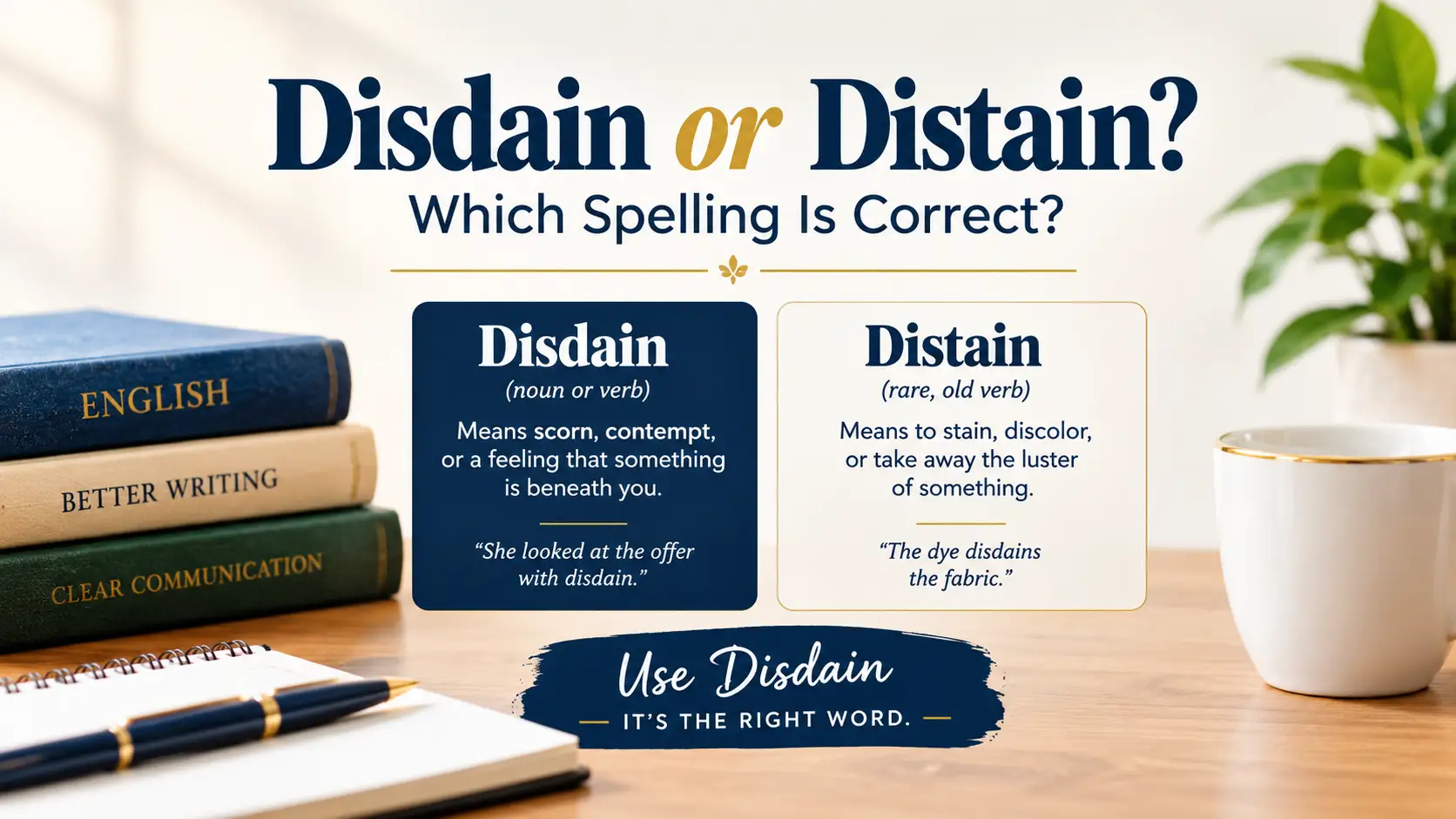
Use “disdain.” It is the word you want almost every time.
- Disdain (noun or verb) means scorn, contempt, or a feeling that something is beneath you.
- “She looked at the offer with disdain.”
- “He disdains cheap shortcuts.”
- Distain is a very old, rare verb that means to stain, discolor, or take away the luster of something. It is almost never used in modern writing.
- “The dye disdains the fabric.” (archaic usage)
If you are writing an email, essay, or social media post about looking down on someone or something, “disdain” is correct. “Disdain” will look like a typo to most readers, even though it is technically a real word.
The Origin of Disdain or Distain
“Disdain” comes from Old French designer, which traces back to Latin dedignari. This Latin root breaks down into de- (away, against) and dignari (to consider worthy). So “disdain” literally means to consider something unworthy of respect.
“Distain” also has French roots, from desteindre or desteint, meaning to take the color out of something. This word entered English separately from “disdain” and was never meant to be a variant spelling. Over time, “distain” fell out of common use, mostly surviving in old poetry and historical texts.
The confusion today is not really about history. It comes from how similar the two words look on a page and how easy it is to mistype one letter. Spell Check tools often recognize “disdain” as a valid English word, so they do not flag it as an error, even when the writer meant “disdain.”
British English vs American English Spelling
This is not a case like “color” versus “colour” or “realize” versus “realise.” “Disdain” is spelled the same way in both British and American English. There is no regional variant.
“Distain” is not a British spelling of “disdain” either. It is a separate, older word with its own (different) meaning, used rarely in both dialects today.
| Word | British English | American English | Meaning |
| Disdain | disdain | disdain | Contempt or scorn |
| Disdain | disdain (rare, archaic) | disdain (rare, archaic) | To stain or discolor |
So if you were hoping this was a simple US-vs-UK spelling issue, it is not. The correct word to use for “contempt” is “disdain” everywhere in the English-speaking world.
Which Spelling Should You Use?
- In the United States: Use “disdain.” “Distain” will be read as a spelling mistake in almost any US context, from business emails to school essays.
- In the UK, Canada, Australia, and other Commonwealth countries: Use “disdain” as well. British dictionaries list “disdain” only as a rare, archaic term, not a standard spelling.
- For global or international audiences: “Disdain” is the safe, universally understood choice. Using “disdain” risks confusing readers or making your writing look unpolished, no matter where they are.
There is no audience where “disdain” is the expected or preferred spelling for expressing scorn. If your goal is clear communication, “disdain” is always the better choice.
Common Mistakes with Disdain or Distain
- Typing “disdain” by accident. This usually happens from fast typing or autocorrect suggestions. Always double-check before sending important messages.
- Assuming “distain” is a shorter or informal version of “disdain.” It is not. They are different words with different meanings.
- Using “disdain” in formal writing, thinking it sounds fancier. This can confuse readers or make your writing seem incorrect.
- Mixing up the meaning. Some writers think “disdain” means “to lose respect for,” blending the meanings of both worlds. Stick with “disdain” for that idea.
- Trusting spellcheck alone. Since “disdain” is a real word, spellcheck will not catch this mistake. Proofread manually or read your sentence aloud.
Disdain in Everyday Examples
- Email: “I understand your disdain for last-minute changes, but this update is necessary.”
- News: “The senator expressed open disdain for the proposed bill during the hearing.”
- Social media: “The way people treat service workers with disdain says a lot about them.”
- Formal writing: “The report reflects a clear disdain for outdated industry practices.”
Notice how “disdain” fits naturally into casual and professional writing alike. “Distain” would sound out of place in every one of these examples, since it does not match the intended meaning.
Disdain or Distain Google Trends & Usage Data
Search interest for “disdain” is far higher than for “disdain” across every English-speaking country, including the US, UK, Canada, and Australia. Most searches for “disdain” actually come from people who are unsure how to spell “disdain” or who saw it used incorrectly somewhere else.
“Distain” shows minimal search volume on its own and almost no usage in modern books, news articles, or websites. It survives mainly in historical or poetic texts, rather than everyday communication. This pattern confirms that “disdain” is the standard, expected spelling across regions and contexts, while “disdain” remains a niche, largely forgotten term.
| Term | Common Usage | Search Popularity | Modern Relevance |
| Disdain | Very common | High | Widely used today |
| Disdain | Rare | Very low | Mostly historical/poetic |
Frequently Asked Questions
Is “disdain” a real word?
Yes, but it is archaic and rarely used. It means to stain or discolor something, not to feel contempt.
Is “disdain” a typo for “disdain”?
In almost all modern writing, yes. Most people who type “disdain” mean to write “disdain.”
Does British English use “disdain” instead of “disdain”?
No. British English uses “disdain” for contempt, just like American English. “Distain” is not a regional spelling variant.
Why does spell check not flag “disdain” as wrong?
Because “disdain” is a real, dictionary-recognized word, even though it is outdated. Spellcheck cannot tell you meant a different word.
Can I use “disdain” in creative writing?
Yes, if you want an old-fashioned or poetic tone and mean “to stain.” For everyday meaning of contempt, use “disdain.”
What part of speech is “disdain”?
It works as both a noun (“full of disdain”) and a verb (“she disdains flattery”).
How do I remember the correct spelling?
Think “dis” + “dain,” linked to “design” (to consider worthy), since “disdain” means not considering something worthy of respect.
Conclusion
“Disdain” and “disdain” look alike, but they are not the same word. “Disdain” means scorn or contempt, and it is the spelling you should use in nearly every situation, If you are writing a formal report, a casual text, or a social media post. “Distain” is a rare, old word meaning to stain or discolor, and it rarely appears in modern English.
There is no British-versus-American spelling divide here. Both dialects use “disdain” for expressing contempt. If you see “disdain” in place of “disdain,” it is almost always a typo, not a valid stylistic or regional choice.
Whenever you write, remember: “disdain” is safe, standard, and correct nearly everywhere. Save “disdain” only for historical or poetic contexts where you specifically mean staining or discoloring something. Proofreading carefully and reading your sentence aloud can help you catch this mistake before it reaches your readers, keeping your writing clear and professional.

Sikandar Hayat is the author and creator of Journalneste.com, a website dedicated to heartfelt wishes, messages, greetings, and inspiring words for every special moment. With a passion for meaningful writing, Sikandar creates warm and thoughtful content that helps readers express their feelings with ease. His goal is to provide beautiful, shareable words for birthdays, celebrations, relationships, and memorable occasions.