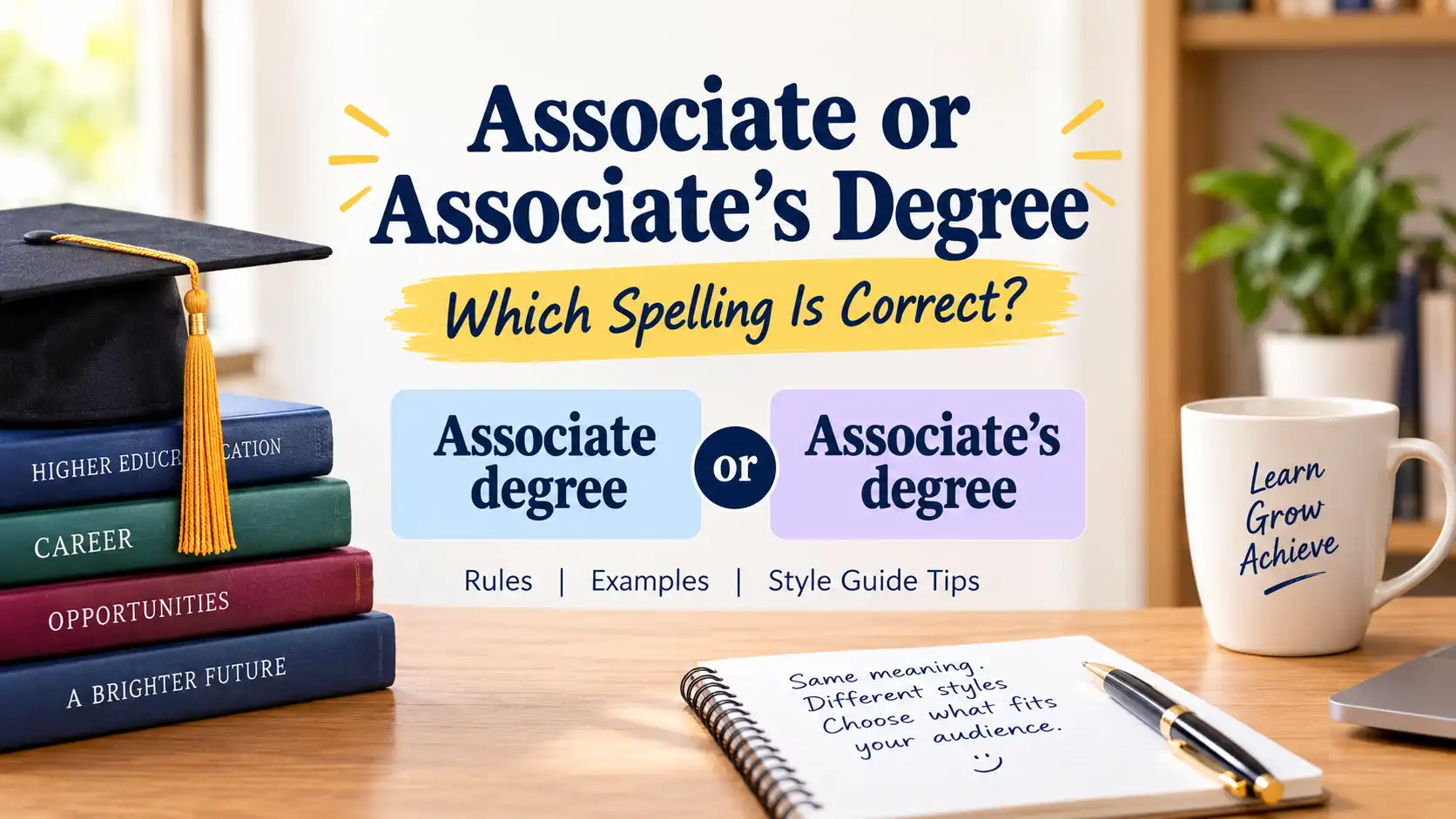
Have you typed “associate degree” and then wondered if you missed an apostrophe? You are not alone. Every day, students, HR teams, and job seekers search for the right way to write this term. Resumes, college websites, and job listings often show different versions. Some say “associate degree.” Others say “associate’s degree.” Both show up in official government sites, too.
This mix-up creates real confusion. A student filling out a college application does not want to look careless. An HR manager writing a job posting wants consistency. A blogger writing about education wants to follow the right style guide.
The good news: this is not a made-up rule. There is a clear answer, and it depends on where you learn it, who you ask, and what style guide you follow. This article breaks down the correct usage, the history behind it, and gives you simple rules you can use today.
Associate or Associate’s Degree Quick Answer
Both forms are used, but they are not interchangeable in formal writing.
- “Associate degree” (no apostrophe) is the standard form used by most U.S. colleges, the Associated Press (AP) Stylebook, and federal education documents.
- “Associate’s degree” (with apostrophe) is common in casual writing and everyday speech. It treats “associate” like “bachelor’s” or “master’s.”
Example:
- Formal: “She earned an Associate Degree in Nursing.”
- Casual: “She got her associate’s degree last spring.”
Most official transcripts and diplomas print “Associate Degree” as a proper title. Most people saying it out loud add the apostrophe without thinking. Neither is “wrong” in daily conversation, but style guides prefer no apostrophe.
The Origin of Associate Degree
The term “associate” comes from the Latin word associare, meaning “to join” or “to unite.” In education, it describes a degree that joins a student partway between a high school diploma and a bachelor’s degree.
The U.S. created the associate degree in the early 1900s. Junior colleges (today’s community colleges) needed a name for a two-year credential. They borrowed language from “bachelor’s degree” and “master’s degree,” which both use possessive forms because they trace back to older English and French traditions describing a person’s status or rank.
But “associate” works differently. It is not a possessive title tied to a person’s rank. It is a category name, similar to “high school diploma” or “doctoral degree.” That is why most style guides dropped the apostrophe over time, even though old habits from “bachelor’s” and “master’s” still influence how people speak.
Formal Style vs Everyday Use: Spelling Comparison
This is not a British-versus-American spelling issue, like “colour” versus “color.” Both “associate degree” and “associate’s degree” are used in American English. The difference comes from style guide rules versus daily speech habits.
| Style Guide / Context | Preferred Form | Example |
| AP Stylebook (journalism) | Associate degree | “He holds an associate degree in IT.” |
| U.S. Department of Education | Associate degree | “Associate degree completion rates rose.” |
| Most college diplomas | Associate Degree (capitalized, formal title) | “Associate Degree in Business Administration” |
| Everyday spoken English | Associate’s degree | “I’m getting my associate’s degree.” |
| Casual writing, blogs, social media | Associate’s degree | “I just finished my associate’s!” |
| UK/Commonwealth countries | Rarely used term | Most use “Foundation Degree” or “Diploma” instead |
Which Spelling Should You Use?
Your choice depends on your audience and purpose.
For U.S. formal writing (resumes, official documents, journalism):
Use “associate degree.” This matches AP style and most government publications.
For U.S. casual or spoken communication:
“Associate’s degree” is fine and widely understood. No one will think you are wrong.
For international or UK/Commonwealth readers:
The term “associate degree” is not common outside the U.S. and a few other countries. If writing for a global audience, briefly explain what it means, or use “two-year college degree” for clarity.
For consistency:
Pick one form and stick with it throughout your document. Mixing both looks inconsistent, even though both are accepted.
Common Mistakes with Associate Degree
- Mixing both forms in one document.
Wrong: “She has an associate degree and is finishing her associate’s degree in nursing.”
Right: Pick one form and use it every time. - Lowercasing when referring to a specific named degree.
Wrong: “He earned an associate degree in applied science.”
Right: “He earned an Associate of Applied Science degree.” (Capitalize official degree titles.) - Adding an apostrophe to the abbreviation.
Wrong: “She has an AA’s degree.”
Right: “She has an AA degree” or “an associate’s degree.” - Confusing it with “associate” as a job title.
“Associate degree” refers to education. “Sales associate” refers to a job role. Don’t blend the two ideas. - Forgetting the field of study.
Weak: “He has an associate degree.”
Stronger: “He has an Associate of Science degree in Computer Programming.”
Associate Degree in Everyday Examples
In emails:
“I’m pleased to share that I completed my associate degree in accounting this May.”
In news articles:
“Community college enrollment for associate degree programs rose 12% this year.” (AP style, no apostrophe)
In social media posts:
“Just walked the stage for my associate’s degree! 🎓 #communitycollege”
In formal resumes:
“Associate of Arts (AA), Business Administration, Springfield Community College”
In job postings:
“Minimum requirement: Associate degree or equivalent work experience.”
Associate Degree Search Trends & Usage Data
Search interest in “associate degree” is highest in the United States, especially in states with large community college systems like California, Texas, and Florida. Searches spike in spring (graduation season) and late summer (enrollment season).
“Associate’s degree” (with apostrophe) tends to appear more in conversational searches, like “how long does an associate’s degree take,” while “associate degree” (no apostrophe) appears more in formal searches, like “associate degree salary” or “associate degree jobs.”
Globally, the term barely appears in UK, Australian, or Canadian search data. Those regions use different systems, like diplomas, certificates, or foundation degrees, so the keyword stays largely a U.S.-driven search term.
Keyword Variations Compared
| Variation | Where It’s Used | Formality Level |
| Associate degree | AP style, education sites, government docs | Formal |
| Associate’s degree | Everyday speech, casual writing | Informal |
| Associate Degree | Diplomas, official titles | Formal (capitalized) |
| AA / AS / AAS | Resumes, transcripts, shorthand | Formal shorthand |
| Two-year degree | General or international audiences | Neutral/casual |
FAQs
1. Is it “associate degree” or “associate’s degree”?
Both are used. “Associate degree” is preferred in formal and journalistic writing. “Associate’s degree” is common in everyday speech.
2. Why doesn’t “associate degree” have an apostrophe like “bachelor’s degree”?
Style guides treat “associate” as a category name, not a possessive title, unlike “bachelor’s” or “master’s,” which follow older possessive naming traditions.
3. Is “associate’s degree” grammatically wrong?
No. It is grammatically acceptable and widely understood. It simply does not match AP style or most official education documents.
4. What is an example of an associate degree?
Common examples include Associate of Arts (AA), Associate of Science (AS), and Associate of Applied Science (AAS).
5. How long does it take to earn an associate degree?
Most associate degree programs take two years of full-time study to complete.
6. Do other countries use the term “associate degree”?
Rarely. The UK, Australia, and most Commonwealth countries use terms like “Foundation Degree,” “Diploma,” or “Certificate” instead.
7. Should I capitalize “associate degree” on my resume?
Yes, when referring to your specific degree title. Example: “Associate of Science in Nursing.” Lowercase when speaking generally, like “I have an associate degree.”
Conclusion
The debate between “associate degree” and “associate’s degree” comes down to formality, not right versus wrong. “Associate degree” is the standard choice for formal writing, journalism, and official education documents, following AP style. “Associate’s degree” works well in everyday conversation and casual writing, matching how most people naturally say it out loud.
The key takeaway: pick one form and stay consistent throughout your writing. If you are writing a resume, job posting, or professional article, choose “associate degree.” If you are chatting, posting on social media, or writing informally, “associate’s degree” works just fine.
Outside the United States, the term is rarely used, so add context for international readers. Whichever form you choose, clarity and consistency matter more than the apostrophe itself. Understanding this small but common grammar question helps you write with more confidence, If you are updating a resume, writing a school assignment, or publishing content online.

Sikandar Hayat is the author and creator of Journalneste.com, a website dedicated to heartfelt wishes, messages, greetings, and inspiring words for every special moment. With a passion for meaningful writing, Sikandar creates warm and thoughtful content that helps readers express their feelings with ease. His goal is to provide beautiful, shareable words for birthdays, celebrations, relationships, and memorable occasions.