You are writing an email. You need to add a small side note. Then you stop. Is it “parenthesis” or “parentheses”? You are not alone. Many people search this question every month.
People search for this keyword for a simple reason. The two words look alike. They sound alike. Yet they do not mean the same thing. One is singular. One is plural. Then add the UK habit of calling these marks “brackets,” and the confusion grows fast.
This guide clears it up. You will get a quick answer first. Then you will learn where the word comes from. You will see how British and American English differ. You will also see common mistakes, real examples, and usage trends.
By the end, you will know which word to use and when. No grammar degree needed. Let’s start.
Parentheses or Parenthesis Quick Answer
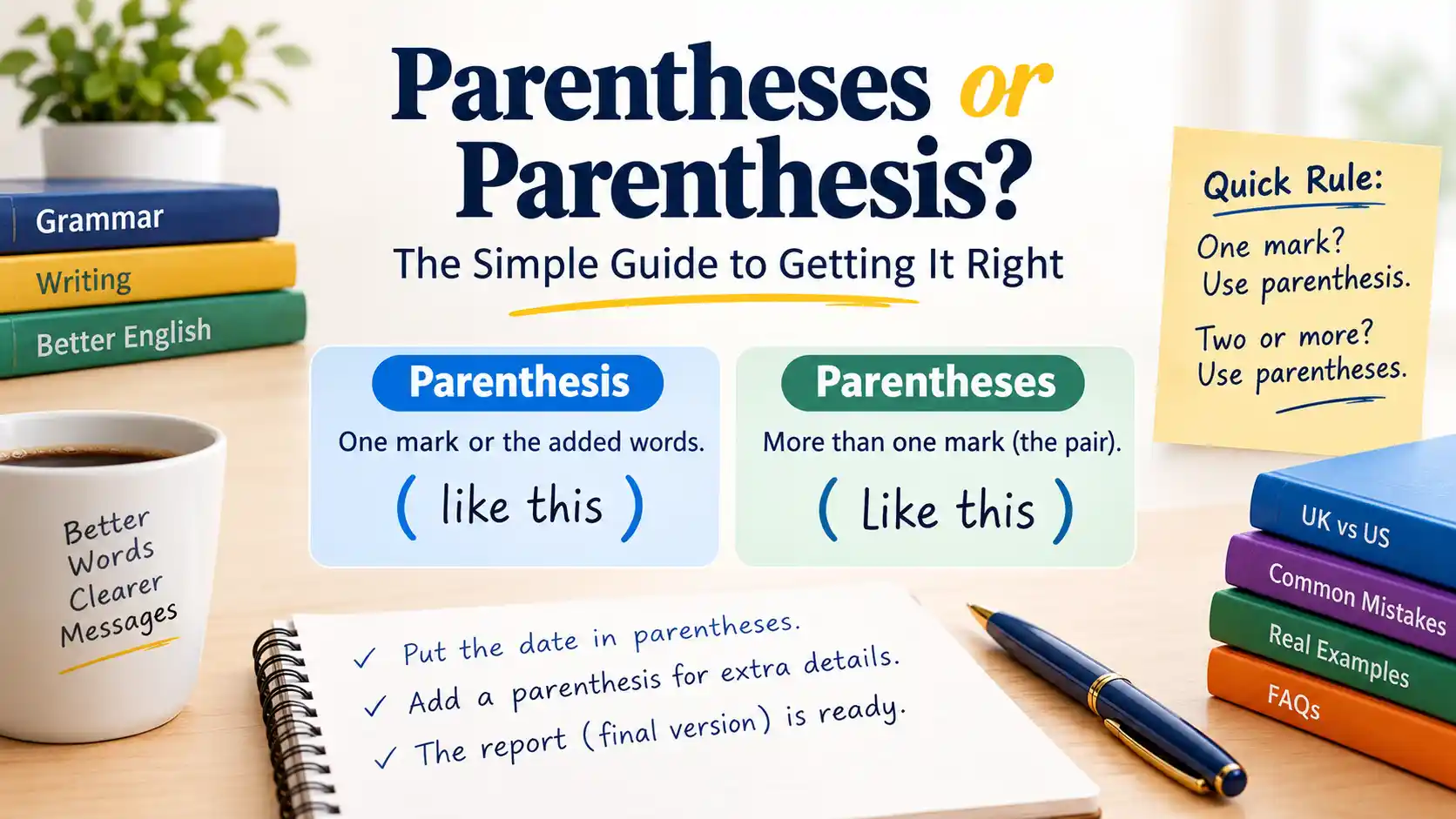
Both are correct. They just mean different things.
- Parenthesis = one mark: ( or ). It can also mean the extra words inside the marks.
- Parentheses = more than one mark. Use it for the pair: ( ).
Examples:
- “Put a parenthesis after the number.” (one mark)
- “Put the date in parentheses.” (the pair)
- “She added a parenthesis to her sentence.” (the side note itself)
Easy rule: One mark? Use parenthesis. Two or more? Use parentheses.
The Origin of Parenthesis
The word comes from Greek. It joins three small parts:
- para = beside
- en = in
- tithenai = to put
Together, it means “to put in beside.” That fits well. A parenthesis puts extra words beside the main sentence.
The word passed from Greek into Latin. Then it came into English in the 1500s.
Why the plural looks odd: Greek words ending in -sis change to -ses in the plural. English kept this habit. Look at these pairs:
- crisis → crises
- analysis → analyses
- thesis → theses
- parenthesis → parentheses
So “parentheses” is not a spelling mistake. It is the normal Greek-style plural.
British English vs American English Spelling
Here is a surprise. The spelling is the same in both. Both use parenthesis and parentheses. The real difference is in what people call the marks.
| Feature | American English | British English |
| Round marks ( ) | Parentheses | Brackets (also “round brackets”) |
| Square marks [ ] | Brackets (or “square brackets”) | Square brackets |
| Curly marks { } | Braces (or “curly brackets”) | Curly brackets (or braces) |
| Singular word | Parenthesis | Parenthesis |
| Plural word | Parentheses | Parentheses |
| Everyday use | “Parentheses” is common | “Brackets” is common |
British writers still use “parenthesis” for the grammar idea. They just say “brackets” for the marks in daily talk.
Which Spelling Should You Use?
Writing for a US audience: Use “parentheses” for the marks. Use “parenthesis” for one mark.
Writing for a UK or Commonwealth audience: “Brackets” feels more natural for the marks. Use “parenthesis” and “parentheses” in grammar or formal writing.
Writing for a global audience: Use “parentheses.” Everyone understands it. You can add “(round brackets)” once for clarity.
Writing code or tech guides: Be exact. Say “parentheses” for ( ), “square brackets” for [ ], and “curly braces” for { }.
Common Mistakes with Parentheses or Parenthesis
| Mistake | Fix |
| “Put it in parenthesis.” (for a pair) | Put it in parentheses. |
| “A parentheses” | A parenthesis |
| “Parenthesises” | Parentheses |
| “Paranthesis” or “parenthises” | Parenthesis (spell it paren-the-sis) |
| “Parentheses’s” | Parentheses’ or reword the sentence |
| Mixing up brackets and parentheses | Round = parentheses. Square = brackets. |
| Wrong pronunciation | puh-REN-thuh-sis (one); puh-REN-thuh-seez (many) |
Tip: Check the number. Is there one mark or a pair? That tells you the word.
Parentheses or Parenthesis in Everyday Examples
Email:
- “Please send the report (the final version) by Friday.”
- “See the attached file (in parentheses below).”
News:
- “The senator (a former teacher) voted no.”
- “Scores are shown in parentheses.”
Social media:
- “Me: I’ll sleep early (narrator: he did not).”
- “I forgot a closing parenthesis. Sorry!”
Formal writing:
- “The study found a rise in sales (see Table 2).”
- “Citations go in parentheses: (Smith, 2020).”
Math and code:
- “Solve what is inside the parentheses first.”
- “The function has a missing parenthesis.”
Parentheses or Parenthesis Google Trends & Usage Data
I have not pulled live Google Trends numbers here, so check the tool yourself for exact figures. These patterns usually hold:
- “Parentheses” gets far more searches than “parenthesis.” Most people want the plural, since the marks come in pairs.
- Students and writers often search for it near exam and essay seasons.
- Coders search it often, with phrases like “missing parenthesis” or “unmatched parentheses.”
- US users search “parentheses” more. UK and Commonwealth users search “brackets” more.
- Spelling searches such as “parenthesis or parentheses” spike when people write formal work.
Keyword variations side by side:
| Search term | Meaning | Common in |
| Parentheses | Two or more round marks | US, global |
| Parenthesis | One mark, or the added words | Grammar, global |
| Round brackets | Same as parentheses | UK, Commonwealth |
| Brackets | Round (UK) or square (US) | UK, US (different meaning) |
| Paranthesis | Common misspelling | Everywhere |
| Parenthesises | Incorrect plural | Everywhere |
Try Google Trends with “parentheses,” “parenthesis,” and “brackets.” Filter by country to see the differences.
FAQs
1. Is it parenthesis or parentheses?
Both. Parenthesis is one. There are more than one.
2. What is the plural of parenthesis?
Parentheses. It follows the Greek -sis to -ses pattern.
3. Are parentheses and brackets the same?
In the UK, “brackets” often means round marks ( ). In the US, “brackets” means square marks [ ].
4. How do you say parentheses?
Say puh-REN-thuh-seez. The singular is puh-REN-thuh-sis.
5. Does a period go inside or outside parentheses?
If the parentheses hold a full sentence, put the period inside. If they hold part of a sentence, put it outside. (Like this.)
6. Is “parenthesises” a word?
No. Use “parentheses.”
7. Why do we use parentheses?
They add extra facts, examples, or short notes without breaking the main sentence.
8. Is the spelling different in British English?
No. The spelling is the same. Only the everyday name for the marks differs.
Conclusion
Here are the key points. Parenthesis is singular. Parentheses is plural. The word comes from Greek and means “to put in beside.” The plural follows the same pattern as crisis and crises.
British and American English spell both words the same way. The big difference is daily speech. Americans say “parentheses.” Many Britons say “brackets” for the same round marks.
Avoid the common slips. Do not write “parenthesises.” Do not write “a parentheses.” Watch the spelling too. It is paren-the-sis, not paranthesis.
Now the practical advice. Writing for a US reader? Use “parentheses.” Writing for a UK reader? “Brackets” works well in casual text. Writing for the whole world? Choose “parentheses” and add “round brackets” once if needed. In code and math, be exact so no one gets confused.
Remember the simple rule. One mark means parenthesis. A pair means parentheses. Keep that in mind, and you will get it right every time.

Sikandar Hayat is the author and creator of Journalneste.com, a website dedicated to heartfelt wishes, messages, greetings, and inspiring words for every special moment. With a passion for meaningful writing, Sikandar creates warm and thoughtful content that helps readers express their feelings with ease. His goal is to provide beautiful, shareable words for birthdays, celebrations, relationships, and memorable occasions.