Your phone buzzes all day. Is it ringing continually or continuously? Many writers stop right here. The two words look almost the same and sound almost the same. But they do not mean the same thing.
People search for “continually or continuously” because they want a fast, safe answer. They are writing an email, a report, or a post. They do not want to look careless. Spell check won’t help, because both words are real. Only the meaning can tell you which one is right.
This mix-up is very common. Even careful writers get it wrong. The good news is that the rule is simple. One word means “again and again.” The other means “without any break.” Once you see the difference, you won’t forget it.
In this guide, you will get a quick answer, a little word history, and a spelling check for British and American English. You will see real examples, common mistakes, and a handy table. At the end, you will find answers to the most common questions. Let’s make it easy.
Continually or Continuously Quick Answer
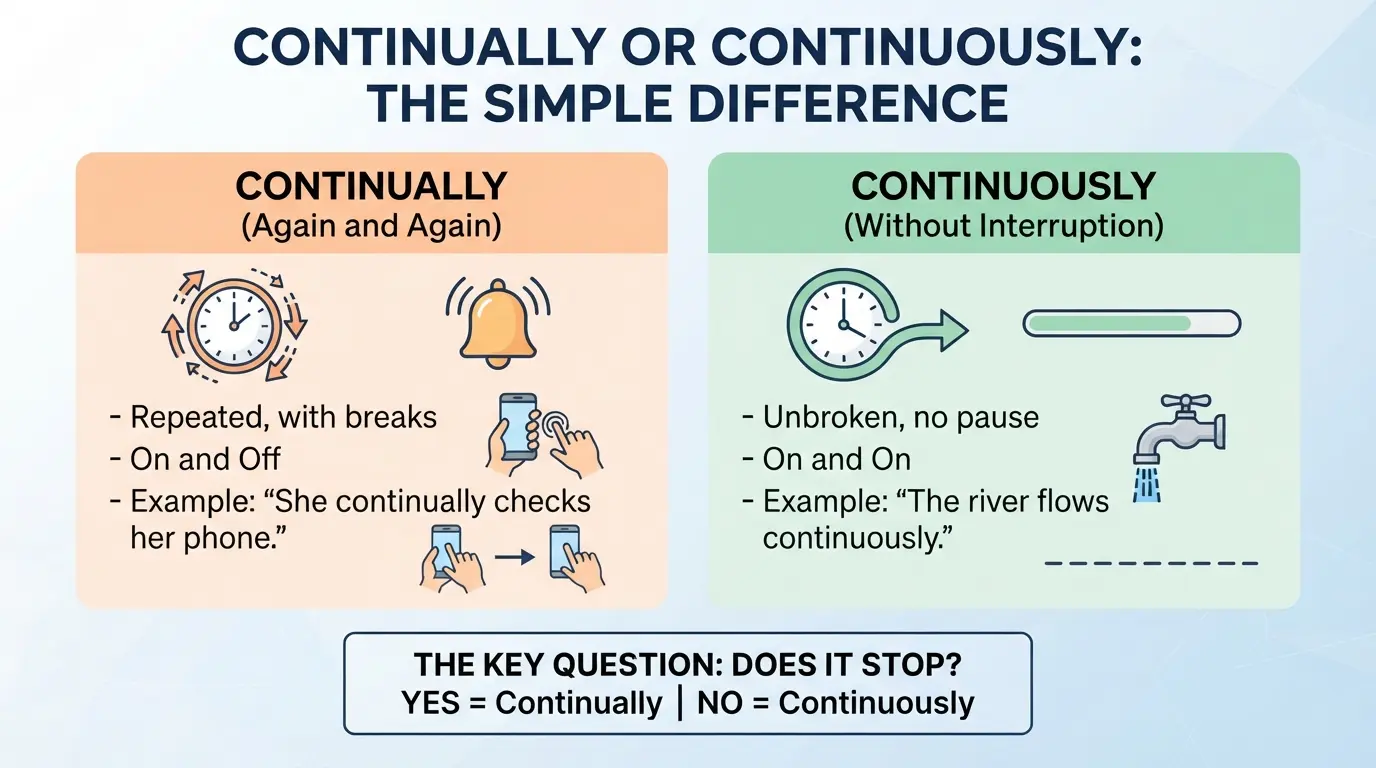
Continually means again and again, with breaks in between.
Continuously means non-stop, with no break at all.
A simple memory trick: continually = on and off. Continuously = on and on.
Examples:
- My neighbor continually plays loud music. (He does it often, but he stops sometimes.)
- The river flows continuously to the sea. (It never stops.)
- The kids continually ask for snacks. (Again and again.)
- The machine ran continuously for 48 hours. (No pauses.)
Ask yourself one question: Is there a break? If yes, use continually. If no, use continuously.
The Origin of Continually and Continuously
Both words come from the Latin word continuus. It means “joined together” or “unbroken.” That Latin word grew from continere, which means “to hold together.”
Continual came into English first, through Old French, around the 1300s. Continuous came later, in the 1600s.
For a long time, people used the two words in the same way. Over the years, writers and editors started to split them. Today, most style guides say that continual is for repeated actions and continuous is for unbroken ones.
The spelling is the same in every country. The only difference is the meaning.
British English vs American English Spelling
Many English words change by region. Think of color and colour, or center and centre. These two words do not.
| Word | American English | British English |
| Continual | continual | continual |
| Continually | continually | continually |
| Continuous | continuous | continuous |
| Continuously | continuously | continuously |
There is no spelling split here. The rule for meaning is also the same in the US, UK, Canada, Australia, and India.
One small note: in casual speech, some people use continually when they mean continuously. Dictionaries often list this loose use. Careful writing still keeps the two apart.
Which Spelling Should You Use?
Since the spelling is the same everywhere, the real question is which word to use. Here is the advice by audience:
- US readers: Keep the two words separate in business writing, news, and school work.
- UK and Commonwealth readers: Same rule. Editors in these regions often watch for this mistake.
- Global readers: Use the strict meaning. Many readers learn English as a second language, and clear rules help them.
- Technical or legal writing: Be exact. “Continuous monitoring” and “continual monitoring” mean different things.
When in doubt, ask: Does it stop at all?
Common Mistakes with Continually or Continuously
1. Using continually for something that never stops.
❌ The heart beats continually.
✅ The heart beats continuously.
2. Using continuously for something that keeps coming back.
❌ I am continuously getting spam emails.
✅ I am continually getting spam emails.
3. Spelling errors.
❌ continously, continuosly, continualy
✅ continuously, continually
4. Mixing up the adjectives.
❌ A continual line of paint ran down the road. (No break in the line.)
✅ A continuous line of paint ran down the road.
5. Overusing both words. Often, “often,” “repeatedly,” or “nonstop” works better and sounds simpler.
Continually or Continuously in Everyday Examples
- “I’m continually updating the file, so check the latest version.”
- “The server has been running continuously since Monday.”
News
- “Prices have risen continually over the past year.”
- “Rain fell continuously for three days.”
Social media
- “My phone continually freezes. So annoying!”
- “I’ve been studying continuously since 6 a.m.”
Formal writing
- “The company continually reviews its safety rules.”
- “Staff must monitor the patient continuously during surgery.”
Continually or Continuously Google Trends & Usage Data
I can’t show live numbers here, but you can check them for free on Google Trends. These patterns usually show up:
- Who searches: Most searches come from English-speaking countries such as the US, UK, Canada, Australia, India, Pakistan, Nigeria, and the Philippines.
- Why they search: Students, office workers, bloggers, and English learners want to be sure they chose the right word.
- Single words vs. the pair: People often search each word alone, and “continuously” tends to get more searches than “continually.” The “difference between” and “continually or continuously” searches come from people who are unsure.
- When searches rise: Interest tends to climb during school terms and exam seasons.
To check for yourself, open Google Trends, enter both words, and compare by country and date range.
Side-by-Side Comparison
| Word | Part of Speech | Meaning | Example |
| Continual | Adjective | Repeated, with pauses | Continual noise from the street |
| Continually | Adverb | Again and again | He continually interrupts me |
| Continuous | Adjective | Unbroken, no pause | A continuous stream of water |
| Continuously | Adverb | Without stopping | The lights burned continuously |
FAQs
1. What is the main difference between continually and continuously?
Continually means repeated, with breaks. Continuously means without any break.
2. Can I use them in the same way?
In casual talk, many people do. In clear, professional writing, it’s best to keep them apart.
3. Is “continually” British and “continuously” American?
No. Both words are used and spelled the same in every English-speaking country.
4. Which one is correct for something that happens often?
Use continually. For example: “She continually checks her phone.”
5. Which one should I use for something that never stops?
Use continuously. For example: “The fan ran continuously all night.”
6. What are easy replacements for these words?
For continually, try “often” or “again and again.” For continuously, try “nonstop” or “without a break.”
7. How can I remember the difference?
Remember: continually = on and off, continuously = on and on.
Conclusion
The choice between “continually” and “continuously” is simple once you know the key question: does it stop? If the action repeats with pauses, use continually. If it runs without any break, use it continuously.
Both words come from the same Latin root, which is why they look so alike. Both are spelled the same in British and American English, so you never need to worry about region. You only need to think about meaning.
Watch out for the common slips. Don’t say a heart beats “continually.” Don’t say you get spam “continuously” unless it truly never stops. Check your spelling too, because “continously” is a very common typo.
When you want to keep things simple, swap in plain words like “often” or “nonstop.” Clear writing wins every time. If you are writing an email, a news story, or a school paper, this one small rule will make your writing sharper and more professional.

Sikandar Hayat is the author and creator of Journalneste.com, a website dedicated to heartfelt wishes, messages, greetings, and inspiring words for every special moment. With a passion for meaningful writing, Sikandar creates warm and thoughtful content that helps readers express their feelings with ease. His goal is to provide beautiful, shareable words for birthdays, celebrations, relationships, and memorable occasions.