Draws or drawers? It looks like a small question, but many people get stuck on it. You may be writing an email.(and) You may be writing a product page for a desk. You stop and think: which word is right?
People search for this keyword for a few reasons. The two words look alike. In some accents, they sound alike. And both words have more than one meaning. “Draws” can mean pulls, sketches, or ties in a game. “Drawers” can mean boxes in a dresser, old-style underwear, or people who draw.
This guide clears up the confusion. You will get a quick answer first. Then you will learn where the words come from. You will see how British and American speakers say them. You will also find common mistakes, real examples, a comparison table, and a short FAQ.
By the end, you will know which word to use. You will also know why people mix them up. Let’s start with the short answer.
Draws or Drawers Quick Answer
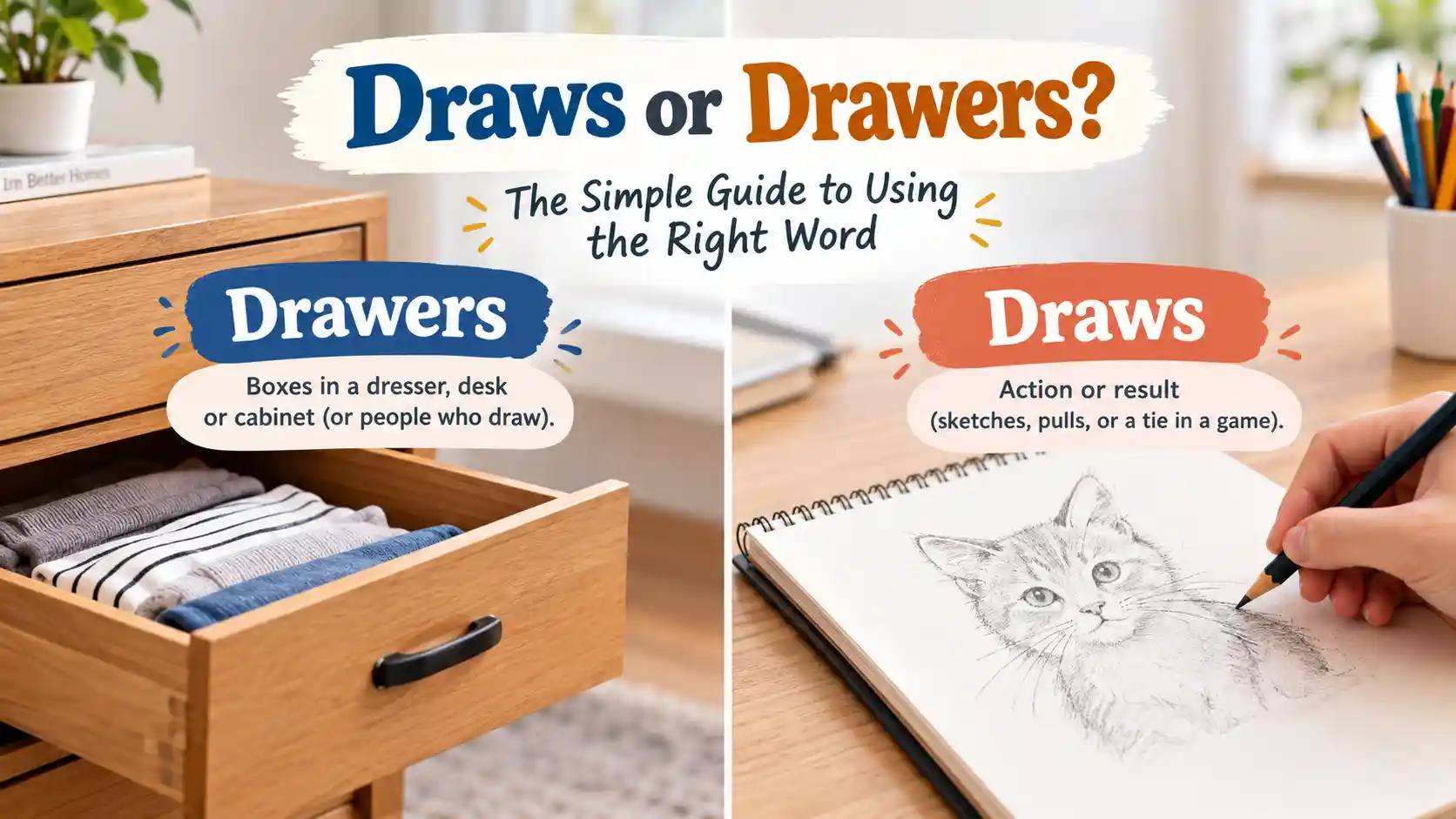
Drawing is about action or results. Drawers are about things or people.
- Draws = the verb “draw” for he, she, or it. She draws a cat. It is also a plural noun for ties or prize events. The team had three draws this year.
- Drawers = plural of “drawer.” The drawers in my desk are full. It can also mean underwear (old-fashioned) or people who draw.
Quick test: can you open it? Does it slide out? Then you want drawers. Is someone doing something, or is a game tied? Then you want draws.
The Origin of Draws and Drawers
Both words come from the same root. The verb “draw” comes from an Old English word, dragan. It meant to drag or pull.
Over time, “draw” gained new meanings:
- To pull a line across paper (to sketch)
- To pull a card or a lottery ticket
- To pull a crowd (the show draws fans)
- To pull even in a game (a tie)
Then came the “drawer.” A drawer is a box you draw out, meaning you pull it out. The word “drawer” also means “one who draws.” That is why an artist can be a drawer, too.
Long ago, people also used “drawers” for clothing. These were garments you drew on. That is why the word still means underwear in older writing.
So why the mix-ups? The words share one root. They differ by only two letters. And in many accents, they sound close or the same.
British English vs American English Spelling
Here is an important fact. There is no British or American spelling difference here. Both use “draws” and “drawers.” Both spell “drawer” the same way.
The real difference is how people say the words.
- In American English, people say the “r” sound. “Drawer” sounds like drawr. “Drawers” sounds like drawrz. “Draws” sounds like drawz. The words sound different.
- In British English (and many Commonwealth accents), the “r” is often silent. “Drawers” sounds like drawz. That sounds the same as “draws.” This is where the confusion grows.
| Word | Spelling (US) | Spelling (UK) | Sound (US) | Sound (UK) |
| Draws | draws | draws | drawz | drawz |
| Drawers | drawers | drawers | drawrz | drawz |
| Drawer (one) | drawer | drawer | drawr | draw |
| Drawing (art) | drawing | drawing | same | same |
Note that the spelling never changes. Only the sound does. If you write by ear, you may pick the wrong word, especially in the UK.
Which Spelling Should You Use?
You do not choose by country. You choose by meaning. Still, your audience can help you.
US readers: The words sound different, so most people spot the error fast. Double-check your meaning and you are safe.
UK and Commonwealth readers: The words can sound the same, so typos happen more often. Read your sentence twice. Ask: “Is this a thing, or an action?”
Global readers: Use simple words. If you mean storage, say “drawers” and maybe add “of a desk” or “in a dresser.” That removes doubt for non-native readers.
For underwear: Skip “drawers.” Most readers find it old-fashioned. Use “underwear” or “boxers” instead.
Common Mistakes with Draws or Drawers
1: Using “draws” for furniture.
❌ Put your socks in the top draws.
✅ Put your socks in the top drawers.
2: Using “drawers” for an action.
❌ She drawers a picture.
✅ She draws a picture.
3: Writing “draws” when you mean one drawer.
❌ Open the bottom draws.
✅ Open the bottom drawer.
4: Spelling it “draws” or “draws” from sound alone.
✅ Always spell it d-r-a-w-e-r-s.
5: Using “drawers” for lottery or game results.
❌ The match ended in two drawers.
✅ The match ended in two draws.
Draws and Drawers in Everyday Examples
- “Please check the file. It is in the second drawer of my desk.”
- “The prize draws happen every Friday.”
News
- “The match draws a large crowd each year.”
- “Police searched the drawers and cabinets.”
Social media
- “My kid draws on everything. Even the drawers.”
- “Three draws in a row. Unreal season!”
Formal writing
- “The bank named the drawer of the cheque.” (The person who writes a cheque is the drawer.)
- “The committee draws its members from each region.”
Draws or Drawers Google Trends and Usage Data
I can’t pull live Google Trends numbers here. You can check them yourself at trends.google.com by comparing “draws” and “drawers.” Here is what you will likely see, based on how the words are used:
- “Drawers” tends to rank high in searches for furniture, such as kitchen drawers, dresser drawers, and drawer organizers. Online shopping drives much of this.
- “Draws” tend to spike around lotteries, sports results, and prize events. Search interest often jumps on draw days.
- Country patterns: Countries with popular lotteries and football leagues often search “draws” more, especially around match days. Countries with big furniture and home-improvement markets search “drawers” more.
- The keyword “draws or drawers” is a spelling and grammar search. It is smaller, but steady. It comes mostly from learners, writers, and people typing fast.
Tip: In Google Trends, set the region and time range. Then compare both words. The shape of each line tells you what people mean.
Side-by-Side Comparison Table
| Word | Type | Meaning | Example |
| Draw | Verb / noun | To sketch, pull, or tie | I will draw a map. |
| Draws | Verb / noun | He/she/it draws; ties; prize events | She draws well. The game had two draws. |
| Drawer | Noun | A sliding box; or a person who draws | The key is in the drawer. |
| Drawers | Noun | Sliding boxes; old word for underwear | The drawers are full. |
| Drawing | Noun / verb | A sketch; the act of sketching | This is my drawing. |
FAQs
1. Is it “draws” or “drawers” for furniture?
It is a drawer. A drawer slides out of a desk, dresser, or cabinet.
2. Are “draws” and “drawers” the same word?
No. They have different meanings. They may sound the same in some British accents, but they are not the same word.
3. Is “drawers” British or American?
Both. The spelling is the same in the UK and the US.
4. How do you pronounce “drawers”?
In American English, say drawrz. In many British accents, say drawz.
5. What does “draws” mean in sports?
A draw is a tie. Neither team wins. Football and cricket use this word often.
6. Does “drawers” mean underwear?
Yes, in older English. It is a plural word, like “trousers.” Most people now say “underwear.”
7. Is “drawer” ever a person?
Yes. A drawer can be a person who draws. In banking, the drawer is the person who writes a check.
8. How can I remember the difference?
Think: a drawer is a thing you open. Drawing is an action or a result.
Conclusion
The answer to “draws or drawers” is simple. Pick the word by meaning, not by sound.
Use drawers for things that slide out of furniture. The use it for people who draw, too. Use draws for actions, like “she draws a picture,” or for results, like a tied game or a prize event.
Remember three key points. First, both words come from the same old root: to pull. Second, there is no UK or US spelling rule here. Both countries spell them the same way. Third, the real trouble is sound. In many British accents, the two words sound the same, so typos are common.
Before you publish or send anything, try the quick test. Can you open it? Then write drawers. Is someone doing it, or did a game even end? Then write draws.
Keep your sentences short. Read them out loud. A few seconds of checking will help you look clear, careful, and professional. Now you can use both words with confidence.

Sikandar Hayat is the author and creator of Journalneste.com, a website dedicated to heartfelt wishes, messages, greetings, and inspiring words for every special moment. With a passion for meaningful writing, Sikandar creates warm and thoughtful content that helps readers express their feelings with ease. His goal is to provide beautiful, shareable words for birthdays, celebrations, relationships, and memorable occasions.