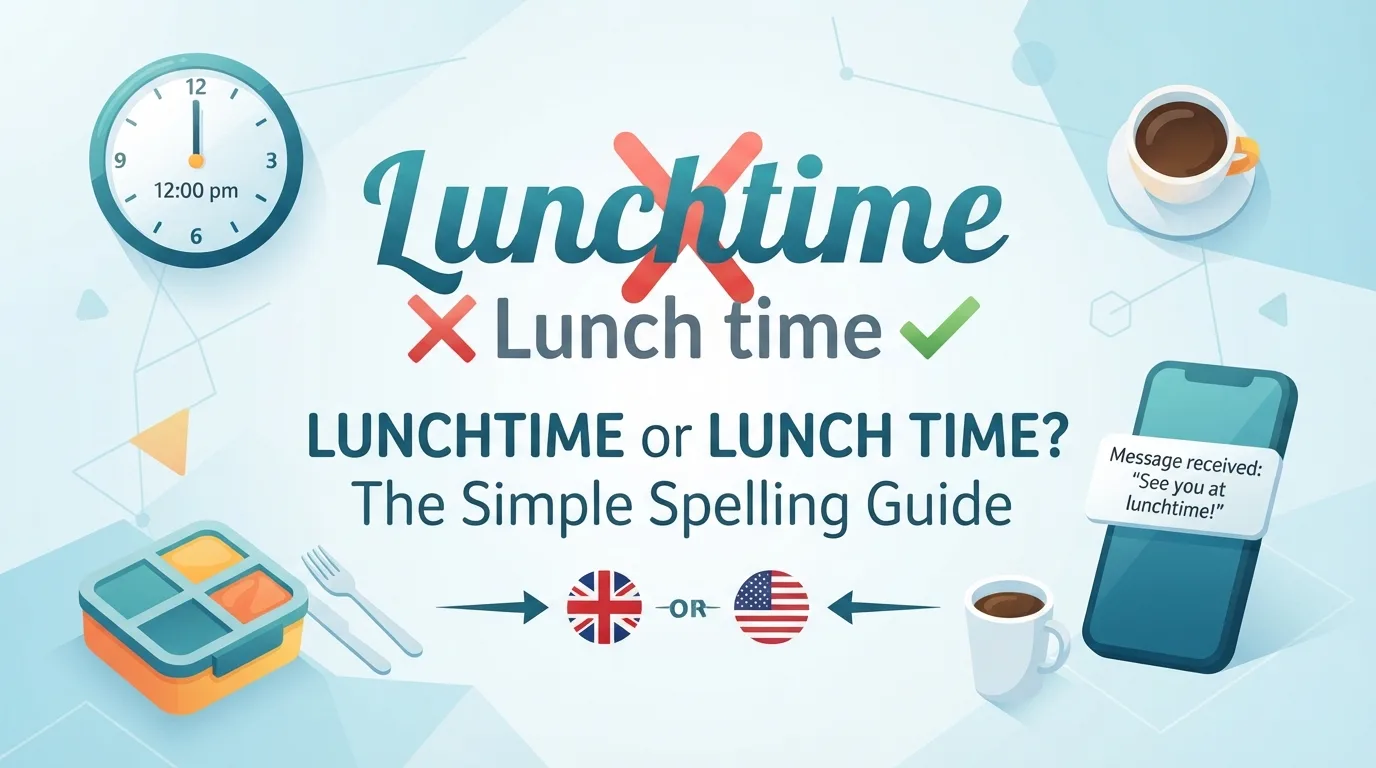
It is noon. You are writing a quick email. You type “see you at lunchtime.” Then you stop. Should it be “lunch time” instead? Many people pause at this exact spot. You are not alone.
Millions of people write about lunch every day. They write menus, meeting invites, school notes, and social posts. Along the way, they hit this small spelling snag. One word or two? Does it change by country? Is one form wrong?
That is why people search for “lunchtime or lunch time.” They want a fast, safe answer. They also want to look professional. A tiny slip in a client email can feel big.
This guide clears up the confusion. Here is the short version. “Lunchtime” is the standard single word. “Lunch time” in two words also appears, and it is right in some cases. It is not a US versus UK split, as many people think. Below, you will find the origin, clear rules, examples, comparison tables, and an FAQ. By the end, you will know exactly which form to use.
Lunchtime or Lunch Time Quick Answer
Use “lunchtime.” It is the standard spelling in major dictionaries. It works as a noun and as an adjective.
- Noun: “I will call you at lunchtime.”
- Adjective: “We went for a lunchtime walk.”
“Lunch time” (two words) is not a serious error. You may see it when “lunch” and “time” feel like two separate ideas.
- “What lunch time works for you?”
- “The lunch time on the schedule is 12:30.”
Still, if you are unsure, pick “lunchtime.” It is the safest choice.
The Origin of “Lunchtime”
“Lunch” is a short word with a long story. It began in the 1500s with a meaning close to “a thick piece” of something, like a lump of bread. Over time, it came to mean a light meal. People also shortened the older word “luncheon” to “lunch.” By the 1800s, “lunch” was a common word for the midday meal.
“Time” is one of the oldest words in English. People often join it to other words to name a part of the day. Think of “bedtime,” “teatime,” “mealtime,” and “playtime.”
“Lunchtime” follows the same pattern. Two words became one because people used them together so often. This is how English often works. A pair of words grows close, and then they merge.
So why do both spellings exist? English has no single rule for joining words. Some pairs stay apart. And some join. Some use a hyphen. Writers also type fast, and many follow what looks right to them. The result is a mix of forms.
British English vs American English Spelling
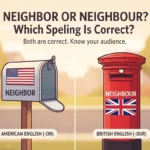
Here is a surprise. This is not a classic British versus American spelling issue. Think of “color” and “colour.” That is a real split. “Lunchtime” is different. Both countries mainly use the one-word form.
What does differ is style. Older British writing sometimes used a hyphen (“lunch-time”). That form is now rare.
| Form | US English | UK English | Notes |
| lunchtime | Standard | Standard | Best choice everywhere |
| lunch time | Seen, less formal | Seen, less formal | Fine when “time” stands alone |
| lunch-time | Rare | Old-fashioned | Avoid in new writing |
| lunch hour | Common | Common | A different phrase, same idea |
The key point: the choice is about style and clarity, not about country.
Which Spelling Should You Use?
US readers: Use “lunchtime.” Dictionaries list it. It looks clean and natural.
UK and Commonwealth readers: Use “lunchtime.” It is the usual form in British news and speech. Skip the hyphen.
Global or mixed audiences: Use “lunchtime.” One word is easy to read and easy to translate.
Formal writing: Use “lunchtime.” It looks neat in reports, emails, and web copy.
When two words are fine: If you mean “the time set for lunch” and want to stress “time,” two words can work. Example: “Please confirm the lunch time.” You can still write “lunchtime” there. Neither will confuse anyone.
A simple rule: when in doubt, join them.
Common Mistakes with “Lunchtime”
1. Using a hyphen.
Wrong: “We met at lunch-time.”
Right: “We met at lunchtime.”
2. Splitting the adjective.
Wrong: “I took a lunch time walk.”
Right: “I took a lunchtime walk.”
3. Mixing forms in one document.
Pick one and stay with it. Do not write “lunchtime” in one line and “lunch time” in the next.
4. Capital letters in the middle.
Wrong: “LunchTime”
Right: “lunchtime” (or “Lunchtime” at the start of a sentence)
5. Confusing it with “lunch hour.”
A “lunch hour” is a break, often one hour long. “Lunchtime” is the time of day. They are close, but not the same.
6. Adding an apostrophe.
Wrong: “lunch’time”
Right: “lunchtime”
“Lunchtime” in Everyday Examples
Emails
- “Can we talk at lunchtime?”
- “The team meeting moves to lunchtime on Friday.”
News
- “Crowds filled the square at lunchtime.”
- “The lunchtime rush closed several roads.”
Social media
- “Best lunchtime view ever.”
- “Lunchtime workout done. Now I need food!”
Formal writing
- “Staff may take a break at lunchtime.”
- “Lunchtime hours are 12:00 to 1:00 p.m.”
Two-word use, when it fits
- “What lunch time suits you?”
- “Lunch time is set for 12:30.”
“Lunchtime” Google Trends & Usage Data
I did not pull live Google Trends numbers here, so I will not invent any. Check Google Trends yourself for current figures. It takes a minute and is free. Here is what you can usually expect to see.
- One word leads. “Lunchtime” is typically the more common form in search and in published text.
- Two words still appear. People type “lunch time” often in casual searches, such as “lunch time near me” or “lunch time ideas.”
- Context matters. Food, school, and work topics drive most searches. Searches rise around midday and during school terms.
- Country. The US, UK, Canada, Australia, and India all use English heavily online. Expect the same one-word lead in each, with small differences.
Tip: In Google Trends, compare “lunchtime” and “lunch time” in one chart. Then filter by country and time range.
| Variation | Typical use | Formality | Recommended? |
| lunchtime | Noun and adjective | Neutral to formal | Yes, best choice |
| lunch time | Casual, or “time” stands alone | Casual | Sometimes |
| lunch-time | Older British style | Dated | No |
| lunch hour | The break itself | Neutral | Yes, for a different meaning |
| LunchTime | Brand names | Brand only | Only for brands |
Frequently Asked Questions
1. Is it “lunchtime” or “lunch time”?
Both appear, but “lunchtime” is the standard spelling. Use it by default.
2. Is “lunch time” wrong?
No, it is not a big error. It is just less common and a bit less polished.
3. Is “lunchtime” British or American?
Neither. Both countries mainly use the one-word form.
4. Should I use a hyphen in “lunch-time”?
No. The hyphenated form is old-fashioned. Skip it.
5. Can “lunchtime” be an adjective?
Yes. Examples: “lunchtime meeting,” “lunchtime crowd,” “lunchtime special.”
6. What is the difference between “lunchtime” and “lunch hour”?
“Lunchtime” is when lunch happens. “Lunch hour” is the break, often about an hour.
7. What is the best form for SEO and web writing?
Use “lunchtime” in titles and headings. You may use “lunch time” once or twice in body text to match how people search.
8. Do other meal words work the same way?
Mostly yes. “Dinnertime,” “teatime,” and “mealtime” are usually one word. “Breakfast time” is often two.
Conclusion
The answer is simple. Write “lunchtime.” It is the standard form, and it works in the US, the UK, and everywhere else.
Here are the key points to remember:
- “Lunchtime” is one word. Use it as a noun or an adjective.
- “Lunch time” is not a serious mistake, but it looks less polished.
- Skip the hyphen. “Lunch-time” is dated.
- This is not a British versus American spelling issue.
- Stay consistent. Use one form throughout your page, email, or report.
- Do not mix up “lunchtime” and “lunch hour.”
For web content, put “lunchtime” in your title, your main heading, and your first paragraph. You can use “lunch time” once or twice in the body if it reads naturally. Then check Google Trends to see how your own audience searches.
Small spelling choices build trust. A clean, correct word tells readers you care about details. So next time you hit that pause at noon, just type it as one word, hit send, and enjoy your meal.

Sikandar Hayat is the author and creator of Journalneste.com, a website dedicated to heartfelt wishes, messages, greetings, and inspiring words for every special moment. With a passion for meaningful writing, Sikandar creates warm and thoughtful content that helps readers express their feelings with ease. His goal is to provide beautiful, shareable words for birthdays, celebrations, relationships, and memorable occasions.