You type a word into a search bar. You are not sure how to spell it. Is it cue? Is it que? Or did you mean queue?
You are not alone. Many people search for this every day. The reason is simple. Cue and queue sound exactly the same. And “que” looks like a neat short version. It also shows up in Spanish, French, and Portuguese, so people see it a lot online.
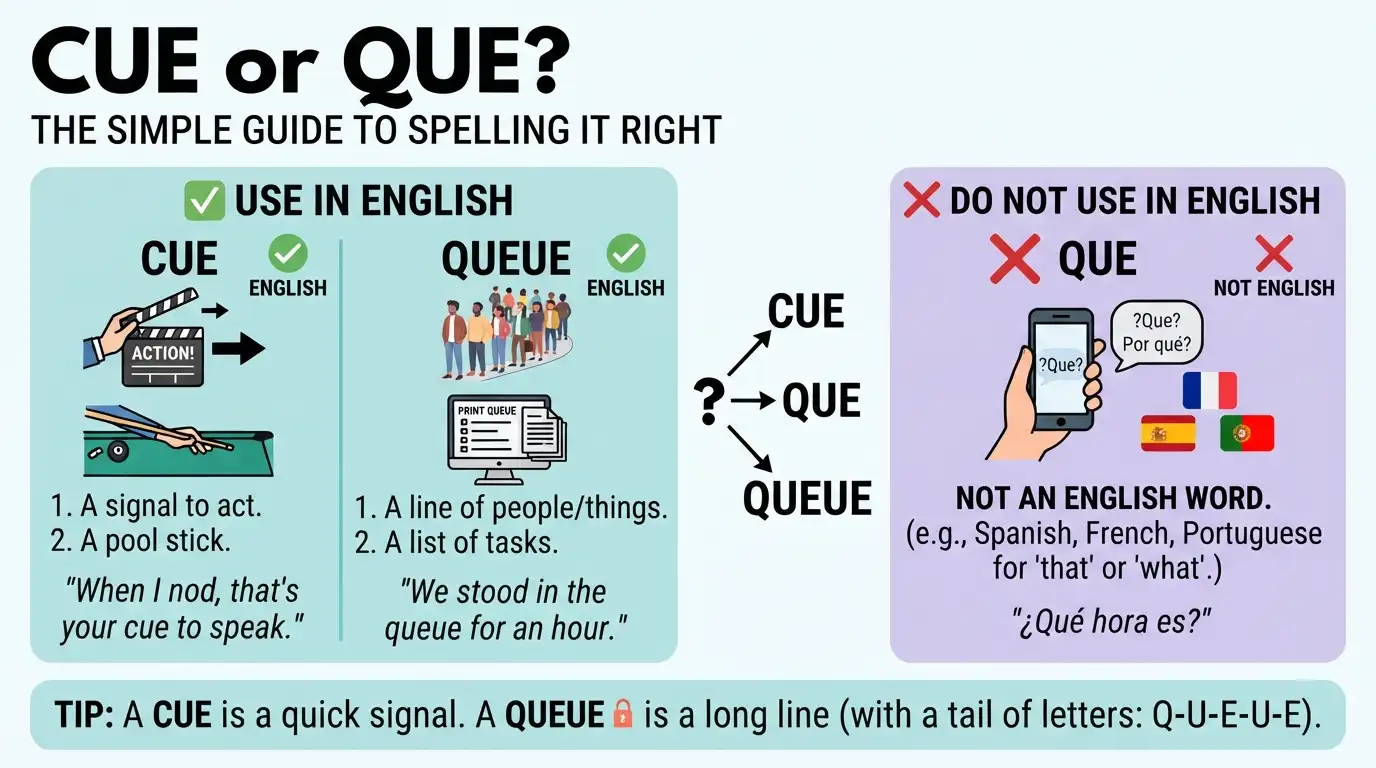
This article clears up the confusion. Here is the short version. Cue is a real English word. Queue is a real English word. Que is not an English word. It belongs to other languages.
Here is more good news. This is not a US versus UK fight. Both sides spell cue and queue the same way.
You will learn what each word means, where each one came from, and which mistakes to avoid. You will also get clear advice for emails, posts, and formal writing. Let’s start.
Cue or Que Quick Answer
Use “cue” in English. Do not use “que.”
- Cue means a signal to act. “When I nod, that’s your cue to speak.”
- Cue is also the stick used in pool and snooker. “He chalked his cue.”
- Queue means a line of people or things waiting. “We stood in the queue for an hour.”
- Que is not English. In Spanish, French, and Portuguese, it means “that” or “what.” “¿Qué hora es?”
If you mean a line, write queue. If you mean a signal, write cue. If you are writing in English, skip que.
The Origin of Cue, Queue, and Que
Cue (signal). This word first appeared in the 1500s in plays. It told an actor when to speak. Its exact source is unclear. One popular theory says it came from the letter “Q,” used in old scripts. Some say it stood for the Latin word quando, meaning “when.” Experts do not agree on this.
Cue (stick). The pool stick came later, in the 1700s. It came from the French word queue, which means “tail.” The stick looked like a tail.
Queue (line). This also comes from French queue, from the Latin cauda, meaning “tail.” A line of people looks like a tail. English began using it for waiting lines in the 1800s.
Que. This is a separate word. It is common in Spanish, French, and Portuguese. It has nothing to do with English “cue.”
So why the mix-up? Because “cue” and “queue” share a French root and sound alike. And “que” looks like a shortcut to a word that sounds like “kyoo.”
British English vs American English Spelling
Here is the key point: there is no US/UK difference for cue or queue. Both use the same spellings. The real differences are in how people use the words.
| Word | British English | American English |
| Cue (signal) | cue | cue |
| Cue (pool stick) | cue | cue |
| Waiting line | queue (very common) | line (common); queue is used mostly in computing |
| Joining a line | to queue up | to line up, get in line |
| Doing it now | queuing (also queueing) | queuing (also queueing) |
| Que | not English | not English |
Two things to remember:
- Brits say “queue” for a line at a shop. Americans usually say “line.”
- Americans do use “queue” for computer tasks, like a print queue or a video queue.
Which Spelling Should You Use?
If your readers are in the US: Use cue for signals and line for people waiting. Use queue for playlists, print jobs, and software.
If your readers are in the UK, Ireland, Australia, India, or other Commonwealth countries: Use cue for signals. Use queue for waiting lines.
If your readers are global: Use cue for signals and queue for lines. Everyone understands these.
If you are writing in Spanish, French, or Portuguese: Use que (or qué with the accent in Spanish questions). It is correct there.
One rule fits all English writing: never use “que” to mean “cue” or “queue.”
Common Mistakes with Cue, Que, and Queue
| Wrong | Right | Why |
| I waited in the cue. | I waited in the queue. | A waiting line is a queue. |
| Take your queue from me. | Take your cue from me. | A signal is a cue. |
| Grab the que ball. | Grab the cue ball. | Que is not English. |
| Que up the next song. | Cue up the next song. | To start something is to cue it. |
| Cue up at the counter. | Queue up at the counter. | Forming a line is queuing. |
| We are queing. | We are queuing. | Keep the “u” after “q.” |
Tip: A queue has a tail of letters: que-ue. Think of a long line of people. A cue is short, like a quick signal.
Cue and Queue in Everyday Examples
Emails
- “Please take your cue from the client’s reply.”
- “Your ticket is in the queue. We will answer soon.”
News
- “Voters waited in a long queue outside the polls.”
- “The singer missed her cue, and the show paused.”
Social media
- “Cue the dramatic music! 🎶”
Formal writing
- “The committee will use the policy as a cue for reform.”
- “Applications are processed in a first-come queue.”
Pool and snooker
- “She lined up her cue and sank the black ball.”
Cue or Que Google Trends & Usage Data
I can’t pull live numbers here, so please check current data at trends.google.com. Search the terms side by side: cue, queue, and que. Here is what you will typically see:
- “Queue” gets strong interest in the UK, Ireland, India, and Australia, where it is an everyday word for a line.
- “Cue” is popular worldwide. People use it for acting, music, pool, and “cue up.”
- “Que” is high in Spanish-speaking and Portuguese-speaking countries. It is a very common word there, so many searches are not about English at all.
- “Cue or que” searches come mostly from English learners and from people unsure about spelling.
Tip: Change the country filter in Google Trends. The picture shifts a lot.
Comparison Table: Cue, Queue, and Que Side by Side
| Term | Language | Meaning | Example |
| cue | English | A signal; a pool stick | “That’s your cue.” |
| queue | English | A waiting line; a list of tasks | “Join the queue.” |
| que | Spanish, French, Portuguese | That; what; which | “Creo que sí.” |
| qué | Spanish | What? | “¿Qué quieres?” |
| queuing / queueing | English | Standing in a line | “We are queuing.” |
| cueing / cuing | English | Giving a signal | “She is cueing the band.” |
| Q | English | The letter, said “kyoo” | “Q for queue.” |
FAQs
1. Is “que” a word in English?
No. It is a word in Spanish, French, and Portuguese. It means “that” or “what.”
2. What is the difference between cue and queue?
A cue is a signal or a pool stick. A queue is a line of people or things.
3. Why do cue and queue sound the same?
They are homophones. English kept the French spelling for queue but made the sound short.
4. Is “queue” British English?
It is used more in British English for waiting lines. Americans say “line.” But both spell it the same.
5. Is it queuing or queueing?
Both are correct. “Queuing” is more common. “Queueing” is also accepted.
6. Is it “cue up” or “queue up”?
Both exist. “Cue up” means to get something ready, like a song. “Queue up” means to join a line.
7. Where does the word “cue” come from?
Its origin is not certain. It was first used in plays in the 1500s. The pool stick meaning came from French queue, meaning “tail.”
Conclusion
Let’s sum it up. Cue and queue are English words. Que is not.
Use cue when you mean a signal, a hint, or a pool stick. Use queue when you mean a line of people or tasks. Use que only when you write in Spanish, French, or Portuguese.
The spelling does not change between American and British English. What changes is the habit. Brits say “queue” for a line at the shop. Americans say “line.” Both say “queue” for computer tasks.
Watch for the common slips. Don’t write “waiting in the cue.” Don’t write “take your queue from me.” Don’t write “que ball.”
A simple memory trick helps. A queue is long, like a tail, so it has the long spelling. A cue is quick, like a signal, so it has the short one.
If you are unsure, read the sentence out loud. Ask yourself one question: am I talking about a signal or a line? Then pick the right word. Do that, and you will never mix them up again.

Sikandar Hayat is the author and creator of Journalneste.com, a website dedicated to heartfelt wishes, messages, greetings, and inspiring words for every special moment. With a passion for meaningful writing, Sikandar creates warm and thoughtful content that helps readers express their feelings with ease. His goal is to provide beautiful, shareable words for birthdays, celebrations, relationships, and memorable occasions.