You are writing an email. You stop. Is it “legal counsel” or “legal council”? You are not alone. Many people pause at this pair of words.
The two words sound the same. They look almost the same. But they mean very different things. One word is about advice. The other is about a group of people. Mix them up, and your writing looks careless.
People search “counsel or council” for a fast answer. They want to know which word fits their sentence. They also want a rule they can trust. Students need it for essays. Workers need it for reports and emails. Writers need it for blogs and books.
This guide clears up the confusion. You will get the quick answer first. Then you will learn where the words came from. You will see how British and American writers treat them. You will also see common mistakes, real examples, and a simple memory trick. By the end, you will not mix them up again.
Counsel or Council Quick Answer
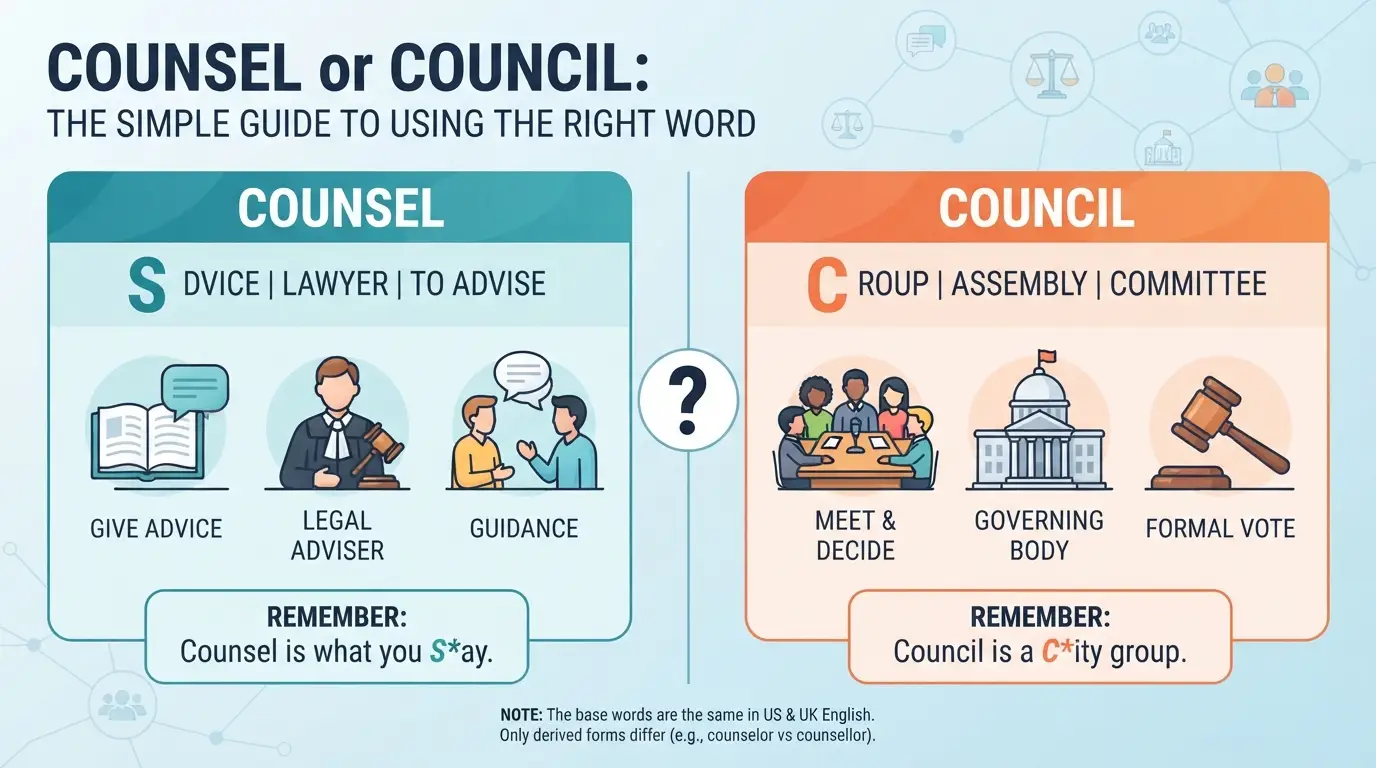
Counsel means advice. It can also mean a lawyer. As a verb, it means to give advice.
Council means a group of people. They meet to make choices or give guidance.
Here are quick examples:
- She gave me wise counsel. (advice)
- The defense counsel spoke first. (lawyer)
- He counsels students on careers. (gives advice)
- The city council voted on the new park. (group)
Memory trick: Council has a c in “city.” Counsel has an s in “say.” A council is a group. Counsel is what you say to help someone.
The Origin of Counsel and Council
Both words came from Latin. They are close cousins, which is why they look so alike.
Counsel comes from the Latin word consilium. It meant advice or a plan. The word passed into Old French as conseil. Then it came into English around the 1200s.
Council comes from the Latin word concilium. It meant a meeting or a gathering. It also passed through Old French, and English took it in around the same time.
So why the mix-up? In the Middle Ages, spelling was not fixed. Writers spelled words as they heard them. The two Latin roots were close, and the French forms were close too. Over time, the spellings drifted together and were confused often.
Later, English settled on two spellings. One was for advice. One was for a group. The sounds, though, stayed the same. That is why we still trip on them today.
British English vs American English Spelling
Here is a surprise. Counsel and council are spelled the same in British and American English. The words do not change between the two.
The difference shows up in a related word: the person who gives advice.
- American English: counselor
- British English: counsellor
Britain often doubles the “l” before an ending. America usually does not. You can see the same pattern in “traveler” and “traveller.”
| Word | American English | British English | Meaning |
| Advice or lawyer | counsel | counsel | Advice; a legal adviser |
| Group of people | council | council | A body that meets and decides |
| Person who advises | counselor | counsellor | One who gives advice |
| Member of a group | councilor | councillor | A person on a council |
| Giving advice (past) | counseled | counselled | Advised someone |
| Advice (ongoing) | counseling | counselling | The act of advising |
Notice the pattern. The US drops the extra “l.” The UK keeps it. But the base words stay the same everywhere.
Which Spelling Should You Use?
The base words do not change. So your choice depends on meaning, not place. But for the “l” words, think about your reader.
Writing for a US audience: Use counselor, councilor, counseling, and counseled.
Writing for a UK or Commonwealth audience: Use counsellor, councillor, counselling, and counselled. This includes the UK, Australia, India, Pakistan, and Canada in some cases. Canada often mixes both styles.
Writing for a global audience: Pick one style and stay with it. Do not switch in the middle of a page. Match the style your readers know best. If you are not sure, use American spelling. It is common online.
Formal tip: Some law firms in the US use “counselor” while UK firms use “counsel” for barristers. Follow the style guide of your school, firm, or company.
Common Mistakes with Counsel or Council
These errors show up all the time.
1: Using council for advice.
- Wrong: She offered me good council.
- Right: She offered me good counsel.
2: Using counsel for a group.
- Wrong: The student counsel met on Friday.
- Right: The student council met on Friday.
3: Mixing the person words.
- Wrong: He is a city counselor, and he voted on the budget.
- Right: He is a city councilor. (A counselor gives advice. A councilor sits on a council.)
4: Mixing US and UK spelling.
- Wrong: The counsellor was counseling teens.
- Right: The counselor was counseling teens. (US style)
- Right: The counsellor was counselling teens. (UK style)
5: Forgetting “legal counsel” is both a person and a title.
- Right: Our legal counsel reviewed the contract. (It means the lawyer.)
Counsel or Council in Everyday Examples
In an email:
“Please ask our legal counsel to review this letter before we send it.”
In the news:
“The city council approved a new bus line on Tuesday.”
On social media:
“Grateful for my mentor’s counsel this year. Best advice I ever got.”
In formal writing:
“The committee sought the counsel of experts before making its decision. The council then voted to adopt the plan.”
At school:
“Our student council is planning a food drive. Our school counselor will help us.”
At work:
“The board took counsel from outside advisers. The union council will respond next week.”
Read each one slowly. Ask: Is it advice, or is it a group? That one question solves almost every case.
Counsel or Council Google Trends & Usage Data
I cannot pull live Google Trends numbers here, so I will not give you exact figures. You can check them yourself at trends.google.com. Search both words together and compare.
Here is what these searches usually show:
- Council is searched far more often. People look for city councils, school councils, and national councils. Many of those searches are about local news and services, not spelling.
- Counsel is searched mostly in legal and work contexts. Think “legal counsel,” “general counsel,” and “defense counsel.”
- Spelling-help searches like “counsel or council” rise around school terms and tax or legal seasons.
- Counselor vs counsellor searches rise in the US, UK, and Commonwealth countries. Each region leans toward its own spelling.
Tip: In Google Trends, set the region to the US, then the UK, and compare. You will see how each place prefers its own form of the “l” words.
| Word variation | Part of speech | Region | Common context |
| counsel | noun / verb | US, UK, global | Advice, law |
| council | noun | US, UK, global | Government, groups |
| counselor | noun | US | School, therapy, law |
| counsellor | noun | UK, Commonwealth | School, therapy |
| councilor | noun | US | City government |
| councillor | noun | UK, Commonwealth | Local government |
| counseling | noun / verb | US | Therapy, guidance |
| counselling | noun / verb | UK, Commonwealth | Therapy, guidance |
Frequently Asked Questions
1. What is the difference between counsel and council?
Counsel means advice or a lawyer. Council means a group of people who meet and make decisions.
2. Can counsel and council ever mean the same thing?
No. They are never the same. The sounds match, but the meanings stay apart.
3. Is “legal counsel” spelled with an s or a c?
It is “legal counsel,” with an s. It means the lawyer or legal adviser.
4. Is “city counsel” or “city council” correct?
“City council” is correct. A city council is a group of leaders for a city.
5. What is the difference between a counselor and a councilor?
A counselor gives advice, like a school counselor. A councilor is a member of a council, like a city councilor.
6. Is counsellor with two l’s wrong?
No. It is the British spelling. Americans write “counselor” with one “l.” Both are right in their own place.
7. How can I remember which word to use?
Think of “council” and “city.” Both start with a c-sound. Think of “counsel” and “say.” Counsel is what you say to help.
8. Is “counsel” ever a verb?
Yes. “She counsels teens” means she gives them advice. “Council” is never a verb.
Conclusion
Counsel or council? The answer is simple. Counsel is advice. It can also be a lawyer. Council is a group of people who meet to decide things.
The spelling of these two words is the same in the US and the UK. The difference shows up in related words. Americans write counselor and councilor. The British write counsellor and councillor.
Remember the main points. Use counsel when you mean advice, a lawyer, or the act of advising. Use council when you mean a group, like a city council or a student council. Do not use council as a verb. Pick one spelling style, US or UK, and keep it throughout your writing.
When you are stuck, use the memory trick. A council is a city group. Counsel is what you say. Ask yourself one question: is this advice, or is this a group? That answer will point you to the right word every time.

Sikandar Hayat is the author and creator of Journalneste.com, a website dedicated to heartfelt wishes, messages, greetings, and inspiring words for every special moment. With a passion for meaningful writing, Sikandar creates warm and thoughtful content that helps readers express their feelings with ease. His goal is to provide beautiful, shareable words for birthdays, celebrations, relationships, and memorable occasions.