You are typing a message. You stop. Is it “labour” or “labor”? You look at the screen. Both look right. Both look wrong.
You are not alone. Millions of people search “labour or labor” every year. Students want to pass an exam. Workers write emails to bosses. Bloggers publish to readers around the world. Everyone wants to look professional.
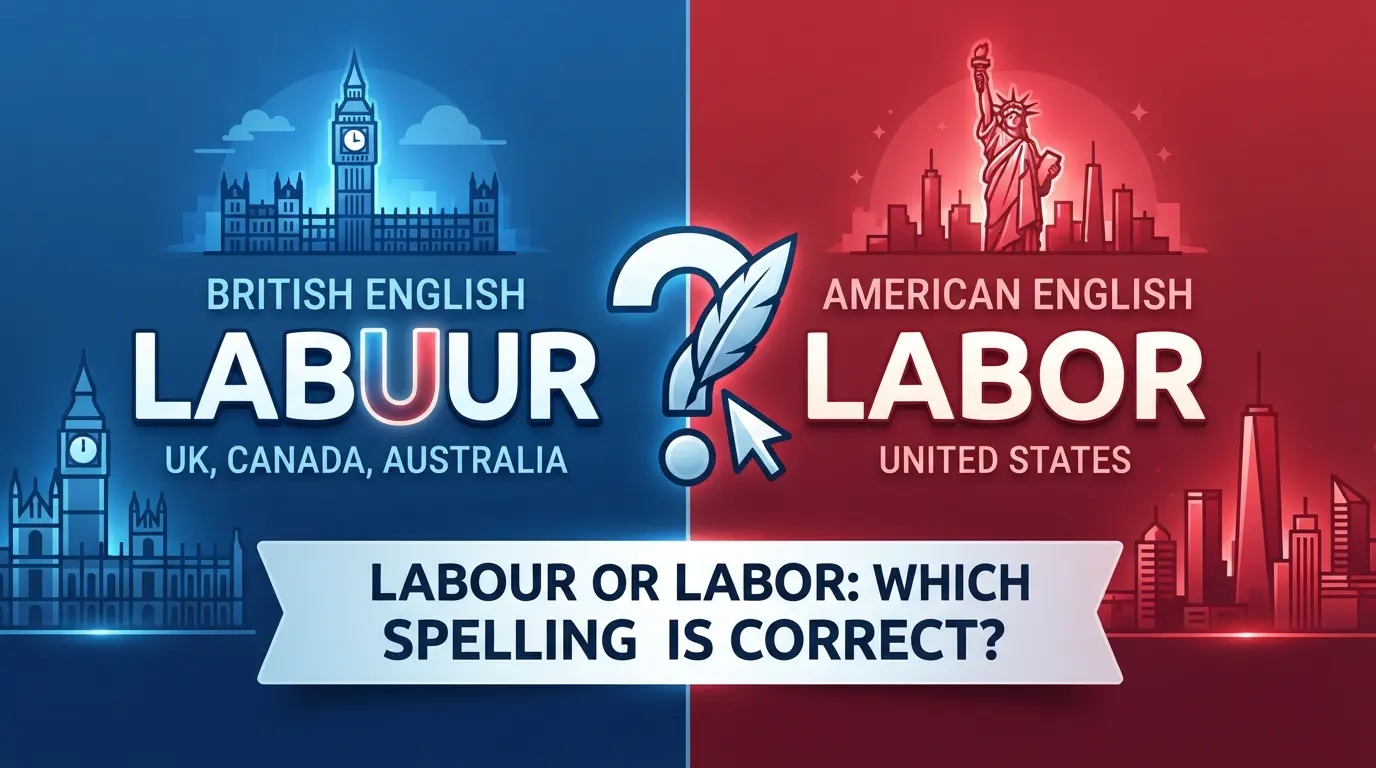
The good news is simple. Both spellings are correct. They are not two different words. They are two spellings of the same word. One is used in British English. The other is used in American English.
So why the mix-up? English has no single rulebook. Different countries made different choices long ago. Today, we live with both.
This guide clears up the confusion. You will get a quick answer first. Then you will learn where the word came from. You will see a side-by-side table, real examples, common mistakes, and answers to common questions. By the end, you will know exactly which spelling to pick.
Labour or Labor Quick Answer
Both are correct. Use “labor” in the United States. Use “labour” in the UK, Canada, Australia, and most other English-speaking countries.
That is the whole rule. Here are some examples:
- US: “The Department of Labor posted new job numbers.”
- UK: “The Labour Party won the vote.”
- Canada: “Many families enjoy the Labour Day long weekend.”
- US: “Hard labor built the railroads.”
- UK: “It was a labour of love.”
The meaning does not change. The word means work, effort, or workers as a group. It can also mean the process of giving birth.
The Origin of Labour or Labor
The word comes from Latin. The Latin word labor meant work, toil, or hard effort.
The word then moved into Old French as labour or labeur. After the Norman conquest in 1066, French words poured into English. “Labour” came with them. It was in English by the 1300s.
For a long time, spelling was loose. People spelled words as they liked. Many used “labour.” Some used “labor.” Nobody called it an error.
Then came Noah Webster. He was an American writer who made a famous dictionary. In the early 1800s, he wanted American English to look simple and different from British English. He cut extra letters. He dropped the “u” in words like colour, honour, and labour.
His 1828 dictionary spread these spellings across the United States. Britain kept the older French-style “-our” spelling.
British English vs American English Spelling
Many words follow the same pattern. British English keeps “-our.” American English uses “-or.”
| Meaning | British English | American English |
| Work or effort | labour | labor |
| A person who works | labourer | laborer |
| Hard to do | laborious | laborious |
| Worked hard | laboured | labored |
| Shade of paint | colour | color |
| Respect | honour | honor |
| Neighbor | neighbour | neighbor |
| Favorite | favourite | favorite |
Two simple rules:
- Noun and verb forms: The UK keeps the “u” (labour, laboured, labouring). The US drops it (labor, labored, laboring).
- “Laborious” is the same in both. Both countries drop the “u” in this word. Many people forget this..
Which Spelling Should You Use?
Think about your reader. Then pick.
Writing for the United States?
Use labor. This includes Labor Day, Department of Labor, and labor laws.
Writing for the UK, Ireland, or Commonwealth countries?
Use labour. This includes Canada, India, South Africa, Nigeria, Kenya, and New Zealand.
Writing for Australia?
Use labour in general writing. But note this: the Australian Labor Party uses “Labor” in its name. Names are special. Always copy the official spelling.
Writing for a global audience?
Pick one and stay consistent. Many global websites use American English because most search traffic comes from the US. But if most of your readers are in the UK or Canada, use “labour.”
Quick rule for names: Official names never change. It is the Labour Party in the UK. It is the U.S. Department of Labor. It is the International Labour Organization. Copy the name exactly.
Tip: Set your spell checker to the right language. In Word or Google Docs, choose English (US) or English (UK).
Common Mistakes with Labour or Labor
Here are the errors people make most often.
1. Mixing both spellings in one text.
❌ “The labor union fought for fair labour rules.”
✅ “The labor union fought for fair labor rules.”
2. Changing an official name.
❌ “The Labor Party won the UK election.”
✅ “The Labour Party won the UK election.”
3. Dropping the “u” in the wrong place.
❌ “The labourious task took hours.”
✅ “The laborious task took hours.” (No “u” in either country.)
4. Using “labour” for a US audience.
It looks odd to American readers. They may think it is a typo.
5. Using “labor” for a UK audience.
British readers may think you are careless.
6. Mixing forms of the word.
❌ “The labourer’s work was labored.”
✅ “The labourer’s work was laboured.” (UK)
✅ “The laborer’s work was labored.” (US)
7. Forgetting the second meaning.
Both spellings can mean childbirth. The UK says “labour ward.” The US says “labor and delivery.”
Labour or Labor in Everyday Examples
Here is how the word looks in real life.
Email (US):
“Hi Sam, the labor costs went up this month. Can we talk on Monday?”
Email (UK):
“Hi Sam, the labour costs went up this month. Can we talk on Monday?”
News headline (US):
“Labor Department Reports Strong Job Growth”
News headline (UK):
“Labour Leader Promises New Jobs Plan”
Social media (US):
“Happy Labor Day! Enjoy your day off. 🇺🇸”
Social media (Canada):
“Enjoy the Labour Day weekend, everyone!”
Formal writing (global):
“The International Labour Organization sets work standards for many countries.”
Formal writing (US business):
“Labor shortages have raised prices in many industries.”
Daily speech:
“Cleaning the whole house was a labor of love.” (US)
“Cleaning the whole house was a labour of love.” (UK)
Labour or Labor Google Trends & Usage Data
You can see how people use each spelling with free tools like Google Trends. Numbers change over time, so check the live data. Here is the general pattern.
By country:
- United States: “Labor” is used far more. Most Americans never type “labour.”
- United Kingdom: “Labour” leads by a wide margin. Politics drives much of this because of the Labour Party.
- Canada: “Labour” is common, especially around Labour Day.
- Australia: Both appear. “Labor” shows up often because of the Australian Labor Party.
- India, Nigeria, Kenya, South Africa: “Labour” is the usual choice, following British style.
By time of year:
- Late August to early September: Searches rise for Labor Day (US) and Labour Day (Canada).
- Around May 1: Searches rise for International Workers’ Day.
- Election seasons: “Labour” spikes in the UK. “Labor” spikes in Australia.
By context:
- Business and law: “labor” (US) or “labour” (UK) in terms like labour law and labor market.
- Health: “labour” or “labor” for childbirth.
- Politics: party names, always spelled the official way.
Overall: Because the US has the largest English-speaking online audience, “labor” is searched more worldwide. But “labour” holds strong in many regions.
Tip: Open Google Trends and compare “labour” and “labor” for your own country. Then write for your readers.
Side-by-Side Comparison: Labour vs Labor
| Feature | Labour | Labor |
| Spelling style | British English | American English |
| Used in | UK, Canada, Ireland, India, South Africa, New Zealand, Nigeria | United States, Philippines (mostly) |
| Worker | labourer | laborer |
| Past tense | laboured | labored |
| Ongoing form | labouring | laboring |
| Holiday | Labour Day (Canada) | Labor Day (US) |
| Political party | Labour Party (UK) | Labor Party (Australia, official name) |
| Childbirth | labour ward | labor and delivery |
| Meaning | Same | Same |
| Correct? | Yes | Yes |
FAQs
1. Is it labour or labor?
Both are correct. “Labor” is American. “Labour” is British.
2. Is labour or labor correct in Canada?
Canada uses “labour.” You will see it in Labour Day and the Canada Labour Code.
3. Why does Australia use “Labor” in the party name?
The party chose that spelling in 1912. Names stay as officially written, even if the rest of Australian writing uses “labour.”
4. Do “labour” and “labor” mean different things?
No. They have the same meaning. Only the spelling differs.
5. Is “laborious” spelled with a “u” in the UK?
No. Both the UK and the US spell it “laborious.”
6. Which spelling is better for SEO?
Use the spelling your audience searches. For a US audience, use “labor.” For a UK or Commonwealth audience, use “labour.” You can also mention both once in your text to catch both searches.
7. Can I use both spellings in one document?
Only when you write about both on purpose, like in this article. Otherwise, stay consistent.
8. What does “labour” mean in childbirth?
It is the process of giving birth. The spelling follows the same rule: “labour” in the UK, “labor” in the US.
9. What is the origin of the word?
It comes from the Latin word labor, meaning work or toil. It reached English through Old French.
Conclusion
Labour or labor? Here is what to remember.
Both spellings are correct. They mean the same thing. The difference is place. Americans write “labor.” The British, Canadians, and many others write “labour.”
The split started long ago. The word came from Latin and French. Then Noah Webster dropped the “u” in his American dictionary. Britain kept it.
Now the rules are easy. Know your reader. If they live in the US, use “labor.” If they live in the UK, Canada, or most Commonwealth countries, use “labour.” If your audience is global, pick one and stay consistent.
Watch for the special cases. Official names never change. It is the Labour Party in the UK and the Labor Party in Australia. “Laborious” never has a “u.” And do not mix spellings in one text.
One last tip: set your spell checker to the right English. It will catch mistakes for you.
Spelling may seem small. But the right choice shows care. It tells your reader you know them. Choose the spelling that fits your audience, and write with confidence.

Sikandar Hayat is the author and creator of Journalneste.com, a website dedicated to heartfelt wishes, messages, greetings, and inspiring words for every special moment. With a passion for meaningful writing, Sikandar creates warm and thoughtful content that helps readers express their feelings with ease. His goal is to provide beautiful, shareable words for birthdays, celebrations, relationships, and memorable occasions.