You type a sentence: “The store opened at nine.” Something looks wrong. You stop and wonder: is it opened or opened?
You are not alone. Many people search this question every month, and the mistake is easy to make. English has many words that double the last letter before adding -ed. “Stop” becomes “stopped,” and “plan” becomes “planned.” So it feels like “open” should become “openned.” It does not.
This article gives you the answer fast, then explains why. You will learn where the word comes from and how US and UK spelling compare. You will also see which mistakes to avoid and how the word looks in emails, news, and social media.
We keep the words simple and the rules clear. By the end, you will never have to guess again.
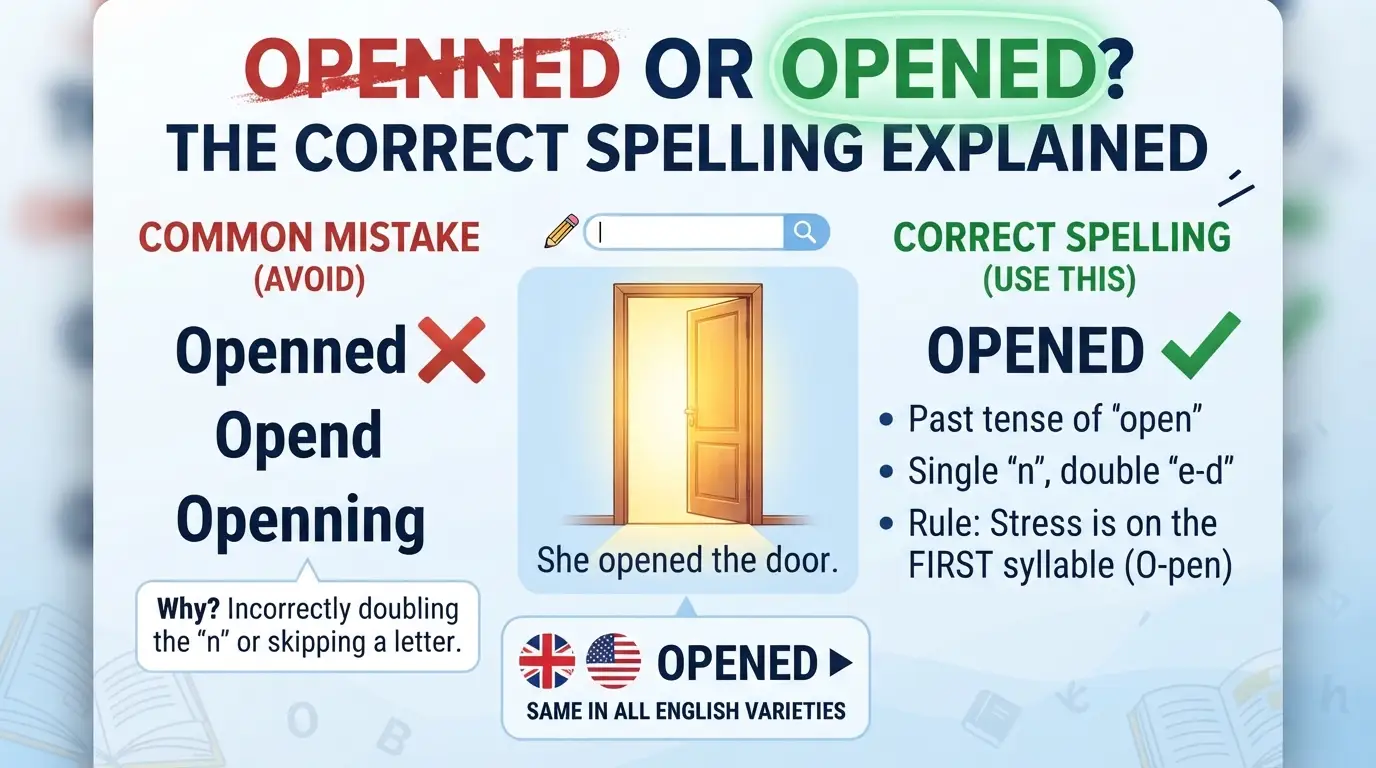
If you want the quick answer right now, here it is: “opened” is correct. “Openned” is a spelling mistake in every kind of English.
Opened or Opened Quick Answer
Opened is the right spelling. It is the past tense of the verb “open.” You add -ed to the end. You do not add another n.
- She opened the door.
- The bank opened at 9 a.m.
- I opened your email.
- They opened a new shop in town.
Open is wrong. Spell-check will mark it, and readers will notice it.
The Origin of Opened
“Open” is a very old English word. It comes from Old English open, which meant “not closed.” Similar words exist in German (offen) and Dutch (open). That shows the word has been in the language family for over a thousand years.
As a verb, “open” followed the normal rule for regular verbs. You add -ed to make the past tense. The word has been spelled “opened” for hundreds of years.
So why do people write “openned”? There are two main reasons:
- A wrong spelling rule. Many short words double their last letter: stop → stopped, run → running, plan → planned.
- Sound. When you say “opened” fast, the n can sound strong, so it feels like there should be two.
Here is the rule that clears it up. You double the last letter only when the last syllable is stressed. In “begin,” you stress the last part: be-GIN. So you write “beginning.” In “open,” you stress the first part: O-pen. So there is no doubling.
British English vs American English Spelling
Here is the good news: there is no US vs UK difference for this word. Both write “opened.” Neither accepts “openned.”
The confusion often comes from other words that do change between US and UK English. For example, UK English often doubles the letter l (travelled), while US English does not (traveled). But that rule is only for words ending in l. “Open” ends in n, so it does not apply.
| Word | US English | UK English | Notes |
| open (past) | opened | opened | Same in both |
| listen (past) | listened | listened | Same in both |
| happen (past) | happened | happened | Same in both |
| travel (past) | traveled | travelled | Different |
| cancel (past) | canceled | cancelled | Different |
| begin (-ing) | beginning | beginning | Stressed ending, so double n |
The lesson is simple: words that end in an unstressed -en do not double the n. Open, listen, happen, widen, and threaten all follow this rule.
Which Spelling Should You Use?
Use opened. This advice holds for every audience:
- US readers: Write “opened.”
- UK, Australia, Canada, India, and other Commonwealth readers: Write “opened.”
- Global or business readers: Write “opened.”
You never need to switch. This is one of the easy ones. If you write for a website, a school, or a company, “openned” will make your text look careless. If you write a text to a friend, it is still a typo.
Pro tip: If you are unsure about a verb, say the word out loud and listen for the stress. If the stress is on the first part, just add -ed.
Common Mistakes with Opened
Here are the errors people make most often, with the fixes.
| Wrong | Right | Why |
| opened | opened | “Open” does not double the n |
| opened | opened | The e is needed before d |
| opened | opened | Only one p |
| opened | opened | Only one e before d |
| opening (as past tense) | opened | “Opening” is the -ing form, not the past |
Other mistakes to watch for:
- Mixing “open” and “opened.” Wrong: “She open the door yesterday.” Right: “She opened the door yesterday.”
- Using “openned” in a hurry. Typing fast often causes this. Read your message once before you send it.
- Trusting the sound. The word sounds like it has a strong n. The spelling does not.
Opened in Everyday Examples
In emails:
- “I opened the file you sent, but it was blank.”
- “Thanks for your message. I have opened a support ticket.”
In news headlines:
- “A new hospital opened in the city center.”
- “The stock market opened higher on Monday.”
On social media:
- “Just opened my gift and I’m in love!”
- “We opened our doors today. Thank you all!”
In formal writing:
- “The committee opened the meeting at 10 a.m.”
- “The company opened a branch office in 2020.”
Notice that every example uses the same spelling. You will not find “openned” in good, edited writing.
Opened or Opened Google Trends & Usage Data
I cannot pull live Google Trends numbers here, so I will not invent any. You can check them yourself for free at trends.google.com. Here is the pattern you should expect, and how to test it.
- “Opened” is far more common than “openned” in books, news, and everyday writing.
- “Openned or opened” is a spelling-check search. People type it when they are unsure. These searches often come from students, writers, and people who use English as a second language.
- Interest is global. English-speaking countries such as the US, UK, India, Pakistan, Nigeria, and the Philippines all have many people who check spelling online.
- Mobile typing adds mistakes. Small keyboards and auto-correct can cause extra letters.
How to check: Open Google Trends, type “openned” and “opened” side by side, and pick your country and date range. You will see “opened” far ahead of the misspelling.
Spelling Variations Side by Side
| Variation | Correct? | Where you may see it | Verdict |
| opened | Yes | Everywhere | Use this |
| openned | No | Typos, rushed texts | Avoid |
| opend | No | Fast typing | Avoid |
| opened | No | Learner errors | Avoid |
| open | Yes (present tense) | “I open the door” | Use for now, not the past |
FAQs
1. Is it “opened” or “opened”?
It is “opened.” “Openned” is always a misspelling.
2. Is “openned” a British spelling?
No. UK English also uses “opened.” No major dictionary lists “openned.”
3. Why doesn’t “open” double the n like “stop” doubles the p?
Stress decides it. In “stop,” the stress falls on the last (and only) syllable, so you double the p. In “open,” the stress falls on the first syllable, so you do not double the n.
4. What is the past tense of “open”?
“Opened.” You can use it for both the simple past (“She opened it”) and the perfect form (“She has opened it”).
5. Is “opened” the same as “opening”?
No. “Opened” is the past tense. “Opening” is the -ing form (“She is opening the door”).
6. What other words follow the same rule?
Listen → listened, happen → happened, widen → widened, threaten → threatened, visit → visited. None of them double the last letter.
7. How can I remember the right spelling?
Remember this line: “Open ends in en, so just add ed.”
Conclusion
Here are the key points. The correct spelling is opened. “Openned” is a mistake in US English, UK English, and every other kind of English. The word “open” is a regular verb, so you make the past tense by adding -ed.
The confusion comes from a real rule: some words double the last letter before -ed. But that rule only applies when the last syllable is stressed, as in “begin → beginning.” In “open,” the stress is on the first syllable, so the n stays single. Words like listen, happen, and widen work the same way.
Remember that you do not need to change the spelling for your audience. A reader in New York, London, Sydney, or Lahore will all expect “opened.”
A few simple habits will keep you safe. Say the word out loud and check the stress. Read your message before you send it. If your spell-check underlines a word, trust it. And if you ever feel unsure, repeat the memory trick: “Open ends in en, so just add ed.”
Now you have the answer, the reason, and the proof. Write “opened” with confidence.

Sikandar Hayat is the author and creator of Journalneste.com, a website dedicated to heartfelt wishes, messages, greetings, and inspiring words for every special moment. With a passion for meaningful writing, Sikandar creates warm and thoughtful content that helps readers express their feelings with ease. His goal is to provide beautiful, shareable words for birthdays, celebrations, relationships, and memorable occasions.