You are writing a card, a text, or a song title. You type “mama.” Then you stop. Should it be “mamma” instead? You are not alone. Many people ask this every month.
People search “mama or mamma” for a simple reason. Both words look right. Both appear in books, songs, and movies. Yet they are not used the same way everywhere. One spelling feels normal in the United States. The other can feel old-fashioned, or even foreign, to some readers.
The fix is easy. Both words mean “mother.” The difference is mostly about habit, region, and style. A few special cases, like the song title “Mamma Mia,” add to the mix.
Below, you will get a quick answer first. Then you will see where the words come from, how US and UK English treat them, and which one to pick. You will also find examples, common mistakes, and FAQs.
Mama or Mamma Quick Answer
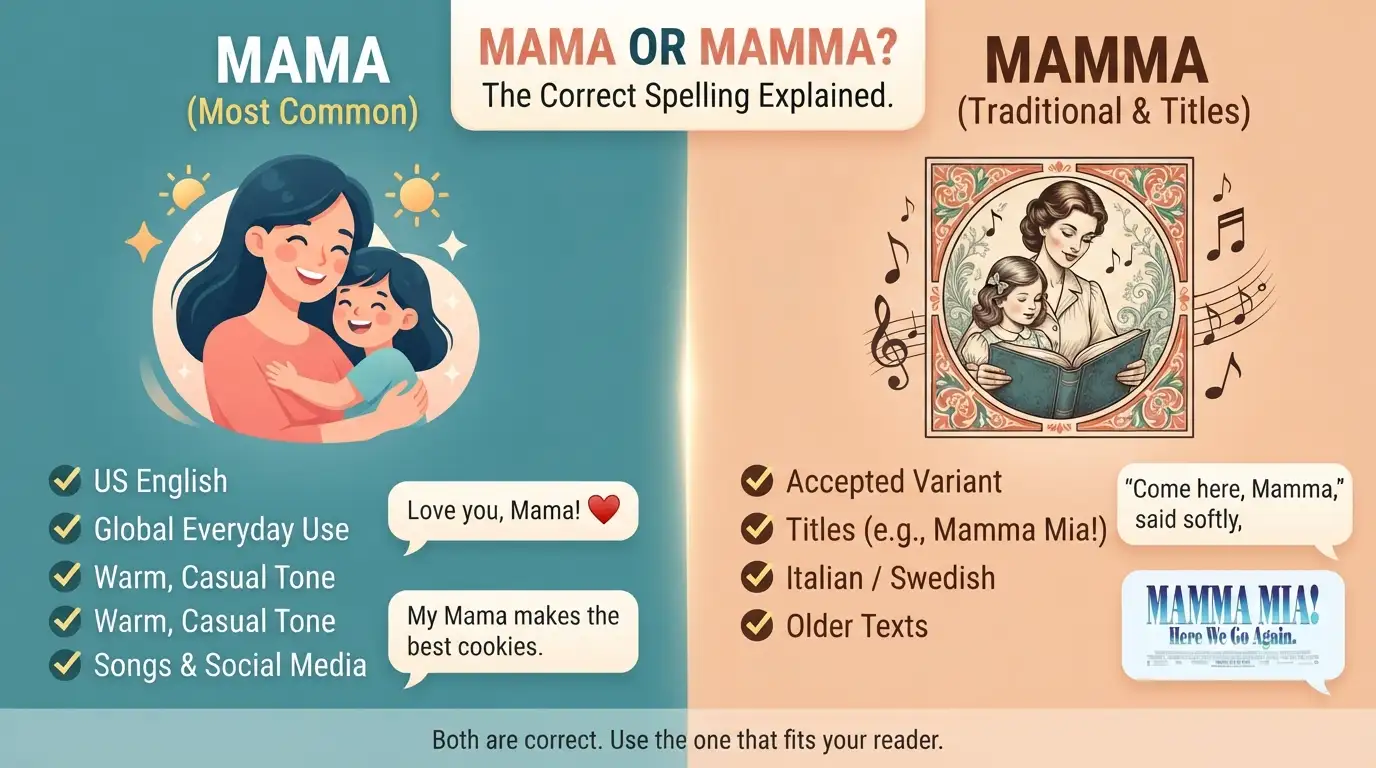
Both spellings are correct. They mean the same thing: a mother.
- Mama is the most common spelling in American English.
- Mamma is a less common variant. You will see it in older texts, in some British writing, and in names borrowed from Italian.
Examples:
- “My mama makes the best soup.” (common in the US)
- “Mamma Mia, here we go again!” (a fixed title, always spelled with two m’s)
Simple rule: If you are unsure, use mama. Keep mamma for titles, names, and Italian or Swedish words.
The Origin of Mama or Mamma
“Mama” and “mamma” are baby-talk words. Babies make “ma” sounds early, so many languages have a similar word for mother. You can find “mama” or “mamma” in English, Italian, Spanish, Swedish, Mandarin, and many others.
In English, both spellings have been used for centuries. At first, spelling was not fixed. Writers chose the form they liked. Over time, dictionaries and publishers settled on common forms.
Why the difference today?
- Italian and Swedish spell the word mamma. English borrowed some uses from them.
- American English often keeps spelling short and simple, so mama became the main form.
- Older English texts often used mamma, and some writers still do.
There is one more thing to know. The Latin word mamma also means “breast.” That is why the medical word “mammary” exists. Today, English readers rarely think of this when they see “mamma” as a name for mother.
British English vs American English Spelling
Here is the key point. This is not a strict spelling rule like “color” vs “colour.” Both forms are accepted in both countries. The difference is in how often each one is used.
British speakers also use other words for mother, like mum, mummy, and mam. So “mama” and “mamma” are used less often in everyday British speech than in the US.
| Feature | Mama | Mamma |
| Most common in | US English | Less common; seen in UK, Italian, Swedish contexts |
| Feel | Modern, warm, casual | Older, softer, or foreign |
| Dictionary status | Standard | Accepted variant |
| Typical use | Everyday writing, songs, social media | Titles, names, Italian phrases |
| Example | “Mama, I’m home.” | “Mamma Mia!” |
Note: Dictionaries differ a little. Check the one your school, editor, or company uses.
Which Spelling Should You Use?
Pick the spelling based on your reader.
US readers: Use mama. It looks natural and familiar.
UK and Commonwealth readers: Both are fine. But most people say mum or mummy. Use “mama” or “mamma” only if you mean those exact words, such as in a quote or a title.
Global readers: Use mama. It is the simplest and most widely understood form.
Special cases:
- Song, show, or film titles: copy the title exactly. “Mamma Mia!” has two m’s.
- Italian text: use mamma.
- Brand or family names: follow the official spelling.
Most important: be consistent. Do not use “mama” in one paragraph and “mamma” in the next.
Common Mistakes with Mama or Mamma
1. Writing “Mama Mia” instead of “Mamma Mia.”
The Italian phrase and the famous title use two m’s. Correct: Mamma Mia.
2. Mixing both spellings in one text.
Wrong: “Mama called, and then Mamma texted.” Pick one.
3. Thinking one spelling is wrong.
Neither is an error. Both are valid.
4. Confusing “mama” with “mom” or “mum.”
“Mom” is US. “Mum” is UK. “Mama” and “mamma” are softer, more personal forms.
5. Using the wrong form in formal writing.
In formal work, “mother” is usually best. Use “mama” or “mamma” only in quotes or casual voice.
6. Forgetting the apostrophe.
Wrong: “Mama’s boy.” Correct: “Mama’s boy” or “Mamma’s boy.”
Mama or Mamma in Everyday Examples
Email (casual):
“Hi Mama, I will call you tonight. Love, Sam.”
Email (formal):
“I want to thank my mother for her support.” (Neither “mama” nor “mamma” fits here.)
News headline:
“Mama bear protects cubs in the national park.” (Mama is common in US headlines.)
Social media:
“Happy Mother’s Day to the best mama ever! ❤️”
Formal writing:
“The film Mamma Mia! became a global hit.” (Title spelling stays fixed.)
Fiction:
“‘Come here, little one,’ said Mamma softly.” (Mamma can give a warm, old-world tone.)
Mama or Mamma Google Trends & Usage Data
I cannot pull live Google Trends numbers here, so check the tool yourself for the latest data. The general patterns are clear, though.
- Mama is searched far more than mamma in the US. People use it in songs, parenting blogs, and social posts.
- Mamma gets a boost from “Mamma Mia,” so searches rise when the show or film is in the news.
- In the UK and other Commonwealth countries, people search “mum” much more than either form.
- In Italy and Sweden, “mamma” is the normal spelling in their own languages.
- Search interest in “mama” often rises around Mother’s Day.
Tip: Open Google Trends, enter “mama” and “mamma” side by side, and compare by country and date.
Keyword Variations Side by Side
| Variation | Region / Context | Tone | Best For |
| Mama | US, global | Warm, casual | Everyday writing, social media |
| Mamma | Italian, Swedish, older English | Soft, traditional | Titles, names, fiction |
| Mom | US | Neutral, common | Everyday speech |
| Mum | UK, Australia, Ireland | Neutral, common | British writing |
| Mummy | UK | Child-like, sweet | Children’s talk |
| Mother | Global | Formal | Official or professional writing |
FAQs
1. Is it mama or mamma?
Both are correct. “Mama” is more common in American English.
2. Which spelling is more popular?
“Mama” is more popular overall, especially in the US.
3. Is “mamma” British English?
Not exactly. It is a variant that appears in British writing, but Britons more often say “mum” or “mummy.”
4. Is it “Mama Mia” or “Mamma Mia”?
It is Mamma Mia. That is the correct title and the Italian spelling.
5. Can I use “mama” in formal writing?
Usually not. Use “mother” in formal work. Use “mama” only in quotes or casual tone.
6. Does “mamma” have another meaning?
Yes. In Latin and in medicine, “mamma” can mean “breast.” In everyday use, it simply means mother.
7. Which spelling is best for SEO or online content?
Use the one your audience searches most. For a US audience, that is “mama.” Add “mamma” naturally if you also want to reach people who search for it.
Conclusion
So, which is right: mama or mamma? The answer is simple. Both are correct. They mean the same thing, and both have a long history in English.
Here are the key points to remember:
- Mama is the best everyday choice, especially for US and global readers.
- Mamma works well for titles, Italian or Swedish words, and a softer, older tone.
- Mamma Mia always keeps two m’s.
- British readers more often use mum or mummy.
- Use mother in formal writing.
- Stay consistent inside one piece of writing.
If you are ever in doubt, choose mama. It is clear, friendly, and widely understood. If you are quoting a title or a name, copy the spelling exactly as written.
Language changes, and spelling habits vary by place and person. What matters most is that your reader understands you and that your writing feels natural. Now you can type the word with confidence and move on with your message.

Sikandar Hayat is the author and creator of Journalneste.com, a website dedicated to heartfelt wishes, messages, greetings, and inspiring words for every special moment. With a passion for meaningful writing, Sikandar creates warm and thoughtful content that helps readers express their feelings with ease. His goal is to provide beautiful, shareable words for birthdays, celebrations, relationships, and memorable occasions.