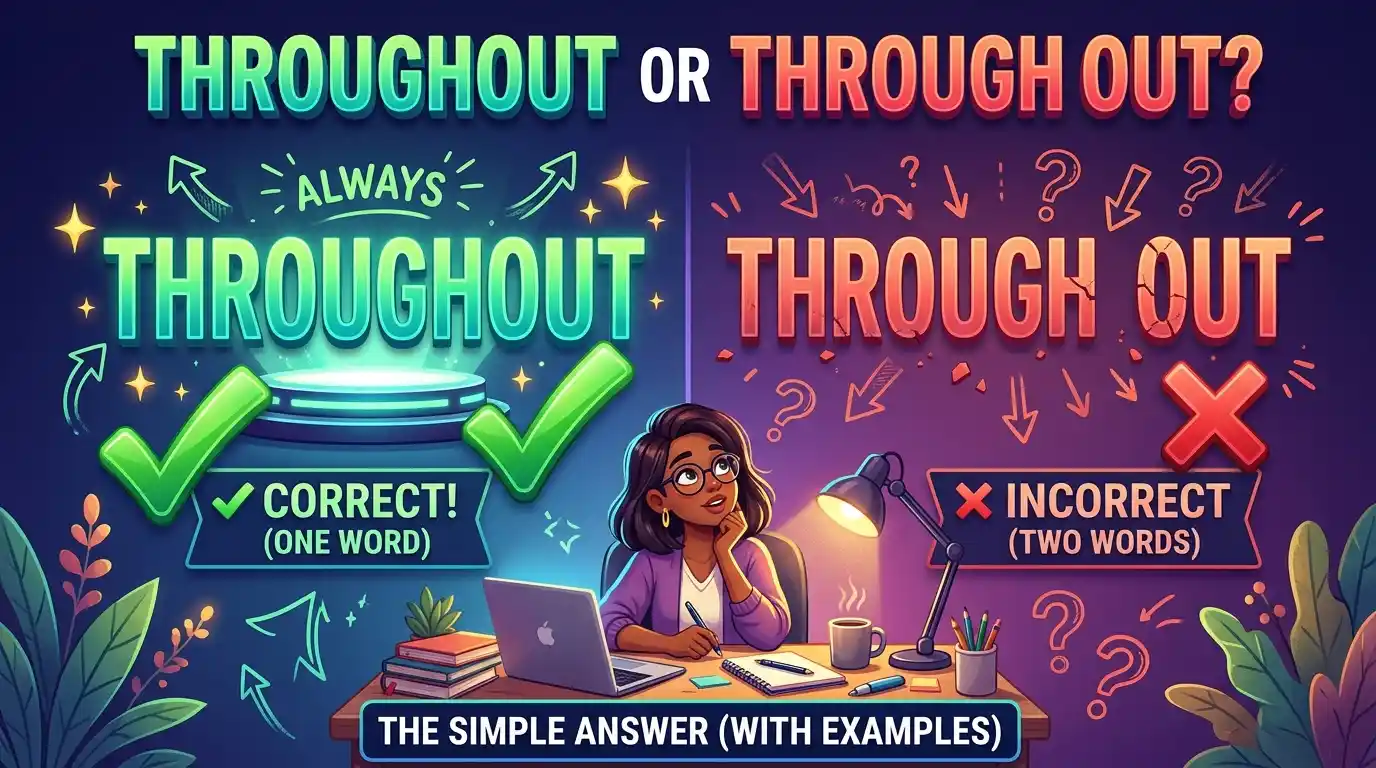
You are typing fast. You reach a word and stop. Is it “throughout” or “through out”? You are not alone. Thousands of people ask this every month.
The two forms look almost the same. They sound the same too. But only one is right in nearly every sentence.
People search this keyword for a simple reason. They want a fast answer before they hit send. Maybe it is an email to a boss. Maybe it is an essay, a report, or a post. One small slip can make good writing look careless.
This guide clears up the confusion. You will get the short answer first. Then you will learn where the word came from and why “through out” looks so tempting. You will see how British and American writers handle it. You will also see real examples, common mistakes, and how people search for it.
By the end, you will know which form to use. You will not second-guess it again. Let’s start with the answer you came for.
Throughout or Through Out Quick Answer
Use “throughout.” It is one word.
“Through out” as two words is almost always wrong.
“Throughout” has two main jobs:
- It means “in every part of.”
- The smell of fresh bread spread throughout the house.
- Prices rose throughout the country.
- It means “during the whole time.”
- She smiled throughout the meeting.
- It rained throughout the night.
A quick test: Can you replace the word with “all through” or “in every part of”? If yes, write “throughout.”
One rare exception: “through” and “out” can sit side by side when they are two separate words. For example: “He looked through out of the window.” Here “through” and “out” do different jobs. This is rare, and most writers will never need it.
The Origin of Throughout
“Throughout” is a very old word. It joins two small words: through and out. The two parts are easy to see in the spelling.
The word dates back to Old English, the language spoken in England over a thousand years ago. Over time, the two parts fused into one. This is common in English. Words like “into,” “onto,” and “upon” grew the same way.
So why do people write “through out”? There are three reasons.
- You can see both parts. “Through” and “out” are both real words, so the split looks natural.
- We say it in two beats. When we speak, there is a tiny break in the middle.
- Other word pairs stay apart. “Out of,” “all over,” and “right now” are all two words, so people guess “through out” follows the pattern.
It does not. English fixed this word as one piece long ago, and dictionaries have listed it as one word for centuries.
British English vs American English Spelling
Here is the good news. There is no difference. British, American, Canadian, and Australian English all spell it “throughout.”
Many spelling fights are about region: “color” or “colour,” “center” or “centre.” This one is not. The confusion comes from habit, not from geography.
| Feature | American English | British English |
| Correct spelling | throughout | throughout |
| “Through out” (two words) accepted? | No | No |
| “Thru-out” accepted? | No | No |
| Hyphenated “through-out” accepted? | No | No |
| Used in formal writing | Yes | Yes |
A related spelling note: Americans sometimes write “thru” in casual signs and texts, like “drive-thru.” That is informal. Do not use “thru” in formal writing, and do not write “thruout.”
Which Spelling Should You Use?
Your answer is the same for every reader.
- US readers: Use “throughout.”
- UK and Commonwealth readers: Use “throughout.”
- Global readers: Use “throughout.”
Does it work for every kind of writing? Yes. Use it in school essays, business emails, legal papers, news, blogs, and texts.
Two tips make it easier:
- Pick the one-word form every time. You will almost never be wrong.
- Turn on spell check. Most tools flag “through out” right away.
Common Mistakes with Throughout
Here are the errors people make most often.
1. Splitting it into two words
- ❌ The rule applies through out the school.
- ✅ The rule applies throughout the school.
2. Adding a hyphen
- ❌ We worked through-out the weekend.
- ✅ We worked throughout the weekend.
3. Using “thru” in formal writing
- ❌ Sales grew thruout the year.
- ✅ Sales grew throughout the year.
4. Mixing it up with “through”
- ❌ She slept throughout the door. (This makes no sense.)
- ✅ She walked through the door.
- ✅ She slept throughout the storm.
5. Using “throughout” with no object
- ❌ He stayed calm throughout. (This one is actually fine, because “throughout” can end a sentence as an adverb.)
- ✅ He stayed calm throughout.
Do not “correct” that last kind of sentence. It is good English.
Throughout in Everyday Examples
In emails
- “Thank you for your help throughout this project.”
- “Please keep this file open throughout the call.”
In news writing
- “Snow fell throughout the northern region on Friday.”
- “The team led throughout the game.”
On social media
- “Laughing throughout this whole movie.”
- “Rain throughout the weekend. Send coffee.”
In formal writing
- “The author uses the same symbol throughout the novel.”
- “The terms of this agreement apply throughout the contract period.”
In school work
- “Water is found throughout the body.”
- “Dates are shown in bold throughout the text.”
Throughout Google Trends & Usage Data
I could not pull live Google Trends numbers for this article. So I will not invent any. You can check the real numbers in a minute at trends.google.com. Search “throughout” and “through out” side by side.
Here is what you can expect to see, based on how this kind of spelling question usually behaves:
- “Throughout” is the far bigger term. It is a common word that people use all day.
- “Through out” gets searched too. These come from people who are unsure and want to check.
- Interest follows the school year. Spelling and grammar searches often rise when students write essays and exams.
- The pattern is similar across English-speaking countries. Since there is no US/UK spelling split, the question is the same everywhere.
How to check it yourself:
- Go to Google Trends.
- Type “throughout” and add “through out” as a second term.
- Set the region to the US, then the UK, then your own country.
- Compare the lines.
Keyword Variations Side by Side
| Form | Correct? | Notes |
| throughout | ✅ Yes | Standard spelling everywhere |
| through out | ❌ No (almost always) | Valid only when the two words do separate jobs |
| through-out | ❌ No | Hyphen is not used |
| thruout | ❌ No | Informal; avoid it |
| thru out | ❌ No | Informal; avoid it |
Frequently Asked Questions (FAQs)
1. Is it “throughout” or “through out”?
It is “throughout.” Write it as one word.
2. Is “through out” ever correct?
Rarely. It works only when “through” and “out” are separate words in a sentence, like “He looked through out of a gap.” Most writers never need this.
3. Is “throughout” spelled differently in the UK and the US?
No. Both use “throughout.”
4. Can I write “throughout” at the end of a sentence?
Yes. “She stayed calm throughout” is correct.
5. What does “throughout” mean?
It means “in every part of” a place, or “during the whole time” of an event.
6. Is “thruout” okay in an email?
Avoid it. “Thruout” is informal. Use “throughout” in emails, even casual ones.
7. What is the difference between “through” and “throughout”?
“Through” means passing from one side to the other: “walk through the park.” “Throughout” means everywhere or the whole time: “flowers bloom throughout the park.”
8. How can I remember the spelling?
Think of it as one long word for something that covers everything. A long word for “all over.”
Conclusion
Here is what to remember.
“Throughout” is one word. “Throughout” is almost always a mistake. You will see both in the wild, but only one is correct.
The word has two main meanings. It means “in every part of” a place, and it means “during the whole time.” If you can swap in “all through,” you are in the right spot.
There is no UK vs US difference here. If you write for readers in New York, London, Lahore, or Sydney, the spelling is the same.
The mistakes are easy to avoid. Do not split the word. And do not add a hyphen. Do not use “thru” in formal work. And do not mix it up with “through,” which means moving from one side to the other.
When in doubt, use the one-word form. It will be right nearly every time, in every kind of writing.
Now you have the quick answer, the reason behind it, and the examples to back it up. Write with confidence and hit send.

Sikandar Hayat is the author and creator of Journalneste.com, a website dedicated to heartfelt wishes, messages, greetings, and inspiring words for every special moment. With a passion for meaningful writing, Sikandar creates warm and thoughtful content that helps readers express their feelings with ease. His goal is to provide beautiful, shareable words for birthdays, celebrations, relationships, and memorable occasions.