You are typing an email. You need the past form of “write.” Then you stop. Does it have one T or two? Is it “writen” or “written”?
You are not alone. Every day, many people search “writen or written” to check. The word is common. We use it in school, at work, and in contracts. A small spelling slip can look careless.
Some people also wonder if this is like “color” and “colour.” Maybe one spelling is American and one is British? That is a fair guess. English has many spelling splits like that.
Here is the good news. This one is simple. There is only one correct spelling, and it is the same in every country. This article gives you the quick answer, the history, and clear examples. You will also see common mistakes and tips for work and school. By the end, you will never doubt this word again.
Writen or Written Quick Answer
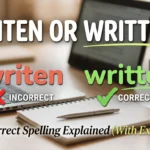
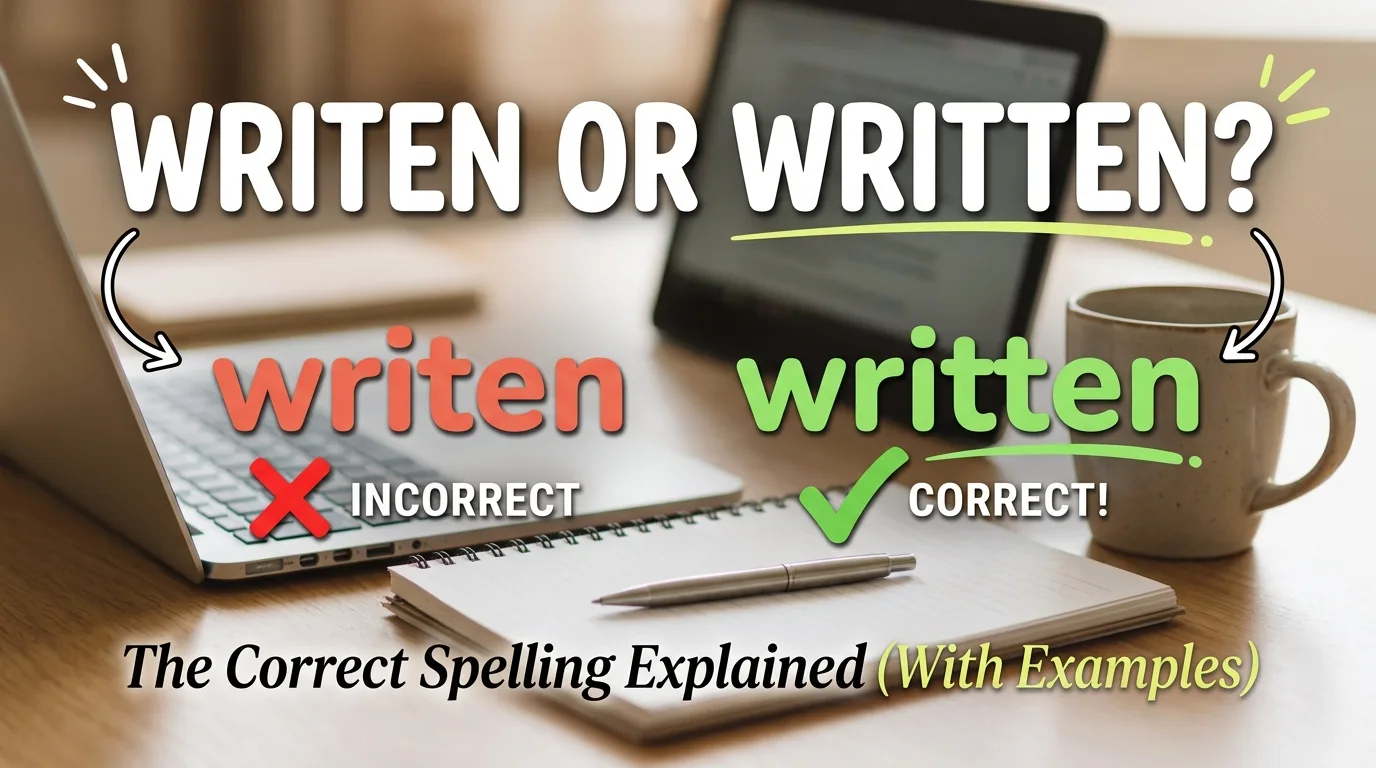
Written is correct. Writen is a misspelling.
“Written” is the past participle of “write.” It always has two Ts.
Examples:
- I have written the report.
- She wrote a letter. ❌ (needs “has”: She has written a letter. ✅)
- The rules are written on the wall.
- This is a written test.
A simple trick: “write” + “ten” = “written.” The double T comes from the old ending “-en” added to the stem “writ.”
The Origin of Written
“Written” comes from Old English. The old verb was writan, which meant to scratch or carve. People first wrote by cutting marks into wood and stone.
The past form was written. It was built like other old verbs: a stem plus “-en.” Think of “bitten,” “hidden,” and “ridden.”
Why the double T? Short vowel sounds often need a double consonant after them. The “i” in “writ” is short, so the T doubles. Compare:
- write (long “i,” one T)
- written (short “i,” two Ts)
Many people search “writen” because they forget this rule. The word “write” has one T, so the mistake feels natural.
British English vs American English Spelling
Many spelling pairs differ between the US and the UK. This is not one of them. Both countries use “written.”
| Word | American | British | Same or different? |
| Past form of write | written | written | Same |
| Color | color | colour | Different |
| Center | center | centre | Different |
| Organize | organize | organise | Different |
| Travelled | traveled | travelled | Different |
| Writen | not a word | not a word | Wrong in both |
British and American spellings split for historical reasons. In the 1800s, Noah Webster pushed to simplify US spelling. That is how “colour” became “color.” Nobody ever made “writen” a variant. It is simply a typo.
Which Spelling Should You Use?
Use written everywhere.
- US readers: written
- UK and Commonwealth readers (Canada, Australia, India, Pakistan, and others): written
- Global audiences: written
There is no audience where “writen” is right. Do not spell it that way in emails, essays, résumés, or websites.
One safe habit: if spell-check underlines it, fix it. Every major spell-checker flags “writen.”
Common Mistakes with Written
| Mistake | Fix |
| I have writen it. | I have written it. |
| She has writting a book. | She has written a book. |
| He wrote it down. / He has wrote it. | He has written it. |
| A writen warning | A written warning |
| It was writed in ink. | It was written in ink. |
Watch out for these:
- Wrote vs. written. “Wrote” is the simple past (I wrote it yesterday). “Written” needs a helper like has, have, had, or was (I have written it).
- Writing vs. written. “Writing” ends in -ing. “Written” is the finished action.
- One T. “Writen” is always wrong.
Written in Everyday Examples
Email: “I have written the summary. Please see the attached file.”
News: “The law was written in 1998 and has changed twice.”
Social media: “Best book I have ever read. Beautifully written!”
Formal writing: “Written consent is required before the procedure begins.”
School: “Your written answers must be handed in by Friday.”
Business: “Please send a written quote by the end of the week.”
Writen or Written Google Trends & Usage Data
I have not pulled live Google Trends numbers for this article, so I will not invent any. Here is what is generally true, and you can check it yourself at trends.google.com.
- The correct form dominates. Searches and published text use “written” far more than “writen.”
- Searches for “writen” are mostly spelling checks. People type it, doubt it, and look it up.
- Interest rises in school seasons. Students write essays and tests, so spelling questions grow.
- It shows up worldwide. The doubt appears in the US, UK, India, Pakistan, Nigeria, and the Philippines. Many readers of English as a second language search this term.
| Variation | Status | Where used |
| written | Correct | Everywhere |
| writen | Misspelling | Nowhere (typo) |
| writing | Correct (different form) | Everywhere |
| wrote | Correct (simple past) | Everywhere |
| writ | Correct (a legal order) | Mostly legal use |
To see the trend, open Google Trends, type both words, and compare by country and time.
FAQs
1. Is it writen or written?
It is “written.” “Writen” is a spelling mistake.
2. Is “writen” British spelling?
No. British English also uses “written.”
3. Is “writen” American spelling?
No. American English uses “written” too.
4. Why does “written” have two Ts?
The short “i” sound in “writ” takes a double T before the “-en” ending. It is the same pattern as “bitten” and “hidden.”
5. What is the difference between “wrote” and “written”?
“Wrote” stands alone: I wrote a note. “Written” needs a helper word: I have written a note.
6. Is “written” a verb or an adjective?
Both. It is a verb form (She has written it) and an adjective (a written test).
7. How can I remember the spelling?
Think “write + ten.” Say it in your head: writ-ten. Two Ts.
Conclusion
Here is the short version. Written is the right spelling. Written is a typo. No country, school, or style guide accepts it.
Remember that this is not like “color” and “colour.” There is no US version and UK version. The word is the same everywhere, so you never need to guess based on your audience.
The word comes from Old English writan, and the double T follows a common rule: a short vowel before the ending doubles the consonant. A quick memory trick is “write + ten.”
Also keep “wrote” and “written” apart. Use “wrote” alone for the past. Use “written” after has, have, had, or was.
In your next email, essay, or post, type “written” with confidence. If you are ever unsure, read the word aloud and count the Ts. You need two. Small details like this make your writing look careful and professional.

Sikandar Hayat is the author and creator of Journalneste.com, a website dedicated to heartfelt wishes, messages, greetings, and inspiring words for every special moment. With a passion for meaningful writing, Sikandar creates warm and thoughtful content that helps readers express their feelings with ease. His goal is to provide beautiful, shareable words for birthdays, celebrations, relationships, and memorable occasions.