You are writing an email. You type “step backward” and stop. Should it be “step backwards”? You look at both and neither looks wrong.
You are not alone. Millions of people search “backward or backwards” every year. Both words look right, both appear in books and news, and both mean almost the same thing. That makes it hard to know which one is correct.
The good news is that this is an easy problem to solve. Neither word is a mistake. The difference comes down to where you live, who reads your writing, and how the word works in your sentence.
In this guide, you will get a quick answer first. Then you will learn where the words came from, how American and British English treat them, and which one to pick. You will also see common mistakes, real examples, usage patterns, and answers to common questions.
By the end, you will never pause over this word again.
Backward or Backwards Quick Answer
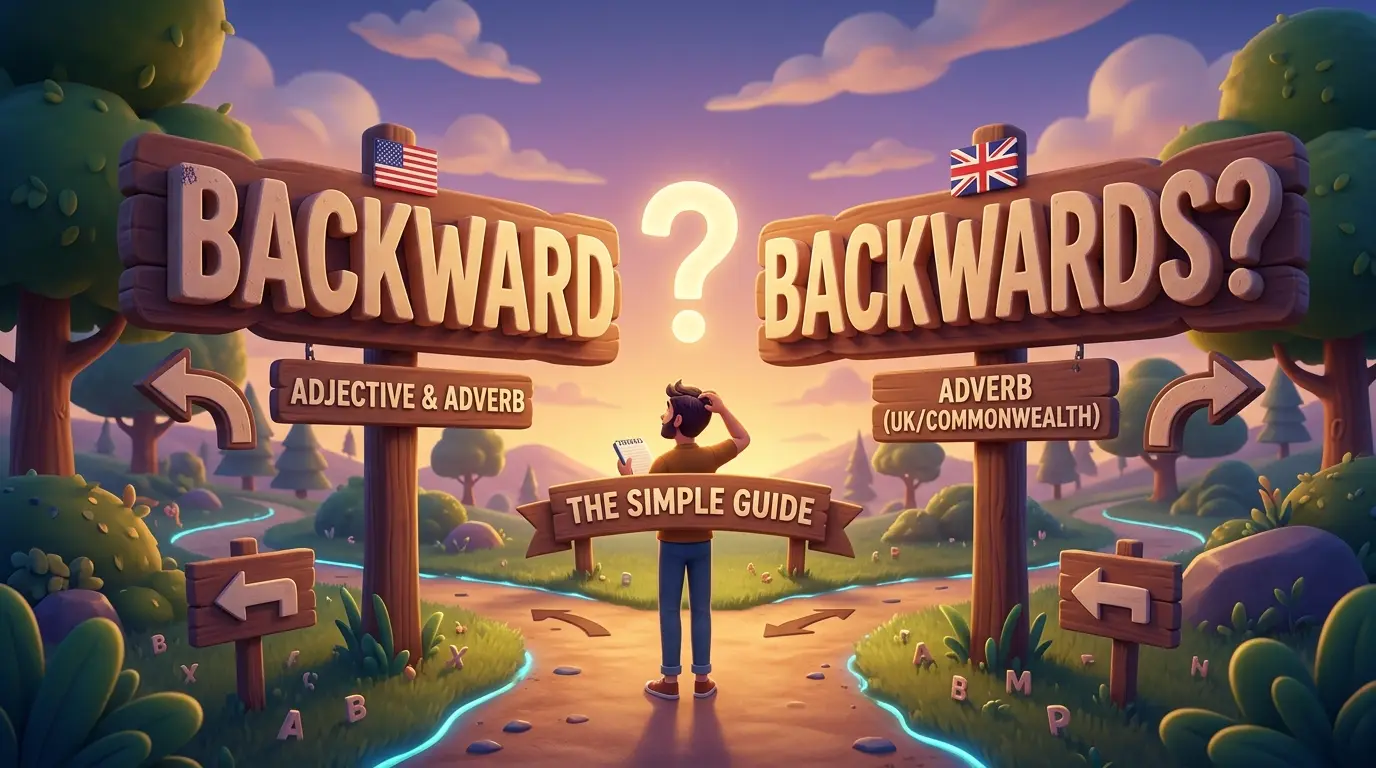
Both are correct. Here is the simple rule:
- Backward is the safe choice. It works in American English as an adjective and an adverb. In British English it works as an adjective.
- Backwards is common in British English as an adverb.
Examples:
- She took a backward step. (adjective, US and UK)
- He fell backward. (adverb, US)
- He fell backwards. (adverb, UK)
- Say the alphabet backwards. (adverb, UK)
- Say the alphabet backward. (adverb, US)
Tip: If you are unsure, use “backward.” Nobody will call it wrong.
The Origin of Backward and Backwards
Both words are very old. They go back to Old and Middle English.
The word “backward” came from “aback” plus “-ward.” The ending “-ward” means “in the direction of.” You see it in “forward,” “toward,” and “upward.”
The ending “-wards” is also old. In Old English, “-weardes” was a form used to build adverbs. Over time, English speakers dropped and kept different endings in different places.
So why do two spellings exist? English never had one rule-maker. People used both forms for hundreds of years. Later, dictionaries tried to set rules. American dictionaries leaned toward the shorter forms, such as “backward,” “toward,” and “forward.” British writers kept the “s” forms more often, such as “backwards,” “towards,” and “afterwards.”
The two spellings are not a mistake. They are two paths of the same word.
British English vs American English Spelling
Here is how the two main styles treat these words.
American English prefers the shorter form. Most American writers use “backward” for everything. You will still see “backwards” in speech and some idioms, but it is less common.
British English uses both. “Backward” is the adjective: “a backward glance.” “Backwards” is the adverb: “walk backwards.” Commonwealth countries such as Australia, India, and Pakistan often follow the British pattern.
| Use | American English | British English |
| Adjective (before a noun) | backward step | backward step |
| Adverb (after a verb) | step backward | step backwards |
| Common in speech | backward (backwards also heard) | backwards |
| Idiom: “bend over ___” | backward | backwards |
| Tech term: “___ compatible” | backward compatible | backward compatible |
| Style preference | shorter form | both, by role |
The adjective is the one place where both styles agree. It is almost always “backward.”
Which Spelling Should You Use?
Pick based on your reader.
Writing for a US audience: Use “backward” every time. It matches American style guides and looks natural to your reader.
Writing for a UK or Commonwealth audience: Use “backward” before a noun and “backwards” after a verb. For example: “a backward glance” and “he looked backwards.”
Writing for a global audience: Use “backward.” It is understood everywhere and is never marked wrong.
Writing for school or work: Follow your style guide. If you have none, stay consistent. Do not use “backward” in one paragraph and “backwards” in the next, unless the grammar calls for it.
Writing SEO content: Match the spelling to your target country. A site for US readers should say “backward.” A site for UK readers should say “backwards” as an adverb.
Common Mistakes with Backward or Backwards
Here are errors people make often.
1. Using “backwards” before a noun.
- Wrong: a backwards step
- Right: a backward step
2. Mixing both in one text.
- Wrong: He leaned backward, then stepped backwards.
- Right: He leaned backward, then stepped backward. (Choose one.)
3. Changing a fixed phrase.
- “Backward compatible” is the standard tech term. “Backwards compatible” is also seen, but “backward” is safer.
4. Thinking one is a typo.
- Neither is a typo. Do not “fix” someone else’s choice unless their text must match a style guide.
5. Using “backwardly.”
- This word exists but is rare. In most cases, “backward” is cleaner.
Backward or Backwards in Everyday Examples
In an email:
- “Let’s not go backward on this plan.”
- “The new update is backward compatible.”
In the news:
- “The economy took a step backward last quarter.”
- “The team moved backwards in the rankings.” (UK style)
On social media:
- “Me trying to walk backwards in heels.”
- “Saying the alphabet backward is harder than it looks.”
In formal writing:
- “The report shows a backward trend in rural education.”
- “The committee will review the policy backward from the final outcome.”
In everyday talk:
- “Put your shirt on backward again?”
- “He bent over backwards to help.”
Backward or Backwards Google Trends and Usage Data
Search tools like Google Trends show how often people look up words. Numbers change over time, so check the live data for exact figures. Here is the general pattern.
United States: People search for and use “backward” more. “Backwards” is still common in casual speech and idioms.
United Kingdom: “Backwards” is used much more as an adverb. “Backward” appears mainly as an adjective.
Canada, Australia, and India: These regions mix both. Many follow British habits, but American media influences them too.
Global search: Many people search for the pair “backward or backwards” because they want to know which is right. Spikes often happen near school terms and exam seasons.
Context matters. In tech writing, “backward compatible” leads. In everyday speech, “backwards” is heard often in the UK and often in idioms like “bend over backwards.”
You can test this yourself. Open Google Trends, enter both words, and compare by country and time.
Side-by-Side Comparison
| Variation | Word type | US use | UK use | Example |
| Backward | Adjective | Standard | Standard | a backward glance |
| Backward | Adverb | Preferred | Accepted | fell backward |
| Backwards | Adverb | Accepted | Preferred | fell backwards |
| Backwards | Adjective | Rare | Rare | (avoid) |
| Backward compatible | Tech phrase | Standard | Standard | backward compatible software |
| Bend over backwards | Idiom | Common | Common | bend over backwards to help |
| Backwardly | Adverb | Very rare | Very rare | (avoid) |
Frequently Asked Questions
1. Is it backward or backwards?
Both are correct. “Backward” is safe everywhere. “Backwards” is common in British English as an adverb.
2. Is “backwards” a real word?
Yes. It is a real word with a long history. It is just more common in some regions.
3. Which is more common in the US?
“Backward” is more common in the United States.
4. Which is more common in the UK?
In the UK, people use “backwards” often as an adverb. “Backward” is the usual adjective.
5. Can I say “a backwards step”?
It is better to say “a backward step.” Adjectives before nouns are almost always “backward.”
6. Is “backward compatible” or “backwards compatible” correct?
“Backward compatible” is the standard form. You may see the other, but “backward” is safer.
7. Is it “bend over backward” or “bend over backwards”?
Both are used. Americans often say “backward,” and British speakers often say “backwards.”
8. Which should I use if I am not sure?
Use “backward.” It is accepted in all English styles.
Conclusion
The question “backward or backwards” has a simple answer. Both words are correct, and neither one is a mistake.
Here are the key points to remember:
- “Backward” is the safest choice. It works as an adjective and an adverb, and it is the preferred form in American English.
- “Backwards” is common in British English, mostly as an adverb. It appears in speech and in idioms too.
- Before a noun, use “backward.” Say “a backward step,” not “a backwards step.”
- Stay consistent. Pick one style for your piece and keep it throughout.
- Know your reader. Use American style for US readers. Use British style for UK and Commonwealth readers.
When in doubt, choose “backward.” It is clear, it is correct, and it fits almost any sentence. For adverbs in UK writing, “backwards” is a fine choice.
Now you can write with confidence. If you are sending an email, writing an essay, or posting online, you know which word to use and why.

Sikandar Hayat is the author and creator of Journalneste.com, a website dedicated to heartfelt wishes, messages, greetings, and inspiring words for every special moment. With a passion for meaningful writing, Sikandar creates warm and thoughtful content that helps readers express their feelings with ease. His goal is to provide beautiful, shareable words for birthdays, celebrations, relationships, and memorable occasions.