Your car gets hit. The insurance agent calls and says it was “totaled.” Or was it “totalled”? You grab your phone and type both words into Google. You are not alone.
People search for this keyword for a few reasons. Some are writing to an insurance company. And some are writing a news story. Some are students checking homework. Others just want to look sharp at work. Both spellings look right, and both appear online, so the doubt is fair.
Here is the good news: both spellings are correct. They belong to two versions of English. One is American. One is British. The trick is to pick the one that fits your reader and stick with it.
In this guide, you will get a quick answer, a little word history, and simple spelling rules. You will also find a comparison table, real examples, common mistakes, and answers to the top questions. By the end, you will know exactly which spelling to use and why.
Totaled or Totalled Quick Answer
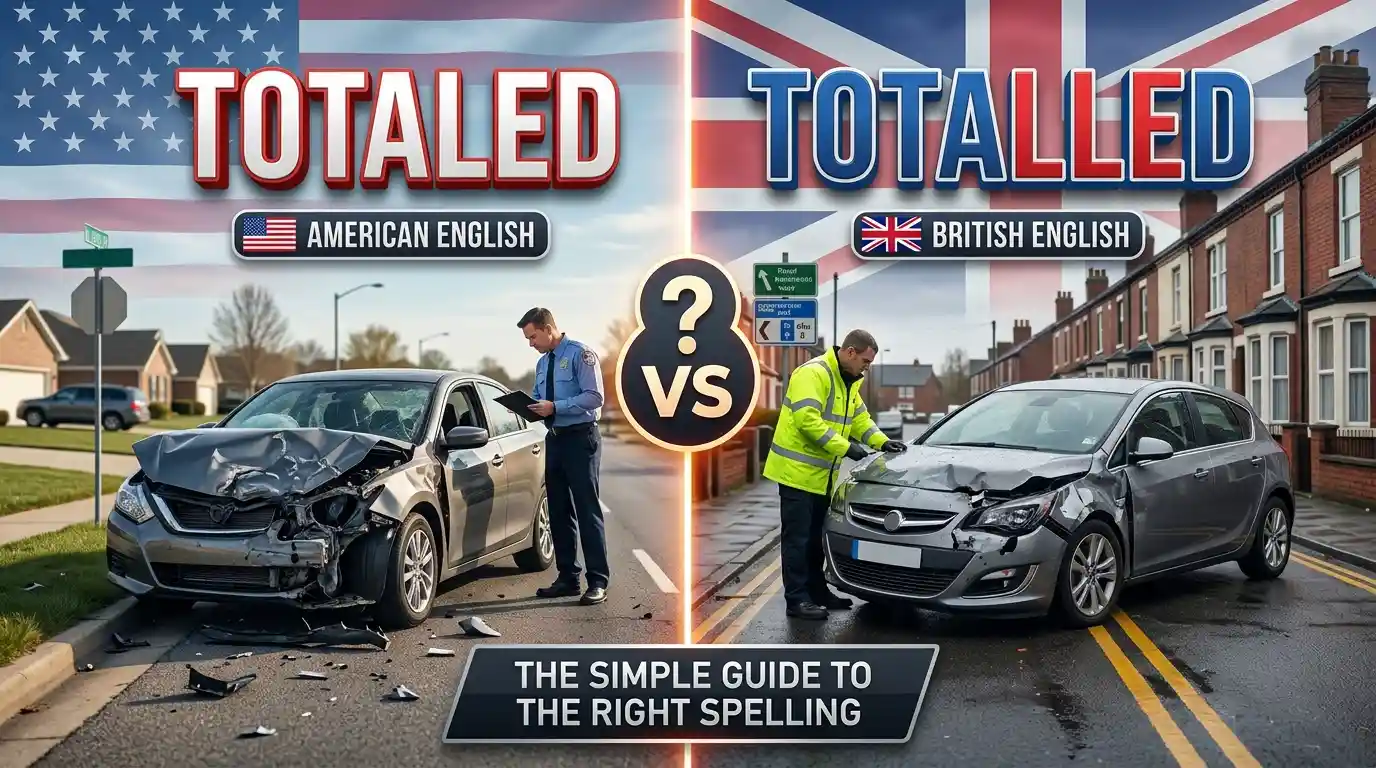
Totaled is the American spelling. Totalled is the British spelling. Both mean the same thing.
The word has two main meanings:
- To add up. “She totaled the bill.” (US) / “She totalled the bill.” (UK)
- To destroy a car. “He totaled his truck.” (US) / “He totaled his van.” (UK)
When a car is “totaled,” the repair cost is more than the car is worth. The insurer calls it a total loss.
Rule of thumb: Writing for Americans? Use totaled. Writing for readers in the UK, Ireland, Australia, or New Zealand? Use totalled.
The Origin of Totaled or Totalled
The word starts with the Latin word totus, which means “whole” or “all.” From it came the Latin totalis, then the Old French total, and finally English total.
At first, “total” was an adjective and a noun. It meant “the whole amount.” Later, people used it as a verb. To “total” a list of numbers meant to add them up.
The car is newer. In the United States, people began using “total” as slang for wrecking a car beyond repair, and the habit spread. Today it is normal in everyday speech.
So why two spellings? It comes down to one old rule fight:
- British English keeps the old habit of doubling the final L when you add -ed or -ing. This happens even when the last syllable is not stressed.
- American English dropped the extra letter. Noah Webster, a dictionary maker in the early 1800s, pushed for simpler spelling. His ideas shaped how Americans write today.
That is why you have traveled in the US and travelled in the UK. Totaled and totalled follow the same pattern.
British English vs American English Spelling
The rule is simple.
- American English: Double the last consonant only if the stress falls on the last syllable. Total stresses the first syllable (TO-tal), so no double L.
- British English: Double the final L almost every time after a single vowel. So you get totalled.
Here are more words that follow the same rule:
| Base word | American spelling | British spelling |
| total | totaled / totaling | totalled / totalling |
| travel | traveled / traveling | travelled / travelling |
| cancel | canceled / canceling | cancelled / cancelling |
| label | labeled / labeling | labelled / labelling |
| model | modeled / modeling | modelled / modelling |
| level | leveled / leveling | levelled / levelling |
Note: Some words keep the double L in both versions. Control becomes controlled everywhere, because the stress falls on the last syllable.
Which Spelling Should You Use?
Let your reader decide. Here is a simple guide.
Writing for a US audience: Use totaled and totaling. This fits American blogs, US insurance sites, and American newspapers.
Writing for the UK, Ireland, Australia, or New Zealand: Use totalled and totalling. These countries follow British-style spelling.
Writing for Canada: Canadian English mixes both styles. Many Canadians write travelled and cancelled with double L, so totalled is common there. Check your brand’s style guide if you have one.
Writing for a global audience: Pick one spelling and use it every time. Match it to your biggest group of readers. If you are not sure, choose the version your website is set to.
Writing for school or work: Follow your teacher’s or company’s style guide. If there is none, match the English version of your spellchecker.
Consistency matters more than which one you pick. Do not use totaled in one paragraph and totalled in the next.
Common Mistakes with Totaled or Totalled
Mistake 1: Mixing both spellings in one text.
Wrong: “The car was totaled. The van was totaled too.”
Right: “The car was totaled. The van was totaled too.”
Mistake 2: Treating one spelling as a typo.
Neither is wrong. Each is correct in its own region. Don’t “fix” a British writer’s totalled in a UK document.
Mistake 3: Using the wrong spelling for the -ing form.
Wrong: “Totaling” in a UK article, or “totalling” in a US one.
Right: Match it to totaled or totalled.
Mistake 4: Writing “totaled” or “totalled up” by accident.
Toted means carried. It is a different word.
Mistake 5: Using “totaled” when the car can be fixed.
A car is “totaled” only when repair costs are too high. A damaged car is not always a total loss.
Mistake 6: Trusting spellcheck blindly.
Your tool may be set to the wrong English. Check it before you publish.
Totaled or Totalled in Everyday Examples
In an email (US):
“Hi Mark, the adjuster said my car was totaled. I will send the claim form today.”
In an email (UK):
“Hi Sarah, the garage said my car was totalled. I will send the claim form today.”
In a news headline (US):
“Driver Walks Away After Truck Is Totaled in Highway Crash”
In a news headline (UK):
“Van Totalled in Motorway Pile-Up, Two Hurt”
On social media:
“Just got hit at a red light. Car is totaled. Thankfully everyone is okay. 🙏”
1-In formal writing (US):
“The insurer totaled the vehicle after the repair estimate exceeded its market value.”
2-In formal writing (UK):
“The insurer totaled the vehicle after the repair estimate exceeded its market value.”
3-In math or accounting:
“The expenses totaled $4,200 this quarter.” (US) / “The expenses totalled £4,200 this quarter.” (UK)
Totaled or Totalled Google Trends & Usage Data
I can’t pull live Google Trends numbers here, so I won’t invent them. The general pattern, though, is well known.
- United States: Totaled is the clear favorite. Most searches about car accidents and insurance use this spelling.
- United Kingdom: Totalled leads. Searches rise after car crashes and in insurance topics.
- Australia and New Zealand: Totalled is the usual choice, in line with British-style spelling.
- Ireland: Totals are common.
- India and Pakistan: Both appear. British-style spelling is common in schools and news, but American spelling shows up online.
- Canada: A mix, often leaning toward the double L.
Searches for the car meaning usually rise after storms, floods, and busy travel seasons. Searches for the math meaning rise around school terms and tax time.
Tip: Want exact numbers? Open Google Trends, type “totaled” and “totalled,” and set the country filter. It takes one minute and gives you real data for your audience.
Keyword Variations Side by Side
| Form | American | British | Meaning |
| Past tense | totaled | totalled | added up, or wrecked a car |
| -ing form | totaling | totalling | adding up, or wrecking |
| Base verb | total | total | same in both |
| Noun | total | total | the whole amount |
| Common phrase | totaled out | totalled out | wrecked beyond repair |
| Typical use | US insurance, news | UK insurance, news | — |
Frequently Asked Questions
1. Is it totaled or totalled?
Both are correct. Totally American. Totally British.
2. Which is more common?
It depends on the country. Totaled wins in the US, and totalled wins in the UK and most Commonwealth countries.
3. What does “totaled” mean for a car?
It means the car is damaged so badly that fixing it costs more than the car is worth. The insurer pays out its value instead.
4. Why does British English use a double L?
British English keeps an older rule that doubles the final L when adding -ed or -ing. American English simplified it.
5. Is “totalling” correct?
Yes, in British English. Americans write totaling.
6. Can I use either spelling in an email?
Yes, but match your reader. Use one spelling the whole way through.
7. Is “totaled” slang?
The car meaning began as slang, but it is now normal English and fine in news and business writing.
8. Does spell check get it right?
Only if it is set to the right English. Check If it is in US or UK mode.
Conclusion
So, totaled or totalled? Both are right. The only difference is where you live and who you write for.
Here are the key takeaways:
- Totaled is the American spelling. Totalled is the British spelling.
- Both words mean “added up” or “wrecked beyond repair.”
- The difference comes from an old spelling rule. British English doubles the L. American English does not.
- Use totaled for US readers. Use totalled for readers in the UK, Ireland, Australia, and New Zealand.
- For global readers, pick one spelling and never mix them.
- Always check your spellchecker’s language setting.
If you remember just one thing, remember this: consistency beats everything. A reader will forgive either spelling, but they will notice if you switch halfway through.
Next time you write about a car crash or a long list of numbers, you will know which word to type. Pick your audience, pick your spelling, and write with confidence.

Sikandar Hayat is the author and creator of Journalneste.com, a website dedicated to heartfelt wishes, messages, greetings, and inspiring words for every special moment. With a passion for meaningful writing, Sikandar creates warm and thoughtful content that helps readers express their feelings with ease. His goal is to provide beautiful, shareable words for birthdays, celebrations, relationships, and memorable occasions.