You are writing an email. You stop. Did the chart “show” the results, or did it “show” them? Is it “has showed” or “has shown”? You are not alone. Many people ask this every month.
People search “showed or shown” because both words look right. Both come from the same verb: show. They sound close. They mean almost the same thing. But they fit different spots in a sentence, and the wrong pick can make your writing feel off.
Many people also wonder if this is a spelling problem. Is it a British thing? An American thing? Here is the good news. It is not about spelling. It is about grammar, and the rules are easy.
In this guide, you get a quick answer first. Then you learn where the words came from and how UK and US writers use them. You will see common mistakes, real examples, and answers to common questions. By the end, you will not have to guess again.
Showed or Shown Quick Answer
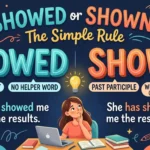
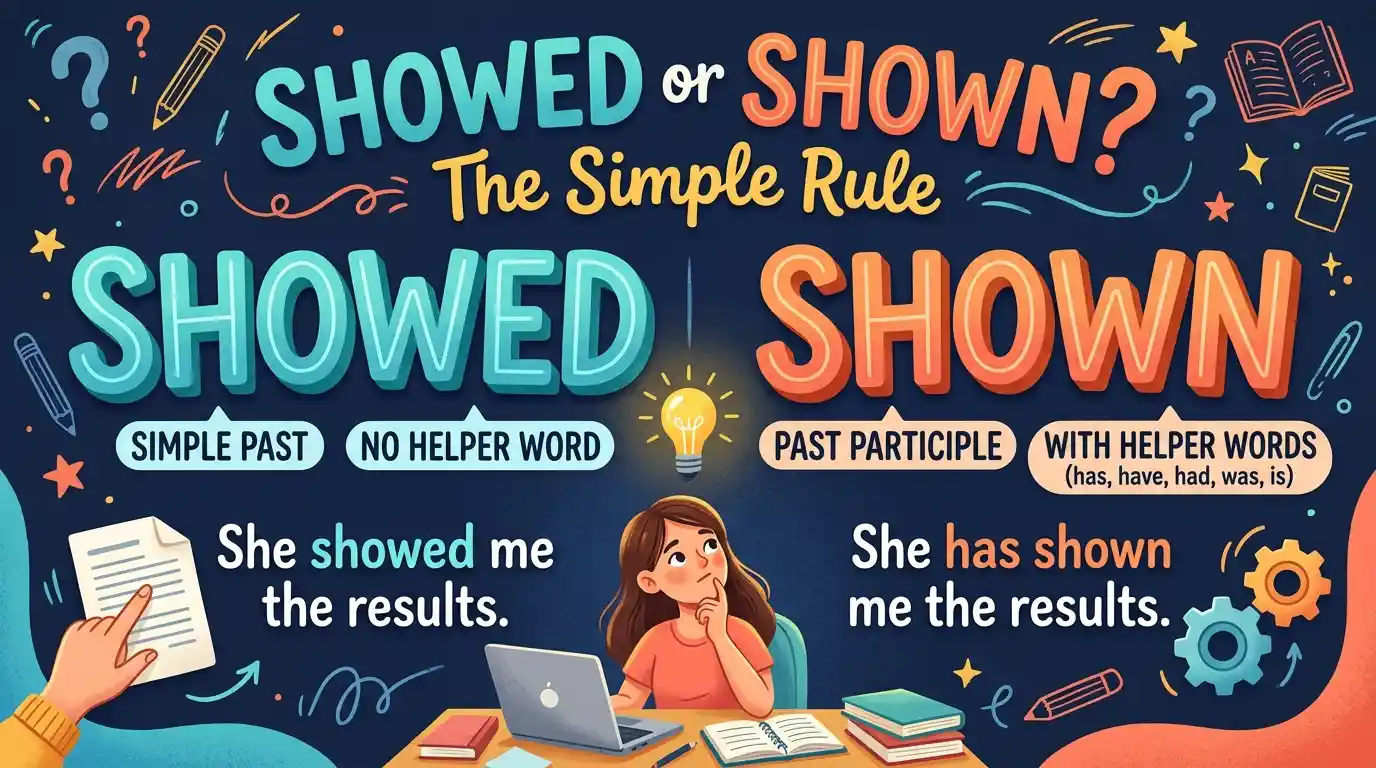
Use showed for the simple past. Use shown after “has,” “have,” “had,” “is,” “are,” “was,” or “were.”
Showed (simple past):
- She showed me her new phone.
- The test showed good results.
- He showed up late.
Shown (past participle):
- She has shown me her new phone.
- The results were shown on screen.
- It has been shown to work.
Easy trick: If there is a helper word before it (has, have, had, be), use shown. If there is no helper word, use show.
The Origin of Showed and Shown
The verb “show” is very old. It comes from the Old English word scēawian, which meant “to look at” or “to see.” Over time, the meaning changed to “to let others see.”
In Middle English, people spelled it many ways, including “shewen.” For hundreds of years, writers used “shew,” “shewed,” and “shewn.” You can still find these spellings in old books and legal papers. By the 1800s, “show” took over in most writing.
The past forms came from two paths. “Showed” follows the regular pattern: add -ed. “Shown” follows the pattern of older verbs like “grown,” “known,” and “blown.” English kept both. That is why we have two choices today.
So there is no spelling fight. There is just one verb with two past forms, and each has its own job.
British English vs American English Spelling
Here is what many people get wrong. Showed and shown are not British or American spellings. Both countries use both words. The spelling is the same everywhere.
The only small difference is a habit. Some writers, more often in the US, use “showed” as the past participle (“has showed”). Most style guides still prefer “shown” there. In the UK, “shown” after a helper word is the clear standard.
| Feature | American English | British English |
| Simple past | showed | showed |
| Past participle (preferred) | shown | shown |
| “Has showed” | Seen, but less formal | Rare, seen as an error |
| Old spelling “shewed/shewn” | Not used | Not used (old legal use only) |
| Example | “He has shown me.” | “He has shown me.” |
The takeaway: the spelling does not change by country. Only the rare habit of “has showed” does.
Which Spelling Should You Use?
If your readers are in the US: Use “showed” for simple past and “shown” after helper words. “Has showed” appears in speech and casual writing, but “has shown” is safer.
If your readers are in the UK or Commonwealth: Use “shown” after helper words. “Has shown” will likely look like a mistake.
If your readers are worldwide: Follow the standard rule. The simple past gets “shown.” Helper word plus verb gets “shown.” This is correct everywhere and works for school, work, and business.
For formal writing such as reports, essays, and job applications, always use “has shown,” “have shown,” and “was shown.”
Common Mistakes with Showed and Shown
1: Using “shown” without a helper word.
- Wrong: She showed me the way.
- Right: She showed me the way.
2: Using “showed” with “has” or “have” in formal writing.
- Weak: The study has shown progress.
- Better: The study has shown progress.
3: Using “shown” after “did.”
- Wrong: Did he show you?
- Right: Did he show you?
4: Mixing up “show” and “shown.”
- Wrong: It was shown on TV.
- Right: It was shown on TV.
5: Using the old spelling “shew.”
- Wrong: He shewed me the book.
- Right: He showed me the book.
Showed and Shown in Everyday Examples
Email:
- “I showed the draft to my boss yesterday.”
- “As shown in the attached file, sales went up.”
News:
- “Polls have shown a close race.”
- “The video showed crowds in the street.”
Social media:
- “Look what my dog just showed me!”
- “Shown here: my first cake.”
Formal writing:
- “Research has shown that sleep helps memory.”
- “The results, shown in Table 2, are clear.”
Showed or Shown Google Trends & Usage Data
I did not pull live Google Trends numbers for this article. I do not want to invent figures. You can check them in minutes at trends.google.com by comparing “showed or shown” with “has showed or has shown.”
Here is what usage patterns usually look like:
- Interest is steady. Grammar questions like this come up all year.
- Peaks follow the school year. Students search more during exams and essay season.
- The US, UK, India, Canada, Australia, and Pakistan are strong English-learning markets, so searches are common there.
- Context matters. Students search for the rule. Professionals search before sending emails or reports.
- In books and news, “shown” is far more common after helper words, while “showed” leads in simple past stories.
Variations side by side:
| Phrase | Correct? | Notes |
| She showed me | Yes | Simple past |
| She has shown me | Yes | Best choice |
| She has showed me | Rare | Accepted by some, avoid in formal writing |
| She shown me | No | Missing helper word |
| It was shown | Yes | Passive voice |
| It was showed | No | Use “shown” |
| He shewed me | No | Old spelling |
FAQs
1. Is it “has showed” or “has shown”?
“Has shown” is the standard form. “Has shown” appears sometimes but is not preferred.
2. Is “showed” or “shown” the past tense?
“Showed” is the simple past. “Shown” is the past participle.
3. Is “shown” British or American?
Neither. Both countries use “shown” the same way.
4. Can I say “I have shown you”?
Some dictionaries allow it, but “I have shown you” is safer and sounds better.
5. What is the passive form?
Use “shown.” Example: “The photo was shown to everyone.”
6. Is “shew” still correct?
No. It is an old spelling. Use “show,” “showed,” and “shown.”
7. Which is right: “showed up” or “shown up”?
Both can be right. “He showed up” is a simple past tense. “He has shown up” uses a helper word.
8. How do I remember the rule?
Look for a helper word like has, have, had, is, was, or were. If you see one, use “shown.”
Conclusion
“Showed or shown” is a grammar question, not a spelling fight. Both words are correct. They just do different jobs.
Use showed when the action is finished and there is no helper word. “She showed me the room.” Use shown after helper words like has, have, had, is, was, and were. “She has shown me the room.” “The room was shown to us.”
British and American writers use the same spelling. The only small gap is that “has showed” appears more often in casual US writing. In formal work, stick with “has shown.” It is safe in every country and every setting.
Avoid the common errors. Do not write “she showed me. And” Do not write “it was shown.” Do not use the old “shew” spelling.
When in doubt, check for a helper word. If it is there, pick “shown.” If not, pick “showed.” That one trick fixes almost every case, and your writing will read clean and professional.

Sikandar Hayat is the author and creator of Journalneste.com, a website dedicated to heartfelt wishes, messages, greetings, and inspiring words for every special moment. With a passion for meaningful writing, Sikandar creates warm and thoughtful content that helps readers express their feelings with ease. His goal is to provide beautiful, shareable words for birthdays, celebrations, relationships, and memorable occasions.