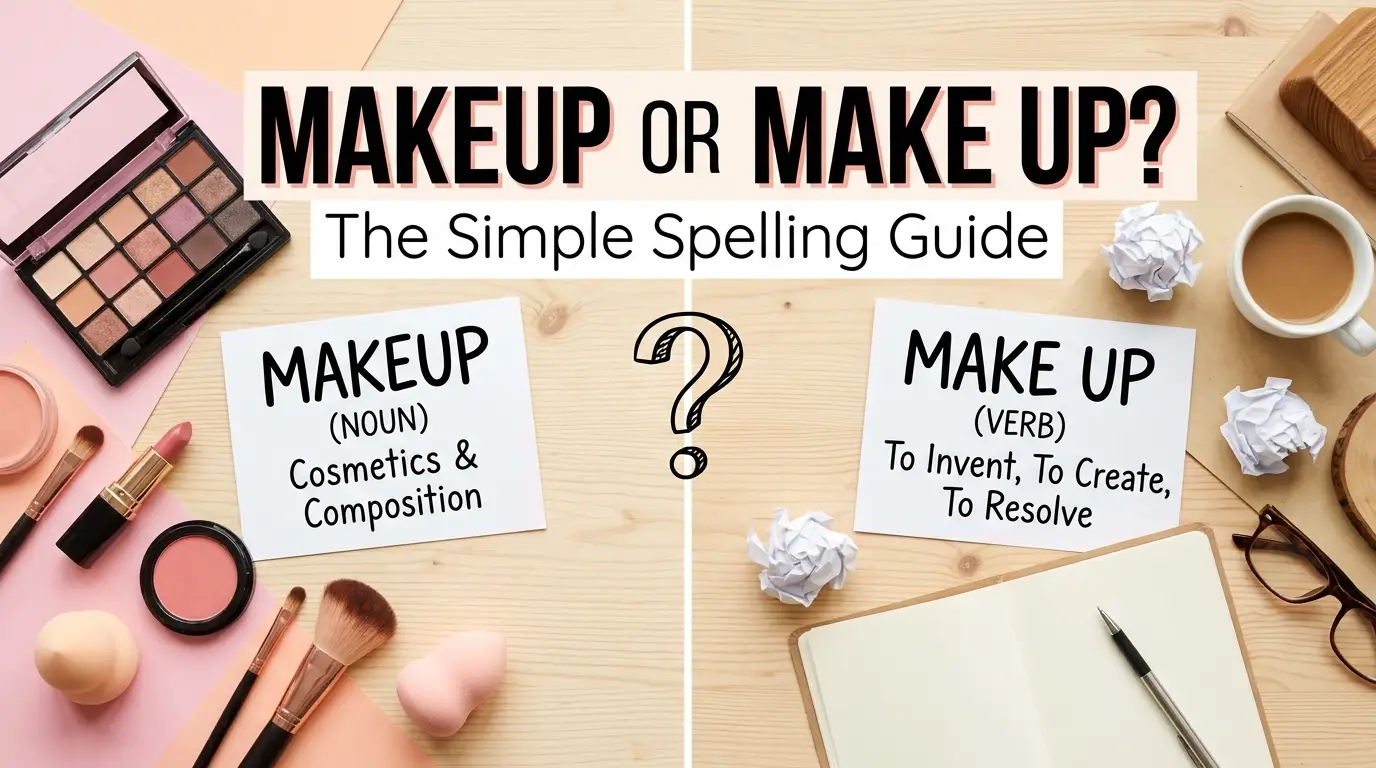
You are writing a note. You stop. Is it makeup or make up? Both look right. One wrong pick can make your writing look sloppy. You are not alone. Many people search this question every month.
People search for this keyword for a good reason. The two forms sound the same. They look almost the same. But they do different jobs. One is a thing. The other is an action. Add British and American habits, and the confusion grows.
This guide clears it up fast. You get a quick answer first. Then you see where the words come from. You learn how British and American writers handle them. And you see common mistakes and real examples. You also get comparison tables and a short FAQ.
By the end, you will know which form to use. You will know it for emails, essays, news, and social posts. Let’s start with the short answer.
Makeup or Make Up Quick Answer
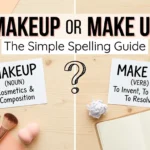
Use makeup (one word) for the thing. Use make up (two words) for the action.
- Makeup is a noun. It means cosmetics, or the way something is put together. She wore light makeup. The team’s makeup is very mixed.
- Makeup also works as an adjective. A makeup test. A makeup artist.
- Make up is a verb. It can mean to invent, to fix a quarrel, to pay back time, or to put on cosmetics. Don’t make up stories. They made up after the fight. I must make up the lost hours.
Quick test: Can you change the word to “create” or “fix” or “repay”? If yes, write two words. If you mean cosmetics or composition, write one word.
One note: some British writers use a hyphen, as in make-up, for the noun. We cover that below.
The Origin of Makeup or Make Up
The two small words make and up are very old. English speakers joined them into the phrase “make up” many centuries ago. It first meant to put things together, to complete, or to invent.
The cosmetic meaning came later. In the 1800s, actors used paint and powder on stage. People called this “making up” the face. The noun followed, often written with a hyphen: make-up.
Later, shops sold cosmetics to everyone. The word was now very common. Over time, many hyphenated words lose the hyphen. Think of e-mail becoming email. Make-up followed the same path in many places and became makeup.
Why do spelling differences exist? English has no single rulebook. Words often travel the same road: two words, then a hyphen, then one word. Dictionaries and publishers move at different speeds. So you still see all three forms today. The verb stayed as two words, because a verb phrase is an action, not a thing.
Note: dates above are general, not exact. Check a dictionary such as Oxford or Merriam-Webster for precise first-use dates.
British English vs American English Spelling
Here is the honest truth. There is no big British American split for this word. Both sides use make up as a verb. Both sides use makeup for cosmetics. The real difference is the hyphen.
- American English nearly always writes makeup for the noun.
- British English accepts makeup too. But some UK dictionaries and publishers still list or prefer make-up with a hyphen.
This pattern matches other words. Americans drop hyphens sooner. British writers keep them a little longer.
| Form | Part of speech | Meaning | American English | British English |
| makeup | Noun / adjective | Cosmetics; composition; a retake test | Standard | Common and accepted |
| make-up | Noun / adjective | Same as makeup | Rare | Older style, still seen in print |
| make up | Verb | Invent; reconcile; compensate; apply cosmetics | Standard | Standard |
| make-up (as a verb) | Verb | Not used | Wrong | Wrong |
Examples:
- US: She bought new makeup. We need to make up the exam.
- UK: She bought new makeup or new make-up. We need to make up the lost time.
Which Spelling Should You Use?
Pick by your reader. Then stay the same all the way through.
- US readers: Write makeup for the noun. Write make up for the verb.
- UK and Commonwealth readers: Makeup is safe and common. Make-up is fine if your style guide asks for it. Keep the verb as two words.
- Global or web readers: Choose makeup. It is the most common form online, and it is easy to read for all English speakers.
Pro tip: Check the house style first. News sites, schools, and brands often have one. If there is none, pick one form and stick with it. Mixed spelling in one document looks careless.
Common Mistakes with Makeup or Make Up
| Mistake | Fix | Why |
| I need to make up my mind. | I need to make up my mind. | “Decide” is an action, so use the verb. |
| She put on some make up. | She put on some makeup. | Cosmetics are a thing, so use the noun. |
| I will make up for lost time. | I will make up for lost time. | Again an action. Add “for” after it. |
| Let’s make-up and be friends. | Let’s make up and be friends. | A hyphen never joins the verb. |
| He makes-up funny stories. | He makes up funny stories. | Change the verb ending. Keep two words. |
| I have a make-up exam. | I have a makeup exam. | Here it describes the exam, so use one word. |
| Mixing makeup and make-up in one page. | Pick one noun form. | Mixed forms look careless. |
A simple memory trick: If you can put “a” or “the” before it, it is a thing. Write makeup. If you can put “I”, “she”, or “they” before it, it is an action. Write make up.
Makeup or Make Up in Everyday Examples
- Hi Sam, I missed the class. Can I take a makeup quiz on Friday?
- I’ll make up the hours this weekend. Thanks for your patience.
News
- The store reported strong sales of makeup this quarter.
- Experts say the committee’s makeup has changed since last year.
Social media
- Soft glam makeup for beginners. Easy steps!
- Don’t make up excuses. Just start today.
Formal writing
- The makeup of the board reflects the region’s diversity.
- The company will make up the shortfall in the next fiscal year.
Notice the pattern. Each makeup names a thing or a quality. Each make up is something someone does.
Makeup or Make Up Google Trends & Usage Data
Note: I did not pull live Google Trends numbers for this draft. The points below are general patterns, not exact figures. Check Google Trends for current data before you publish.
The one-word form makeup usually leads in search. People type it when they want products, tutorials, and beauty tips. This is true in the US, the UK, Canada, Australia, India, and other English-speaking regions.
The two-word form make up is searched for a different reason. People look for its meaning, such as “make up for” or “make up your mind.” Many of these searches are language questions, not shopping.
The hyphenated make-up appears less often. You may see it more in UK-style print and older writing.
| Variation | Typical meaning | Typical search intent | Where you see it most | Verdict |
| makeup | Cosmetics; composition | Shopping, beauty, tutorials | US, UK, global web | Best default for the noun |
| make-up | Cosmetics; composition | Spelling checks, formal print | Some UK publishers | Fine if style guide asks |
| make up | Invent; reconcile; compensate | Meaning and grammar | Everywhere | Always for the verb |
| make up for | Compensate for | Phrase meaning | Everywhere | Correct verb phrase |
| makeup test / exam | A retake | School and work | Schools, US-style | Use one word here |
FAQs About Makeup or Make Up
1. Is it makeup or make up? Both are right, in different jobs. Write makeup for cosmetics or composition. Write make up for the action.
2. Is “make-up” with a hyphen wrong? No. It is an older noun form, still used by some British writers and publishers. But makeup is now more common.
3. Which spelling is American? Americans use makeup for the noun and make up for the verb. The hyphen is rare in US writing.
4. Which spelling is British? British writers accept makeup and also make-up. Check your style guide. The verb is always two words.
5. What is a “makeup exam”? It is a test you take later because you missed the first one. Write it as one word: makeup exam.
6. Is “makeup artist” one word or two? Write as a makeup artist. In UK-style print, you may see make-up artists.
7. Can I use “makeup” as a verb? No. The verb is make up. Say, “I will make up the time,” not “I will make up the time.”
8. Which form is best for SEO and the web? Use makeup for the noun. It is the most common form online, and readers know it at a glance.
Conclusion
The answer to “makeup or make up” is simple once you see the job each word does. Makeup is a thing. It means cosmetics, or the mix of parts that form something. Make up is an action. It means to invent, to reconcile, to repay, or to put on cosmetics.
There is no big gap between British and American English here. Both use make up for the verb. Both use makeup for the noun. The only real difference is the hyphen. Some British writers still use make-up. Most others now write makeup.
Here is your quick guide:
- Writing for the US? Use makeup and make up.
- Writing for the UK or Commonwealth? Use makeup or make-up, and follow your style guide.
- Writing for the web? Use makeup for the noun.
- Never use a hyphen or one word for the verb.
- Keep one form all the way through your text.
Keep the memory trick close. If you can say “the” before it, write one word. If you can say “I” or “they” before it, write two. Use it, and you will get it right every time.

Sikandar Hayat is the author and creator of Journalneste.com, a website dedicated to heartfelt wishes, messages, greetings, and inspiring words for every special moment. With a passion for meaningful writing, Sikandar creates warm and thoughtful content that helps readers express their feelings with ease. His goal is to provide beautiful, shareable words for birthdays, celebrations, relationships, and memorable occasions.