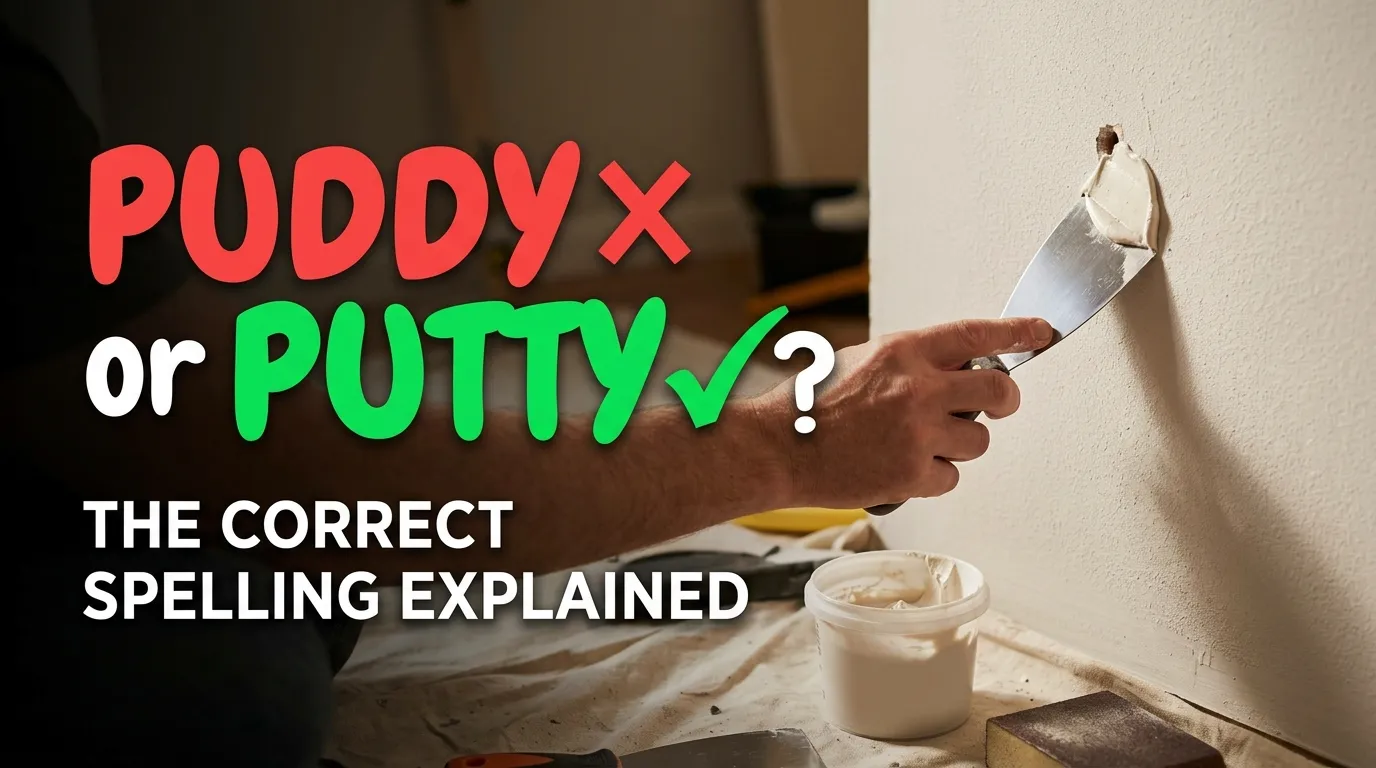
You are writing a note. You need to fix a small hole in the wall. Then you freeze. Is it puddy or putty? You are not alone. Many people stop at this word. They type it into Google to be sure.
There is a good reason for the mix-up. In American speech, the “tt” in putty sounds like a soft “d.” So the word sounds like “puddy.” Your ear says one thing. Your eyes say another.
This article clears it up fast. You will get the short answer first. Then you will learn where the word came from. You will see how US and UK spelling compare. You will also find common mistakes, real examples, and a list of questions and answers.
If you write emails, reports, or social posts, this guide helps. By the end, you will know which spelling is right. You will know when to use it. And you will never second-guess it again.
Puddy or Putty Quick Answer
Putty is the correct spelling. It is right in American English, British English, and every other form of English.
“Puddy” is not a standard English word. It is a misspelling of putty, based on how the word sounds.
Putty means a soft, sticky material. People press it into holes and gaps. It is also used to hold glass in window frames.
Examples:
- ✅ “He filled the crack with putty.”
- ✅ “The glass was held in place with old putty.”
- ✅ “The kids played with Silly Putty.”
- ❌ “He filled the crack with puddy.”
There is one small exception. “Puddy” can be a name or nickname, like David Puddy on Seinfeld, or a pet name for a cat. In those cases, it is a proper name, not the common word.
The Origin of Putty
Putty came into English from French. The old French word was potée. It meant “a potful.” It came from the word for pot.
The word was first named a fine powder. Workers used it to polish metal and glass. Over time, the meaning changed. By the 1600s, putty was the name for the soft paste used to set glass in windows.
So why do people write “puddy”? The answer is sound, not history.
In American English, a “t” between two vowels often turns into a quick “d” sound. Linguists call this flapping. It is why “butter” sounds like “budder” and “water” sounds like “wadder.” Putty follows the same pattern. People hear “puddy” and spell what they hear.
But spelling does not follow sound. English keeps the old spelling, even when speech changes. The word has always been putty, and it still is.
British English vs American English Spelling
Here is the good news. There is no British or American difference for this word. Both use putty.
The confusion comes from speech, not from spelling rules. British speakers usually say the “t” clearly. So UK writers make this mistake less often. American speakers soften the “t,” so the error shows up more in the US.
Other words show real spelling differences, like color and colour. Putty is not one of them.
| Feature | American English | British English |
| Correct spelling | putty | putty |
| Spoken sound of “tt” | Often soft, like “d” | Usually a clear “t” |
| Is “puddy” accepted? | No | No |
| Common error | “puddy” | “puddy” (less often) |
| Related words | putties, puttied | putties, puttied |
Which Spelling Should You Use?
Always use putty. The answer is simple, but here is how it applies to each group.
If your readers are in the US: Use putty. Even if you say it like “puddy,” write it with two t’s.
If your readers are in the UK or Commonwealth: Use putty. It is the same word and the same spelling.
If your readers are global: Use putty. It is the only form every dictionary accepts.
If you write for work or school: Use putty. A misspelling can make your writing look careless.
If you write a character’s name: Use “Puddy” only if that is truly the name.
A simple tip helps. Say the word slowly, with a hard “t”: put-ty. Then it is easy to remember the double t.
Common Mistakes with Putty
Here are the errors people make most often.
| Mistake | Correct form | Why it happens |
| puddy | putty | The “tt” sounds like “d” |
| putti | putty | Mixed up with the Italian art word for cherubs |
| pudy | putty | Dropped a letter |
| puty | putty | Only one t |
| puttie | putty | Wrong ending |
| puddies | putties | Wrong plural |
Two more tips:
- Plural: The plural of putty is putties.
- Verb: Putty can be a verb. You put a hole. The past tense is puttied.
Also watch out for the phrase “putty in someone’s hands.” It means a person is easy to control. It is never “puddy in someone’s hands.”
Putty in Everyday Examples
Here is how the word looks in real writing.
Email:
“Hi Sam, please pick up some putty on your way home. We need it to fix the window.”
News:
“Workers used putty to seal the old frames before the winter storm.”
Social media:
“Just tried the new putty from the hardware store. It dried fast and looks great! #DIY”
Formal writing:
“The contractor applied a layer of putty to the damaged surface before painting.”
Idiom:
“When it comes to his kids, he is putty in their hands.”
Product names:
“Silly Putty” is a famous toy. It is always spelled with two t’s.
Puddy or Putty Google Trends and Usage Data
Search data tells a clear story. “Putty” is searched far more than “puddy” in almost every country. That makes sense, since putty is the real word.
“Puddy” still gets searched, though. Most come from people who are unsure of the spelling. Some come from people looking for a name or a pet.
Here is how it generally breaks down:
- United States: Most “puddy” searches come from here. The soft “d” sound is the main reason.
- United Kingdom and Commonwealth: Fewer people search for “puddy.” The clear “t” sound helps.
- Context matters: Searches for putty rise around home repair and DIY projects. They also rise around toys and crafts.
For exact numbers, check Google Trends yourself. Type in both words and compare them by country and date. Numbers change over time, so a fresh look is best.
Keyword Variations Side by Side
| Term | Meaning | Correct? | Where you see it |
| putty | Soft, sticky filler | ✅ Yes | Everywhere |
| puddy | Misspelling, or a name | ❌ Usually no | Typos, nicknames |
| putties | More than one putty | ✅ Yes | Home repair, crafts |
| puttied | Filled with putty | ✅ Yes | Writing about repairs |
| PuTTY | A computer tool for remote login | ✅ Yes (a brand name) | Tech guides |
| Silly Putty | A toy | ✅ Yes (a brand name) | Toy stores |
Frequently Asked Questions
1. Is it puddy or putty?
It is putty. “Puddy” is a misspelling.
2. Why do people write puddy?
In American speech, the “tt” sounds like a soft “d.” People spell the word the way they hear it.
3. Is puddy ever correct?
Only as a name or nickname, like a character’s name or a pet name. It is not a standard word.
4. Is putty spelled differently in the UK and the US?
No. Both use putty.
5. What is putty used for?
People use it to fill holes and cracks. It also holds glass in windows. Some kinds are made for kids and crafts.
6. What is the plural of putty?
The plural is putties.
7. What does “putty in someone’s hands” mean?
It means the person is easy to influence or control.
8. How can I remember the right spelling?
Say it slowly with a hard “t”: put-ty. Think of two t’s, like in “butter” or “letter.”
Conclusion
Here is what to remember. Putty is the only correct spelling. “Puddy” is a common mistake. It happens because the “tt” in putty often sounds like a “d” in American speech.
The word comes from the French potée, meaning “a potful.” It first named a polishing powder. Later it became the soft paste we know today. English kept the spelling, even as the sound changed.
There is no US and UK split here. Both use putty. So you do not need to pick a side. You only need to use two t’s.
For emails, reports, news, and posts, write putty every time. The plural is putties. The verb past tense is puttied. If you are unsure, say the word slowly and hear the hard “t.”
Use “Puddy” only when it is a real name, such as a person or a pet.
Next time you stop and ask, “puddy or putty?”, you will know the answer. Write it with confidence. Your readers will notice the care.

Sikandar Hayat is the author and creator of Journalneste.com, a website dedicated to heartfelt wishes, messages, greetings, and inspiring words for every special moment. With a passion for meaningful writing, Sikandar creates warm and thoughtful content that helps readers express their feelings with ease. His goal is to provide beautiful, shareable words for birthdays, celebrations, relationships, and memorable occasions.