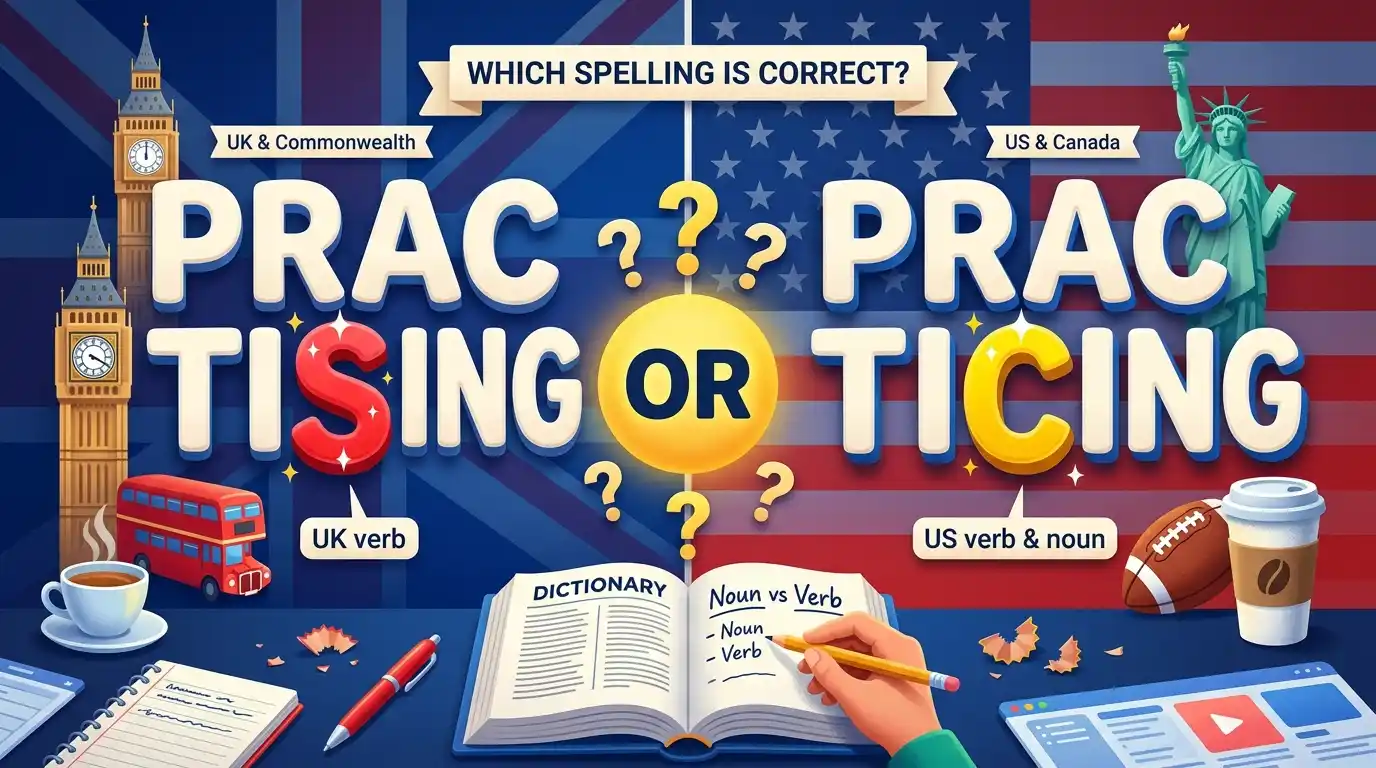
Have you ever stopped mid-sentence and thought, “Is it practising or practicing?” You are not alone. Thousands of people search this question every month. Students, writers, teachers, and business owners all hit the same wall.
The two spellings look almost the same. Both seem right. But one may look wrong to your reader, depending on where they live.
People search for this keyword for simple reasons. They want to write a clean email. And they want a good grade. They want a sharp resume or a clean website. Nobody wants a red squiggly line under their work.
Here is the good news. The answer is easy. It comes down to one thing: which kind of English you use. In American English, you write “practicing.” In British English, you write “practising” when it is a verb.
This guide gives you the quick answer first. Then it shows where the spellings came from, compares British and American rules, and lists common mistakes. By the end, you will know which spelling to pick, and why.
Let’s clear up the confusion for good.
Practising or Practicing Quick Answer
Both spellings are correct. They belong to different kinds of English.
- Practicing is the standard American spelling of the verb form.
- Practising is the standard British spelling of the verb form. Australia, New Zealand, India, and South Africa also use it.
The noun is simple. In both American and British English, the noun is practice, spelled with a “c.”
Examples:
- American: “She is practicing the piano.”
- British: “She is practising the piano.”
- Both: “Piano practice starts at six.”
Memory trick: Think of “advice” and “advise.” The noun has a “c.” The verb has an “s.” British English works the same way with “practice” and “practise.”
The Origin of Practising or Practicing
The word has a long road. It began in Greek as praktikos, which meant “fit for doing.” Latin borrowed it. Old French passed it on. Then it reached English in the Middle Ages.
Early English writers spelled it in many ways. The spelling was not fixed yet. Over time, English writers began to copy a pattern from other word pairs. The noun took “-ice.” The verb took “-ise.” You can see the same pattern in these pairs:
- advice (noun) and advise (verb)
- licence (noun) and license (verb), in British English
- prophecy (noun) and prophesy (verb)
So why do the spellings differ today? The split came in the 1800s. American writers wanted simpler spelling. Noah Webster led this push. His dictionary of 1828 shaped how Americans write. In the US, one spelling, “practice,” now does both jobs. Britain kept the old split. This is why “practicing” is American and “practising” is British.
Neither spelling is a mistake. They just grew up on different sides of the ocean.
British English vs American English Spelling
The rule in British English is easy. The noun ends in “-ice.” The verb ends in “-ise.” American English uses “-ice” for both.
| Word form | British English | American English |
| Noun | practice | practice |
| Verb (base) | practise | practice |
| Verb (-ing form) | practising | practicing |
| Verb (past tense) | practised | practiced |
| Verb (he/she/it) | practises | practices |
| Adjective | practised (skilled) | practiced (skilled) |
Examples:
- British: “I practise yoga every day.” (verb)
- British: “Yoga practice helps me sleep.” (noun)
- American: “I practice yoga every day.” (verb)
- American: “Yoga practice helps me sleep.” (noun)
The same split shows up in other words, like “licence” and “license.” Once you learn one pair, the rest feel easy.
Which Spelling Should You Use?
Pick the spelling your reader expects. Here is a simple guide.
- Writing for the US: Use “practicing.” Use “practice” for the noun too.
- Writing for the UK, Australia, New Zealand, India, Pakistan, or South Africa: Use “practising” for the verb. Use “practice” for the noun.
- Writing for Canada: Usage is mixed. Many Canadians use “practice” for both noun and verb. Others use “practise” for the verb. Follow your school, company, or style guide.
- Writing for a global audience: Choose one style and stick with it. “Practicing” is the safer pick for a worldwide site, since most online tools and spell checkers default to American English. If most of your readers are in the UK or South Asia, choose “practising.”
Three pro tips:
- Set your spell checker to the right language, such as English (UK) or English (US).
- Check your style guide, if you have one. Many schools and news groups publish theirs.
- Be consistent. Never mix “practising” and “practicing” in one document. Mixed spelling looks careless.
Common Mistakes with Practising or Practicing
Most errors come from mixing the two styles. Here are the ones you will see most.
| Mistake | Why it is wrong | Fix |
| “I need more practise.” (UK) | “Practice” is the noun. | “I need more practice.” |
| “She is practicing the violin.” in a UK document | American spelling in British text. | “She is practising the violin.” |
| “He practices law in London.” (UK) | The UK verb takes “-ise.” | “He practises law in London.” |
| “Practising makes perfect.” | The saying uses the noun. | “Practice makes perfect.” |
| “A practicing doctor” and “a practising doctor” in one report | Mixed spelling. | Pick one and keep it. |
Other things to watch for:
- Do not think “practise” is a typo. In British English, it is correct.
- Do not think “practice” is always a noun. In American English, it is both.
- Do not trust a spell checker blindly. It may be due to the wrong English.
Practising or Practicing in Everyday Examples
See how the spelling changes by place and tone.
Emails
- US: “Thanks for your note. I am practicing my talk for Monday.”
- UK: “Thanks for your note. I am practising my talk for Monday.”
News headlines and reports
- US: “Doctors practicing in rural areas face a staff shortage.”
- UK: “Doctors practising in rural areas face a staff shortage.”
Social media
- US: “Practicing my guitar every night. Wish me luck!”
- UK: “Practising my guitar every night. Wish me luck!”
- Both: “Daily practice is the secret.”
Formal and professional writing
- Resume (US): “Licensed attorney practicing family law for 10 years.”
- Resume (UK): “Qualified solicitor practising family law for 10 years.”
- Policy (both): “All staff must follow safe practice rules.”
Religion and culture
- “A practising Christian” is common in British writing. “A practicing Christian” is common in American writing.
Notice the pattern. The verb and the “-ing” form change. The noun stays the same.
Practising or Practicing Google Trends and Usage Data
Note: These are general patterns, not exact figures. For live numbers, search both words in Google Trends and set your own country and date range.
Which one is more popular overall? “Practicing” is searched far more often worldwide. The US has a very large online population, and American spelling is the default in most software.
Where does “practising” lead? It does best in countries that follow British spelling. These include the UK, Australia, New Zealand, India, Pakistan, and South Africa. In these places, school and news writing use it often.
Why do people search at all? Interest likely rises around school terms, exam seasons, and job hunts. Confirm this in Trends. Learners and professionals check the spelling before they submit work.
Context matters too:
- Music, sport, and study: People often write “practising” or “practicing” for daily skill building.
- Law and medicine: Job titles such as “practising solicitor” (UK) and “practicing physician” (US) show the split clearly.
- Faith and lifestyle: Both spellings appear, matching the writer’s region.
What this means for you: Use the Trends tool to see which spelling your own audience searches. Then match it.
Practising vs Practicing vs Practice vs Practise: Side by Side
| Spelling | Part of speech | Used in | Example |
| practising | Verb (-ing form) | UK, Australia, NZ, India, Pakistan, South Africa | “She is practising her speech.” |
| practicing | Verb (-ing form) | US; often Canada | “She is practicing her speech.” |
| practice | Noun | US and UK | “Speech practice is at noon.” |
| practice | Verb | US | “I practice every day.” |
| practise | Verb | UK and similar | “I practise every day.” |
| practised | Verb or adjective | UK and similar | “He practised for hours.” |
| practiced | Verb or adjective | US | “He practiced for hours.” |
Frequently Asked Questions
1. Is it practising or practicing?
Both are correct. “Practicing” is American. “Practising” is British and is used in many Commonwealth countries.
2. Is “practice” a noun or a verb?
It is a noun in all English. It is also a verb in American English. In British English, the verb is “practise.”
3. Which spelling is right in Canada?
Usage is mixed. Many Canadians write “practice” and “practicing.” Some prefer “practise” for the verb. Follow your school or company style guide.
4. Which spelling is right in Australia, India, and Pakistan?
These countries mostly follow British spelling. Use “practising” for the verb and “practice” for the noun.
5. Is “practising” a typo?
No. It is the correct British form. A US spell checker may flag it, but it is not wrong.
6. What is the easy way to remember the rule?
Think “advice” and “advise.” The noun has a “c.” The verb has an “s.” That is the British pattern.
7. Is it “practice makes perfect” or “practise makes perfect”?
The saying uses the noun. So write “practice makes perfect” everywhere.
8. Can I use both spellings in one document?
No. Pick one style and keep it. Mixed spelling looks careless.
Conclusion
So, is it practising or practicing? Now you know. Both are right. Your reader decides which one to use.
Here are the key points:
- “Practicing” is the American spelling of the verb.
- “Practising” is the British spelling of the verb. It is also common in Australia, New Zealand, India, Pakistan, and South Africa.
- “Practice” is the noun in all English.
- In British English, the verb is “practise.”
- Canada is mixed, so follow your style guide.
Here is the simple advice. First, know your audience. Second, set your spell checker to match. Third, stay consistent from the first line to the last. Never mix the two styles in one document.
If you get stuck, think of “advice” and “advise.” The noun gets the “c.” The verb gets the “s” in British English.
Spelling is a small thing. But clean spelling builds trust. Pick your style, keep it steady, and keep practising (or practicing) your writing.

Sikandar Hayat is the author and creator of Journalneste.com, a website dedicated to heartfelt wishes, messages, greetings, and inspiring words for every special moment. With a passion for meaningful writing, Sikandar creates warm and thoughtful content that helps readers express their feelings with ease. His goal is to provide beautiful, shareable words for birthdays, celebrations, relationships, and memorable occasions.