Your fingers move fast. You type a sentence. Then you stop. Is it steel or steal?
You are not alone. Millions of people pause at these two words every year. They sound the same. They look almost the same. But they mean very different things. One is a strong metal. The other is a crime, or sometimes a great bargain.
Mix them up, and your sentence turns silly. “The bridge is made of steal” sounds like a bridge made of stolen goods.
People search “steel or steal” for simple reasons. They want a fast answer. And they are writing an email, a school essay, a post, or a work report. They do not want to look careless. Spell check often will not help, because both words are real words.
This guide clears up the confusion. You will get the quick answer first. Then you will see where the words come from, how to use them, and which mistakes to avoid. You will also find real examples, handy tables, and answers to common questions. Read on, and you will never mix them up again.
Steel or Steal Quick Answer
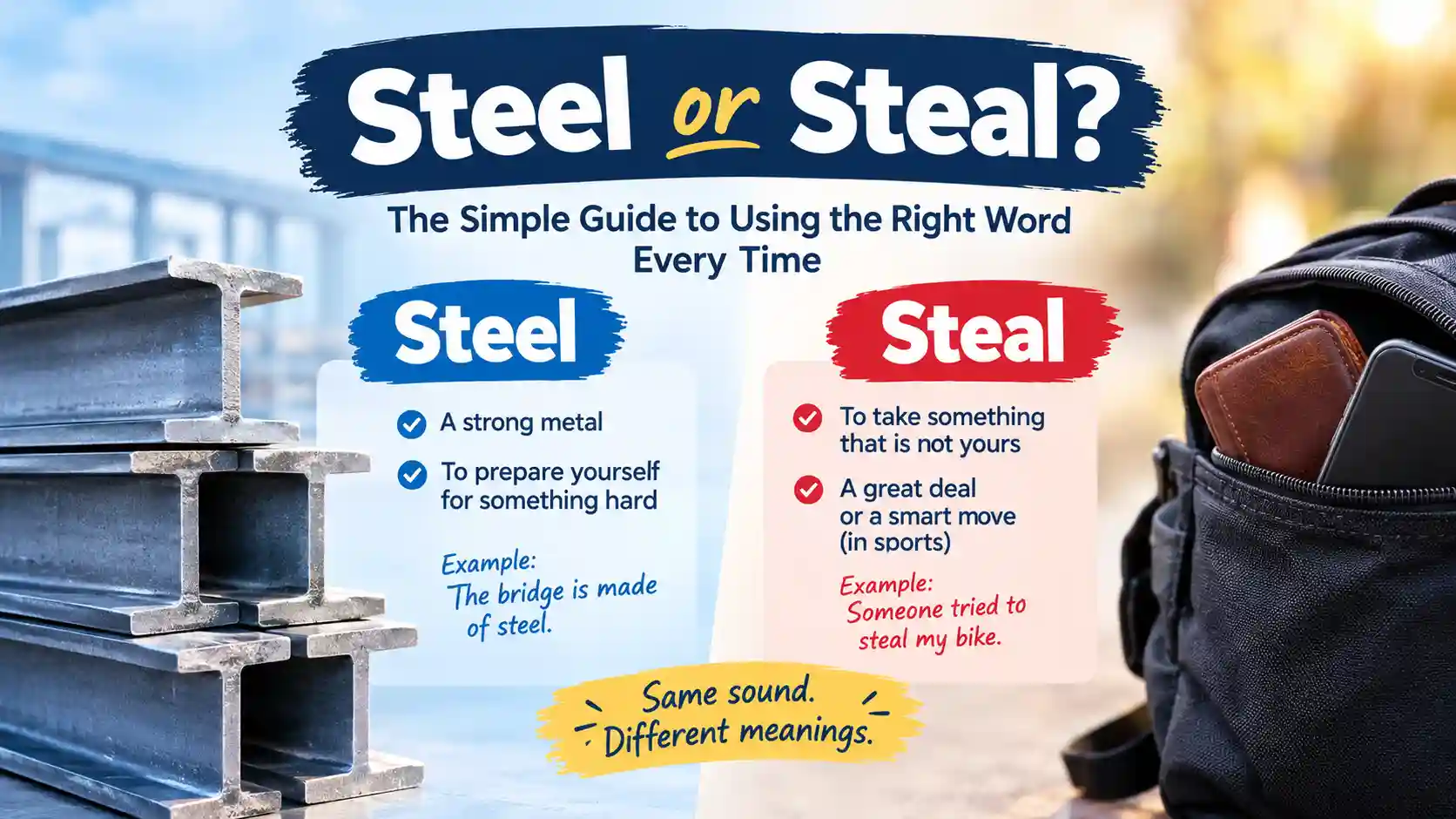
Steel is a strong metal. It is also a verb meaning to prepare yourself for something hard.
Steal means to take something that is not yours. It can also mean a great deal, or a smart move in sports.
Here are quick examples:
- The knife is made of steel. (metal)
- Someone tried to steal my bike. (take without asking)
- The shoes were a steal at $20. (a bargain)
- She had to steel herself before the speech. (get ready)
- He tried to steal second base. (a sports move)
Memory trick: Steel has two e‘s, like “extra extra strong.” Steal has “a,” like “take.”
The Origin of Steel or Steal
Both words are very old. They come from Old English, the language spoken in England over a thousand years ago.
Steel comes from an Old English word for metal. It is linked to older words meaning “firm” or “stiff.” That fits. Steel is hard and strong.
Steal comes from the Old English word stelan, which meant to take secretly. Its past forms are stolen and stolen. Those forms still exist today.
So why are they spelled differently if they sound the same? Over time, English pronunciation changed a lot. Words that once sounded different started to sound alike. But spelling stayed fixed in print. That left us with pairs like steel and steal, meat and meat, or peace and peace. Words that sound alike but have different spellings and meanings are called homophones.
The spellings are different on purpose. They keep two different ideas apart on the page.
British English vs American English Spelling
Here is the good news. There is no British or American difference for these words. Both countries spell the metal “steel.” Both spell the crime “steal.” Canada, Australia, India, and Pakistan do the same.
Many people expect a difference because English has many spelling splits, like colour and color. This is not one of them.
| Word | American English | British English | Same? |
| Metal | steel | steel | Yes |
| To take | steal | steal | Yes |
| Color (example) | color | colour | No |
| Center (example) | center | centre | No |
| Realize (example) | realize | realise | No |
The takeaway is simple. If you see “steal” used for the metal, it is a mistake in every country.
Which Spelling Should You Use?
Pick the word by meaning, not by country.
- US readers: Use steel for metal and steal for taking. No exceptions.
- UK and Commonwealth readers: The same rule applies.
- Global audiences: The same rule applies. Both words are universal.
A fast test works for any audience. Ask yourself one question: “Am I talking about metal or strength?” If yes, use steel. If you are talking about taking, a bargain, or a sneaky move, use steal.
For formal writing, read your sentence out loud with the other word swapped in. If it sounds like a crime story, check your spelling.
Common Mistakes with Steel or Steal
Here are the errors people make most, with fixes.
| Wrong | Right | Why |
| The gate is made of steel. | The gate is made of steel. | Metal needs steel. |
| Don’t steal my idea. | Don’t steal my idea. | Taking needs steal. |
| He stealed the money. | He stole the money. | Steal is irregular. |
| She has nerves of steel. | She has nerves of steel. | Strong nerves are like metal. |
| He steeled my phone. | He stole my phone. | Past tense of steal is stole. |
| Prices were steel. | Prices were a steal. | A bargain is a steal. |
Two more tips:
- Past tense: Steal becomes stole (past) and stolen (past participle). Steel becomes steeled.
- Idioms: “Steel yourself” means get ready. “Steal the show” means be the star. Mixing these up changes the meaning completely.
Steel or Steal in Everyday Examples
In an email:
- “Please find the steel specs attached.”
- “This deal is a steal, so let’s act fast.”
In the news:
- “Prices of steel rose sharply this quarter.”
- “Police arrested a man for trying to steal copper wire.”
On social media:
- “That sale was a total steal! 🔥”
- “Time to steel myself for Monday.”
In formal writing:
- “The building uses reinforced steel for strength.”
- “The report warns that hackers may steal private data.”
In sports:
- “He tried to steal the ball from the defender.”
Steel or Steal Google Trends & Usage Data
Searches for “steel or steel” are small compared with big topics, but they are steady. That is typical for spelling questions. People search when they are writing, so interest follows the school and work calendar.
Here is what usually shapes the pattern:
- Students: Searches often rise during school terms, when essays are due.
- Workers: Business writers search when drafting reports about industry, building, or security.
- English learners: Countries with many English learners, such as India, Pakistan, and the Philippines, often show strong interest in homophone questions.
- Context: “Steel” searches often link to industry and metal. “Steal” searches often link to crime, bargains, and sports.
Check the live data at Google Trends. Compare “steel or steal” with “steal or steel” and related phrases to see current patterns by country and time.
Keyword variations side by side:
| Phrase | Meaning | Correct? |
| steel | metal; to prepare oneself | Yes |
| steal | to take; a bargain | Yes |
| stole | past tense of steal | Yes |
| stolen | past participle of steal | Yes |
| steeled | prepared oneself (past) | Yes |
| stealed | (not a word) | No |
| nerves of steel | very calm and strong | Yes |
| nerves of steal | (mistake) | No |
| steal the show | be the star | Yes |
| steel the show | (mistake) | No |
FAQs
1. Is it steel or steel?
It depends on the meaning. Use steel for the metal and steal for taking something.
2. Are steel and steel homophones?
Yes. They sound the same but have different spellings and meanings.
3. Is there a UK vs US spelling difference?
No. Both countries spell the words the same way.
4. What is the past tense of steal?
It was stolen. The past participle is stolen. “Stealed” is not a word.
5. What does “steel yourself” mean?
It means to get ready for something hard. For example: “She steeled herself for bad news.”
6. What does “a steal” mean?
It means a very good bargain. “That jacket was a steal at $10.”
7. Is it “nerves of steel” or “nerves of steel”?
It is “nerves of steel.” It means being calm and strong under pressure.
8. How can I remember the difference?
Steel has a double e, like “extra extra strong.” Steel has an a, like “take.”
Conclusion
Here is what to remember. Steel and steal sound the same, but they are two different words. Steel is a strong metal. It can also mean getting ready for something hard. Steal means to take what is not yours. It can also mean a bargain.
There is no US or UK difference. Everyone spells them the same way. So you can write with confidence for any reader in any country.
Use the quick tests. Ask if you mean metal or taking. Look at the letters: double e for strong, a for take. Watch the past tense too. Steal becomes stole and stolen, never “stealed.”
Be careful with idioms. “Nerves of steel” and “steal the show” are both correct, but only with the right word. A single wrong letter can change your whole message and make a good document look careless.
Before you hit send, read your sentence out loud. If the meaning fits, you are set. Keep this guide handy, and you will not pause over these two words again.

Sikandar Hayat is the author and creator of Journalneste.com, a website dedicated to heartfelt wishes, messages, greetings, and inspiring words for every special moment. With a passion for meaningful writing, Sikandar creates warm and thoughtful content that helps readers express their feelings with ease. His goal is to provide beautiful, shareable words for birthdays, celebrations, relationships, and memorable occasions.