You type a word, stop, and wonder: is it “flavour” or “flavor”? You are not alone. Every day, people search for this exact question. They write emails, menus, school essays, product labels, and blog posts. And they want to look professional. They do not want to look careless.
Here is the good news. Both spellings are correct. The two forms are not a mistake and not a typo. They are two versions of the same word. One belongs to British English. The other belongs to American English.
So why the confusion? English has no single rulebook. Different countries grew their own spelling habits. Today, readers move between those habits all the time through the internet, streaming, and global business.
This guide clears it up. You will get a quick answer first. Then you will learn where the word comes from, how the two spellings differ, and which one to pick for your readers. You will also see common mistakes, real examples, and a short FAQ.
Flavour or Flavor Quick Answer
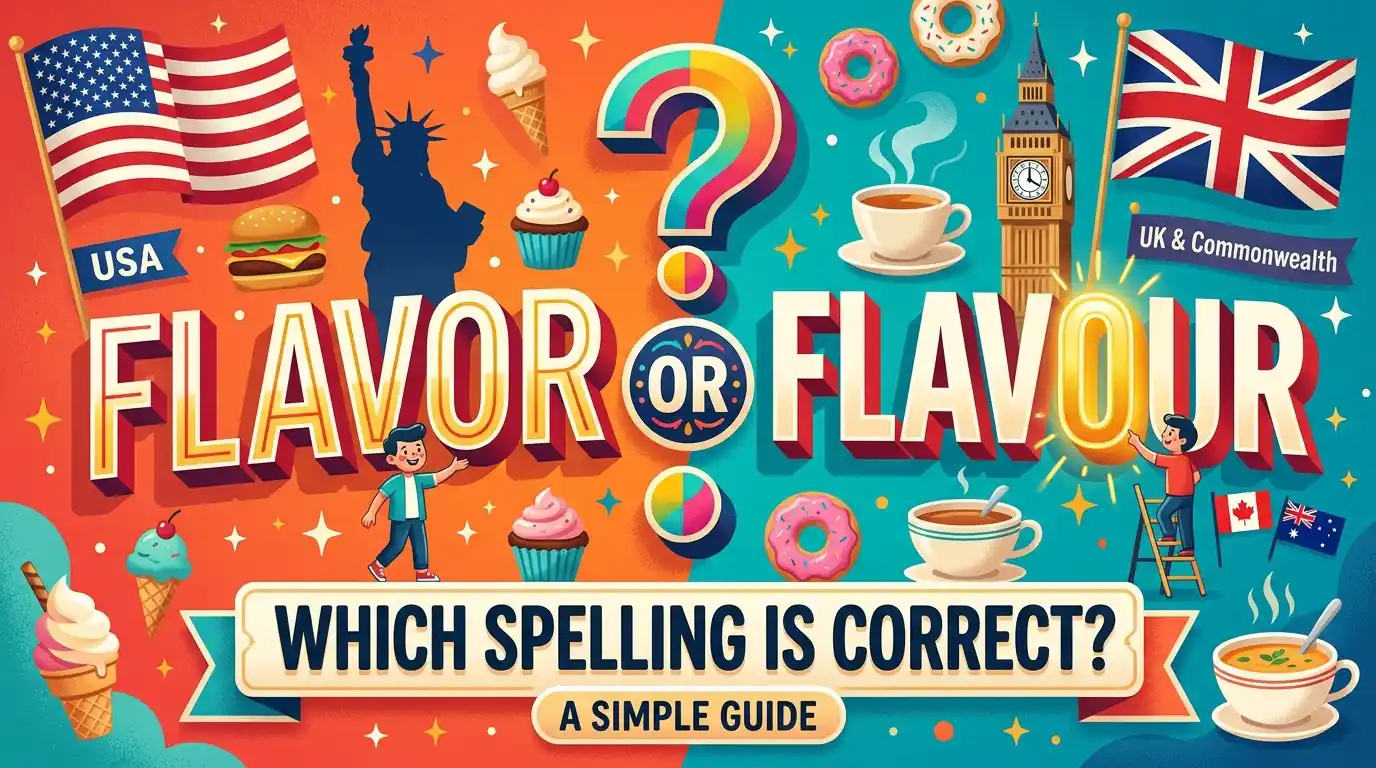
Flavor is the American spelling. Flavour is the British spelling. Both mean the same thing: the taste of food or drink.
- US: “This ice cream has a rich chocolate flavor.”
- UK: “This ice cream has a rich chocolate flavour.”
Use flavor if your readers are in the United States. Use flavour if your readers are in the UK, Canada, Australia, New Zealand, India, Pakistan, or South Africa.
The word can also be a verb. “Add herbs to flavor the soup” (US). “Add herbs to flavour the soup” (UK).
The rule that matters most: pick one spelling and stay with it in the whole text.
The Origin of Flavour or Flavor
The word entered English from Old French around the 1300s. In French, it looked like flaur or flavour. It first meant “smell” or “aroma.” Over time, English speakers used it for taste as well. Experts still debate the exact older root, so no one can say for sure.
The “-our” ending came with the French. Many English words took it: colour, honour, labour, neighbour. For hundreds of years, English writers used the “-our” form.
Then came Noah Webster. He was an American writer who made dictionaries. In the early 1800s, he wanted spelling to be simple and match the sound. He also wanted American English to look different from British English. He dropped the “u” from words like color, honor, and flavor. His 1828 dictionary spread these forms across the United States.
Britain did not follow. British writers kept the old French-style spelling. That is why we have two versions today. Neither one is older or “more correct.” They are just two paths from the same start.
British English vs American English Spelling
The flavour/flavor split is part of a bigger pattern. In many words ending in the “or” sound:
- British English keeps -our.
- American English uses -or.
| British English | American English | Meaning |
| flavour | flavor | taste |
| colour | color | shade |
| favour | favor | kind act |
| honour | honor | respect |
| neighbour | neighbor | person next door |
| humour | humor | funny quality |
| labour | labor | work |
| behaviour | behavior | way of acting |
One handy rule: if you write “colour” in British style, write “flavour” the same way. Keep the whole text consistent.
Watch the endings. Adding a suffix can change things in British English:
- flavour → flavoured, flavouring, flavourful, flavourless
- flavor → flavored, flavoring, flavorful, flavorless
Some British words drop the “u” when a suffix is added, like humour → humorous and honour → honorary. But “flavour” keeps its “u” in most forms.
Which Spelling Should You Use?
The best choice depends on who reads your work.
Writing for a US audience? Use flavor. This applies to US websites, US food brands, US schools, and US businesses.
Writing for a UK or Commonwealth audience? Use flavour. This includes the UK, Ireland, Australia, New Zealand, South Africa, India, and Pakistan. Canada mostly uses flavour too, though it mixes in some American spelling.
Writing for a global audience? Pick one and be consistent. Many global brands choose American spelling because the US market is large. Others choose British spelling for a more formal feel. Either is fine. Choosing is not the issue. Mixing is.
Quick tips:
- Set your spell checker to the right language (English US or English UK).
- Follow the style guide of your school, company, or publisher.
- Do not change the spelling inside a brand name or a quote.
Common Mistakes with Flavour or Flavor
1. Mixing both spellings in one text.
Wrong: “Try our new flavour. It is a fruity flavor.”
Right: “Try our new flavor. It is a fruity flavor.”
2. Mixing “-our” and “-or” words.
Wrong: “The colour and flavor are great.”
Right: “The colour and flavour are great.” (UK) or “The color and flavor are great.” (US)
3. Writing “flavur” or “flavore.”
Neither is a word. Only flavour and flavor are correct.
4. Forgetting the suffix rule.
Wrong: “flavourful” in a US text.
Right: “flavorful” in a US text.
5. “Correcting” a brand name.
If a brand spells it its own way, keep it. Do not change it.
6. Thinking one spelling is wrong.
Neither is wrong. Do not “fix” the other version in someone else’s work unless you know their audience.
Flavour or Flavor in Everyday Examples
Email (US):
“Hi Sam, we added a new vanilla flavor to the menu. Please test it this week.”
Email (UK):
“Hi Sam, we have added a new vanilla flavour to the menu. Please test it this week.”
News headline (US): “Snack Maker Launches Spicy Mango Flavor”
News headline (UK): “Snack Maker Launches Spicy Mango Flavour”
Social media (US): “Tried the new coffee flavor today. Loving it! ☕”
Social media (UK): “Tried the new coffee flavour today. Loving it! ☕”
Formal writing (UK):
“The study tested how temperature affects the flavour of tea.”
Formal writing (US):
“The study tested how temperature affects the flavor of tea.”
Notice the pattern. The meaning never changes. Only the spelling does.
Flavour or Flavor Google Trends & Usage Data
I did not pull live Google Trends numbers for this article, so I will not make up figures. You can check them yourself at trends.google.com by comparing the two words. Here is the general pattern you will usually see:
- “Flavor” gets more total searches worldwide. The United States has a very large online population.
- “Flavour” is strong in the UK, Ireland, Canada, Australia, New Zealand, India, Pakistan, and South Africa.
- Context matters. People search “flavor” more for recipes, snacks, and products. They often search both versions when they want to check spelling.
- Many searchers type the question itself: “flavour or flavor.” This shows they want a clear answer, not a definition.
Tip for writers and site owners: if your audience is mainly in one region, use the spelling common there. If your readers are mixed, you can mention both once, like “flavor (flavour)”, and then stay with one.
Keyword Variations Side by Side
| Form | American | British | Example |
| Noun | flavor | flavour | “A sweet flavor/flavour.” |
| Plural | flavors | flavours | “Three flavors/flavours.” |
| Verb | flavor | flavour | “Flavor/flavour the sauce.” |
| Past tense | flavored | flavoured | “Mint-flavored/flavoured tea.” |
| Adjective | flavorful | flavourful | “A flavorful/flavourful soup.” |
| Without taste | flavorless | flavourless | “A flavorless/flavourless meal.” |
| -ing form | flavoring | flavouring | “Artificial flavoring/flavouring.” |
FAQs
1. Is it flavour or flavor?
Both. “Flavor” is American. “Flavour” is British.
2. Which spelling is correct in Canada?
Canada mostly uses “flavour.” Some Canadians use American forms in casual writing.
3. Is “flavor” wrong in the UK?
It is not wrong, but it looks American. UK readers expect “flavour.”
4. Is “flavour” wrong in the US?
It is not wrong, but it looks British. US readers expect “flavor.”
5. How do I spell the word for adding taste, like “flavoring”?
US: flavoring. UK: flavouring.
6. Can I use both spellings in one document?
No. Choose one and keep it the same all the way through.
7. Which spelling is better for SEO?
Use the spelling your audience searches for. Use “flavor” for US readers and “flavour” for UK and Commonwealth readers. For global sites, one spelling is fine, as long as you stay consistent.
8. Do other words follow the same rule?
Yes. Color/colour, favor/favour, honor/honour, and neighbor/neighbour follow the same pattern.
Conclusion
So, flavour or flavor? The answer is simple: both are right. They are two spellings of one word. “Flavor” is the American form. “Flavour” is the British form, and countries such as Canada, Australia, India, and Pakistan use it too.
The difference began long ago. The word came from French and kept its “-our” ending in Britain. In the early 1800s, Noah Webster cut the “u” in America, and that choice stuck.
Remember three things. First, know your reader. Use “flavor” for a US audience and “flavour” for a UK or Commonwealth audience. Second, stay consistent. Do not mix “flavor” with “colour” or any other mismatched pair. Third, watch your suffixes: flavorful and flavourful, flavored and flavoured.
When in doubt, set your spell checker to the right English and let it help you. Do not worry about “fixing” the other version. Neither one is a mistake. What matters is that your writing looks clean, clear, and fits the people who read it.

Sikandar Hayat is the author and creator of Journalneste.com, a website dedicated to heartfelt wishes, messages, greetings, and inspiring words for every special moment. With a passion for meaningful writing, Sikandar creates warm and thoughtful content that helps readers express their feelings with ease. His goal is to provide beautiful, shareable words for birthdays, celebrations, relationships, and memorable occasions.